Authors: SanTi Li, Naxida, Yinyue
Abstract
Over the past eight years, Web3 has experienced multiple bull and bear market cycles and shifts in technological narratives, leading to severe market fatigue with Layer 1 public chains. Simply hyping theoretical TPS (transactions per second) or EVM compatibility can no longer support the envisioned multi-billion dollar valuation of next-generation Web3 infrastructure, as many chains have never averaged more than 20 TPS per day, resulting in consistently low actual network utilization.
So before the formal analysis, let's first explain some unique and distinctive terms specific to the NEAR project, which will greatly reduce the difficulty of understanding the value of the analysis later: (If you are already a NEAR veteran, you can skip this section; if you are studying NEAR for the first time, I suggest you read it carefully, because the following discussion will almost entirely revolve around these concepts)
1. Nightshade sharding:NEAR's native dynamic sharding architecture achieves both single-chain experience and horizontal scaling. It solves the problem of traditional public chains where "performance improvements must sacrifice decentralization."
1. Nightshade sharding:NEAR's native dynamic sharding architecture achieves both single-chain experience and horizontal scaling. It solves the problem of traditional public chains where "performance improvements must sacrifice decentralization."
The official definition is a "logical monolith, physical sharding" underlying architecture. In plain terms: traditional sharding (like Cosmos or early Polkadot) is like building multiple unconnected highways, making cross-chain communication extremely difficult; while NightShadow sharding is like quietly widening a single-lane highway into dozens of parallel lanes. Drivers (developers and users) are completely unaware of being split up; global liquidity remains unified, but congestion is completely eliminated. 2. Chain Abstraction: Users don't need to care which chain they're on; they only need to express "what they want to do." It allows multiple chains such as BTC, ETH, SOL, Base, and Arbitrum to gradually take a backseat, with NEAR handling unified coordination and execution. This completely shields the protocol layer from the complexity of the underlying blockchain infrastructure. In layman's terms: it's like a "one-card-for-all" in Web3. You don't need to understand the different currencies (gas fees) and cumbersome customs (cross-chain bridges) of chains like Ethereum and Solana; just swipe this NEAR account card, and the backend will automatically handle all the complex cross-chain exchanges and asset settlements for you. (Many public chains, exchange wallets, and DEXs' smooth exchanges are actually running behind the scenes using NEAR's chain abstraction.) PS: Therefore, I personally prefer to call this concept "chain aggregation" rather than "chain abstraction," haha. 3. Near Intents Network: Users tell the network the goal, and the network automatically finds the optimal execution path. For example: "I want to buy an NFT on Solana with USDC on Arbitrum." The entire complex process of cross-chain transactions, exchanges, and gas payments is automatically completed by the Intents network. The core routing network for the execution chain abstraction. In layman's terms: Traditional on-chain transactions are like "manual driving"—you have to buy gas, handle authorization, and analyze the path yourself. Intents are like "ride-hailing"—you simply send a request on the front end: "I want to use money from Arbitrum to buy NFTs on Solana," and countless experienced drivers (solver) in the back end will instantly accept the order, find the cheapest path for you, and execute it automatically. 4. SPICE Upgrade: NEAR is a next-generation execution architecture that further reduces network latency and improves the execution efficiency of high-frequency transactions and AI agents. SPICE's design goal is to further decouple consensus and execution, enabling more parallel transaction ordering and state execution, thereby reducing network latency and providing a higher-performance execution environment for machine economy M2M high-frequency transactions and AI agent scenarios. Imagine a restaurant: the front-of-house staff (consensus layer) are only responsible for quickly recording and arranging customer orders; the kitchen (execution layer) cooks in parallel in the background according to the orders. The front-of-house doesn't need to wait for each dish to be ready before taking more orders, and the kitchen doesn't need to affect the front-of-house's service efficiency. The two work together, significantly improving the restaurant's throughput. Separating "recording orders" and "cooking" eliminates the need for the blockchain to perform calculations while producing blocks. In traditional blockchains, consensus (determining the order of transactions) and execution (calculating transaction results) are often highly coupled. Nodes typically need to wait for the transactions in the current block to be executed before they can proceed with subsequent processes, which limits the overall network throughput. (Note: As of July 2026, SPICE is still in the ongoing development phase of the official roadmap.) 5. Stateless Validation: Validating nodes do not need to store the complete chain state to complete transaction verification. This significantly lowers the barrier to entry for node operation and provides a foundation for future network expansion. Validating nodes no longer need to store the entire network's historical data dictionary to verify new blocks. In layman's terms: Previously, to become a validating node, one had to memorize an entire "global ledger" several terabytes in size, making hardware costs expensive; now, the system directly provides you with a "single-page cheat sheet (state witness)" needed for the current transaction, which you can discard after verification. Even a regular home computer can easily become a node, completely lowering the hardware cost ceiling. Why are these five concepts so important? If we consider NEAR as a "next-generation internet operating system," then: Nightshade addresses computing power (how to scale up) Stateless Validation addresses validation efficiency (how to reduce node costs) The five elements are not independent of each other, but together constitute NEAR's evolution from a Layer 1 public chain to AI Native + Chain Abstraction. The complete technological closed loop of the infrastructure. Understanding these five points allows us to further advance a more specific value analysis. 1. NEAR Protocol Underlying Logic Reconstruction: From EVM Limitations to Account Model Optimization Project Positioning: AI Native Layer 1 | Blockchain Abstraction Layer | Public Chain for AI Agents Before discussing the long-term investment value of the NEAR public chain, we must first clarify the fundamental generational difference between its underlying design and public chains such as Ethereum and Solana. In the past few years, the public blockchain sector has been caught in a blind involution focused on maximizing the physical performance of a single node, collectively ignoring the biggest pain point hindering Web3 from achieving mass adoption (billion-level adoption): counterintuitive account systems, high user cognitive barriers, and isolated state models. Co-founders Illia Polosukhin (one of the core authors of the paper "Attention Is All You Need," which laid the foundation for modern large language models) and Alexander Skidanov (former leader of Microsoft and top distributed database MemSQL) infused NEAR with "AI genes" and a "distributed database" design philosophy from the project's inception in 2018. This directly laid the foundation for the underlying framework of the Near public chain: It anticipated the future demands of AI agents for high-frequency automated execution of on-chain infrastructure and the experience of seamlessly handling massive concurrent data through horizontal sharding. To support future interactions between billions of users and high-frequency machine intelligence (M2M), simply copying Ethereum's rigid address system based on EOA (Externally Owned Account) is absolutely unworkable. EOA has led to endless phishing attacks, authorization theft, and private key loss tragedies, fundamentally due to the absolute and mandatory binding of "identity" and "control (private key)" under the EOA mechanism. Therefore, NEAR's most core and long-term sustainable underlying innovation lies in the complete reconstruction of the account model.
Deduction and Visual Understanding:If we compare Ethereum's EOA system to an "old-fashioned single-hole safe," you either have a single physical key (private key) that allows you to take all the money inside, or you can't open it at all. This "single point of failure" makes permissions rigid. When you click "Approve" on a DApp, you are essentially handing over a copy of this single key to a hacker. Once the mnemonic phrase is stolen or the authorization fails, all assets inside will be instantly wiped out. Not only ordinary users, but even experienced users with security awareness, have experienced asset theft when interacting with a very small number of carefully selected DApps in mainstream Web3 wallets (such as the author's own OKX Web3 wallet) due to the black-box nature of the underlying authorization mechanism (for example, a hacker steals a small amount of Gas during the incubation period, and then transfers the entire balance). This security anxiety is a fatal flaw that prevents large funds from entering the market. NEAR's account model, at its underlying logic, is a flexible "smart contract container," more like a "modern corporate bank account." Its address not only natively supports human-readable addresses (such as st.near, without relying on external services like ENS), but also allows for the seamless attachment of numerous "Access Keys" with different levels of permissions to this account. You can grant the "CFO (Full Access Key)" absolute authority to transfer core assets and lock them in a cold wallet; simultaneously, you can grant the "Front-end (Restricted Key)" or "AI Agent" only the right to call specific DApps and consume a maximum of $10 in gas per day. Even if the Front-end key is accidentally lost or the AI Agent is hijacked, the main assets remain unscathed, and the main authority can revoke these sub-keys at any time with a single click. Near's Access Key is Protocol Native, not a wallet plugin implementation. This is more advanced than ERC4337. This complete decoupling of the "identity entity" and "execution key" at the underlying protocol level brings revolutionary results: it not only makes seamless Web2-level experiences such as FastAuth (based on biometric FaceID/fingerprint login) and social recovery natively supported at the protocol level, but also lays a crucial foundation for the full integration of AI agents (securely granting AI restricted smart contract execution rights) in 2026, resolving the "asset security anxiety" of AI accessing on-chain finance. 2. 2018-2026 Technological Evolution: The End of State Bloat and the Realization of Infinite Scaling Unbeknownst to many, seven years have passed since I wrote my first in-depth investment analysis of NEAR in 2019, when the NEAR token economy was still in its infancy. The history of NEAR's technological evolution is essentially a history of hardcore computer science engineering tackling the blockchain's "state bloat" and "computational bottlenecks." While many Ethereum-based networks adopted Layer 2 stacks (or even Layer 3), a compromise that fragmented global liquidity and increased systemic risks to cross-chain bridges, NEAR chose to tackle the most difficult technological hurdle: Horizontal Scaling at the underlying protocol level.
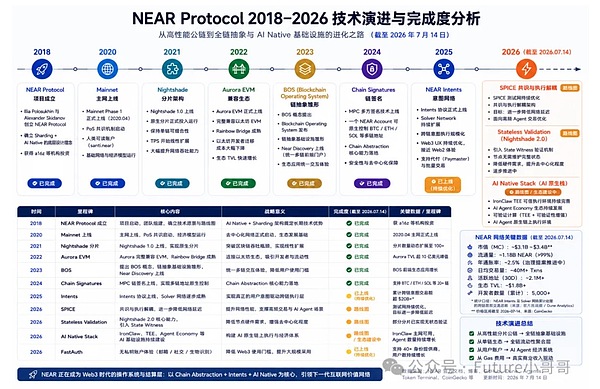
Table.1 NEAR Protocol 2018-2026 Roadmap and Completion Status
As early as 2020, NEAR launchedNightshade Protocol (Nightshade 1.0). Unlike traditional sharding, which rigidly divides the network into multiple parallel chains (such as the early Polkadot or Cosmos application chains), Nightshade logically maintains a monolithic main chain (ensuring global composability, and developers and users are unaware of the existence of sharding), while physically dividing blocks into multiple data chunks for parallel processing.
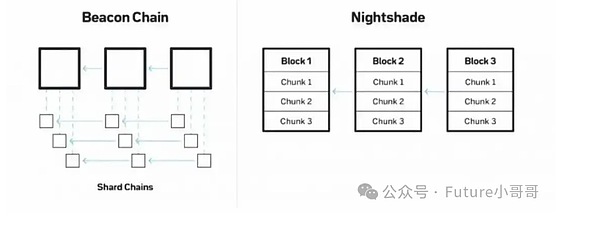
Pic.1 Basic Diagram of Night Shadow Slicing Technology
By 2024 to 2026, NEAR has completed several textbook-level underlying upgrades, and its technical completion and concurrent processing capabilities have formed a substantial generational advantage in the industry:
Stateless Validation - Nightshade 2.0:With the continuous accumulation of active users and smart contracts on the chain, all traditional public chains face the fatal problem of "state bloat". In the past, in order to verify any new transaction, full nodes had to store and retrieve the complete "global state tree" in real time on a large and expensive local NVMe SSD. This caused the hardware cost of validating nodes to rise exponentially, and eventually the network would inevitably move towards centralization controlled by a few institutions. The introduction of stateless validation has changed the validation paradigm. Validating nodes no longer need to store tens of terabytes of historical state of the entire network. They only need to obtain the "state witness" (a small data packet with cryptographic proof) required for the current transaction to complete the mathematical verification.
SPICE Upgrade (Complete Separation of Consensus and Execution):Traditional public chains (such as Ethereum and even the early Solana) have a strictly coupled processing mechanism. Nodes must wait for all transactions in the current block to be executed step by step and the state updated before they can package a block. This serial waiting severely slows down the network. The SPICE upgrade completely decouples "consensus ordering" and "state execution" at the underlying architecture. This architectural revolution aims to compress the NEAR block time to the physical limit of 200 milliseconds, and finality confirmation (Finality) only takes 0.4 seconds. This performance completely surpasses the lag of traditional blockchains, reaching the latency standards of traditional financial-grade high-frequency clearing engines like Nasdaq. Dynamic Resharding: Faced with sudden surges in traffic (such as the minting of blockbuster NFTs, the launch of popular Meme coins, or the outbreak of AI high-frequency arbitrage), traditional monolithic networks (like Solana) often passively bear the burden of network-wide congestion, or experience gas fee spikes of tens of times, like Ethereum. However, the NEAR network's underlying protocol monitoring mechanism can automatically "dynamically fission" congested shards into new shards within approximately 2-3 seconds based on the real-time load and computing resource consumption of each shard, distributing the traffic evenly. When traffic subsides, the shards are automatically merged, with zero downtime and completely imperceptible to front-end users. In dealing with the high-frequency and pulse-like bursts of transaction traffic generated by AI machines in 2026, this "elastic unlimited scalability" capability is the core guarantee for maintaining extremely low and stable gas fees across the entire network.
3. NEAR Token Economics: In-depth Analysis - Deflation Flywheel and Business Closed Loop
2026 Basic Economic Model Data:
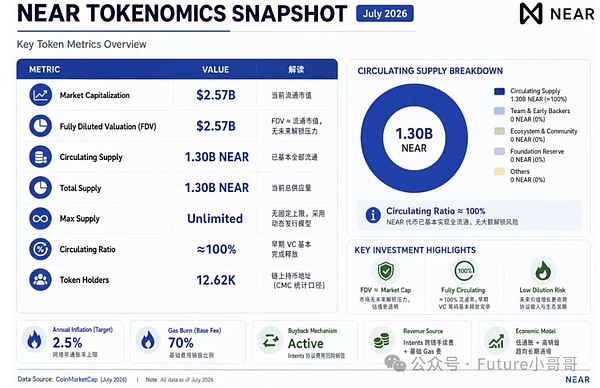
Table.2 Near According to the latest official data and CMC data, NEAR's overall FDV as of July 14th was $2.57 billion, and its overall circulation rate is almost 100%, eliminating the selling pressure from large-scale future token releases that all projects in the industry fear most. Being in full circulation, the future overall value of the project's token is directly and completely linked to the project's core development, progress, and supply and demand scarcity.
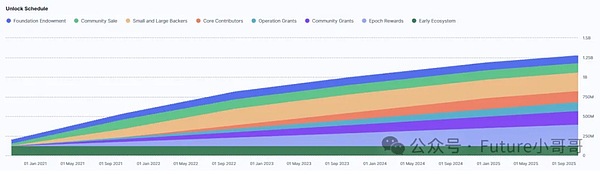
Pic.2 Near Token Release Chart (Data Source: CMC)
To assess the long-term viability and investment safety cushion of a Layer 1 asset, token economics is the core benchmark.
To assess the long-term viability and investment safety cushion of a Layer 1 asset, token economics is the core benchmark.
In the past, the vast majority of public blockchains (including early NEAR and most current emerging L1 blockchains) relied on high inflation (issuing new tokens) to pay for the network's security budget (i.e., the block rewards given to miners/validators). This is essentially a long-term dilution that continuously "steals" the resources of all token holders. Many projects have fallen into this trap in recent years. This model of "using future high inflation to subsidize current network security, and using token subsidies to obtain a false TVL" is nothing short of a Ponzi scheme when lacking real external business cash flow. Once the market turns bearish, the flywheel will collapse instantly. However, entering the 2025-2026 phase, NEAR made two bold and decisive shifts in its economic model, completely establishing a positive closed loop in its business logic: **Cliff-like Halving and Tightening of Basic Supply:** Through a highly consensus-driven on-chain governance proposal, NEAR emulated Bitcoin's halving philosophy, forcibly reducing the network's maximum annualized inflation rate from 5% to 2.5%. This means that the annual new selling pressure released into the market is directly halved, and the 2.5% inflation rate is lower than the inflation rate of most countries. After deducting the gas burning caused by the massive daily transactions on the network (70% of the base fee for each block is destroyed), the actual net inflation rate is suppressed to an extremely low level. From the supply side, this is equivalent to building the first line of defense for the token price. NEAR Intents Fee Switch Activation (Empowering Real Business Revenue): This is the most critical inflection point for the $NEAR economic model to undergo a qualitative change and move towards the logic of traditional high-quality interest-bearing assets. As NEAR Intents rises as a unified, full-chain cross-chain execution abstract network, its current cumulative processed real cross-chain transactions and swap volume has exceeded $20 billion. The protocol has officially activated its protocol-level "Fee Switch," beginning to extract a few per thousandths of the transaction fees from these extremely high-frequency, real-world cross-chain financial activities. Most importantly, the protocol directly channels these real external revenues, denominated in fiat currency, USDC stablecoins, or mainstream blue-chip assets (such as BTC and ETH), into the decentralized exchange (DEX), where they are forcibly bought back in the open market, and then completely destroyed (or injected into a long-term ecosystem reward pool). Data Profiling and the Financial Logic of Web2 Tech Stocks: This mechanism perfectly mirrors the most mature "share buyback" logic of profitable Web2 tech giants (such as Apple and Microsoft). It doesn't rely on fictitious share issuance subsidies, but rather earns real money to reduce the circulating supply. Furthermore, the valuation logic of blockchain Web3 projects is even richer than that of Web2 projects because the special attributes of tokens, the immediacy of their transfer value, and their multi-dimensional usability directly increase the multiple consumptions and user experiences in different scenarios. Beyond just voting and dividend rights like stocks, combined with detailed on-chain data analysis models, when NEAR Intents' daily cross-chain transaction volume stabilizes above $177 million, coupled with the massive Gas burning generated by the AI agent's huge and continuous computing power calls, the network's total burn and repurchase volume will achieve a historic "golden cross" (i.e., Burn ≥ Issue) on the mathematical curve with the 2.5% new issuance.
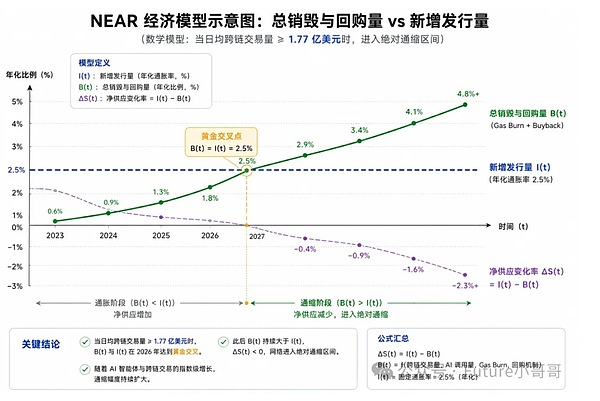
Pic.3 is merely a schematic diagram illustrating the inflation and deflationary trends during the non-indicative explosive demand of NEAR, to help users understand. The timeline is only for case reference.
This means that the NEAR network not only stopped diluting the value of token holders, but also relied on the abundant cash flow from the real external business world (cross-chain clearing, network-wide exchange commissions, AI) The cryptocurrency market has officially entered a period of "absolute deflation." Against the backdrop of a crypto market flooded with projects lacking profitability and exhibiting excessively high FDV (Full Flow Value) for dumping, the scarcity of Layer 1 assets with strong positive business cash flow discounting logic is self-evident. However, the additional value of a project is also closely related to the overall market trend and sentiment. During market euphoria or panic, value mismatches often occur, much like the World Cup prediction market. For example, the odds of Argentina winning might fluctuate wildly, from 80% to 4%, and then back to 100%. Market sentiment cannot be analyzed to understand its intrinsic level; it can only be measured by the score and remaining time. Of course, this example is essentially an options analysis, and for long-term tokens like NEAR, it should only be considered as a short-term example of emotional fluctuations.
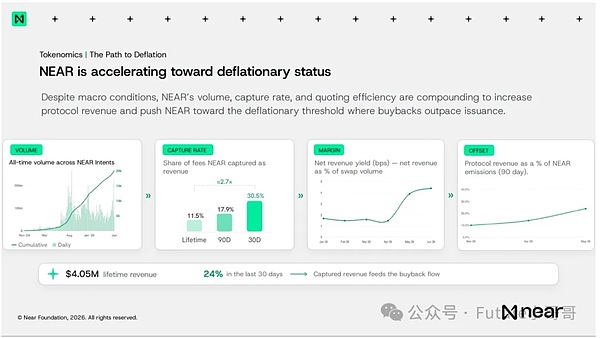
Pic.4 Near official real-time data chart on the shift towards deflation (updated July 14th)
Regarding the explosion of the AI intelligent agent economy, I personally lean towards an exponential explosion rather than a linear one. After the initial experiments and logical security verification are successful, it is very likely that a larger-scale explosion will occur.
The amount of GAS consumed and the overall value increase of the project will then be even more anticipated. 4. The Ultimate Form of the NEAR AI Native Public Chain: Verifiable Confidential Computation and Agent Economy The macro narrative of 2026 has already shifted from simple DeFi Ponzi mining to a machine-driven "AI Agent Economy Network (Agentic Web)". While major public blockchains and startups are rushing to label themselves with "AI" (such as simply issuing an AI-concept Meme coin or merely storing the results of AI models on-chain), NEAR, leveraging Illia's large-scale model research background and network, has chosen a hardcore, hard-to-replicate technology implementation path: building a verifiable confidential computing environment to establish digital ownership of AI agents and an automated economic settlement network. Its core breakthrough component is IronClaw (an open-source and verifiable confidential AI agent runtime environment), which is already being deployed in 2026.
Solution and Deduction of the Pain Points of the "Black Box Paradox":Why do traditional Wall Street quantitative funds, top hedge funds, and even high-net-worth Web3 users still dare not allow complex AI agents to directly manage large sums of money on the blockchain and conduct 24-hour high-frequency automated trading? The core issue lies in the inability to break the "black box paradox" of traditional cloud computing. If your AI trading model (containing the weights of your painstakingly trained long and short strategies, as well as the private key controlling millions of dollars) runs on traditional centralized servers such as AWS and Alibaba Cloud, the cloud vendor's super administrator, low-level operations and maintenance personnel, or hackers can physically steal the AI's strategy logic at the memory level at any time, or even directly copy the private key and steal all assets. You are asking institutions to entrust their life and death to centralized data centers, which violates the moral bottom line. IronClaw cleverly breaks this deadlock. It deeply integrates blockchain's zero-knowledge proofs (ZKP) with the TEE (Trusted Execution Environment) confidential computing architecture underlying the Intel SGX/NVIDIA H100 chip. To put it simply: This is equivalent to creating a "cryptographically-grade stainless steel black box" directly locked by a hardware chip within a physical server in the cloud for the AI agent. Your private key and core quantitative strategy are stored and run within this black box, and the AI automatically executes complex cross-chain arbitrage or asset rebalancing for you. Even the cloud provider supplying this physical server, and even NEAR's core underlying developers, absolutely cannot physically unplug the disk or use top-level code to hack into the box to peek at the data inside (the memory is encrypted at the chip level). At the same time, everyone can objectively verify, through zero-knowledge cryptographic proofs on the NEAR chain, that this AI indeed meticulously executed the operation according to your original intent (e.g., "buy 100 ETH when ETH drops below 2500"), without being tampered with by any malicious code. On this infrastructure, NEAR has successfully built a thriving "AI Agent Market." This is not a toy-like chatbot, but tens of thousands of independent AI workers with "full economic agency rights." On the NEAR chain, they hire each other, purchase API data, and settle micropayments (M2M payments) in milliseconds. For example, Agent A, responsible for executing a transaction, can automatically hire Agent B, who is skilled in data scraping, to analyze the sentiment of the entire network X (formerly Twitter), and automatically settle the payment in milliseconds using a fraction of a cent of $NEAR. Thanks to the SPICE upgrade mentioned earlier (0.4-second ultra-fast confirmation) and extremely low gas costs, NEAR has become one of the very few underlying networks in the entire network that can truly support this kind of ultra-high frequency, micro-dollar level machine-to-machine economic settlement. Furthermore, NEAR's deep involvement in the NVIDIA Inception Program not only grants it access to underlying CUDA hardware-level optimization support and priority in enterprise-grade GPU procurement, but also substantially solidifies its engineering dominance in decentralized AI computing networks. However, for the use of all agents, current access control still requires individual restrictions at the permission level, and there have indeed been cases where excessive authorization in AI has led to the automatic integration and deletion of years of hard-earned data; even the most advanced GPT5.6 and Claude models have experienced similar issues. Therefore, often a stripped-down version of a dedicated agent is safer. For example, the agent economy described above that only analyzes Twitter and is only responsible for a certain trading strategy. 5. Asymmetric Moat: Chain Abstraction Benefits from the Aggregation of Network Liquidity If AI is the infinite new frontier for NEAR's expansion, then "chain abstraction" is NEAR's most brilliant and fatal strategic move in the public chain zero-sum game facing the Ethereum L2 battle and Solana's rapid counterattack: Abandoning the inefficient TVL (Total Value Locked) zero-sum game with Ethereum, it directly embraces and controls the incremental liquidity of the entire network through the underlying protocol. While other Layer 1 blockchains are still struggling with how to write complex EVM-compatible layers and how to "drain" Ethereum's funds and users through large-scale token airdrops, NEAR has unveiled the ultimate narrative of "chain abstraction." Leveraging a breakthrough in chain signatures based on MPC (Multi-Party Secure Computation Network), a smart contract on the NEAR network can directly and natively generate, sign, and control any real address on Bitcoin, Ethereum, Solana, and even non-EVM chains. Underlying Logic Derivation and User Journey Analysis: The chain abstraction protocol is like a "globally universal card" in the Web3 world (similar to a global clearing and settlement network like Visa/Mastercard). In the old days, users had to prepare ETH for transaction fees on Ethereum and buy SOL on Solana. Cross-chain transactions were fraught with risks, requiring the use of various flawed cross-chain bridges (similar to exchanging different currencies for different countries, resulting in significant exchange rate losses and considerable hassle). Now, in a typical application scenario: a Web2 user with no understanding of the underlying blockchain logic, or even a mnemonic phrase, only needs to register a NEAR account (this black card) via email. They can then initiate a natural "intent" on the front end—for example, "Use my 5000 USDC on Arbitrum to buy a hot-selling NFT on Solana." Upon receiving this intent, NEAR's underlying decentralized solver network automatically searches for the cross-chain path with the lowest slippage and best exchange rate in global liquidity pools within milliseconds. Then, NEAR's MPC validator node cluster jointly signs the instruction, completing the entire process automatically in the background: withdrawing USDC from Arbitrum -> exchanging -> cross-chain transfer -> even using a payment mechanism (Paymaster) to advance the Solana gas fees for the target chain -> purchasing the NFT -> depositing it into the user's unified multi-chain address. For this end-user, they don't even need to know about the existence of the Arbitrum and Solana chains; they simply feel like they've completed a seamless "one-click purchase," much like WeChat Pay. The one who truly controls value is not necessarily the underlying asset, but rather the party that controls the user entry point, transaction routing, and clearing capabilities. This constitutes an extremely deep and absolutely exclusive moat: NEAR essentially absorbs all other leading public chains (including Bitcoin's unshakeable strong store of value attribute and Ethereum's massive and prosperous DeFi ecosystem) into its own "underlying asset liquidity pool" and "passive execution terminal." When NEAR Intents are deeply embedded in super entry points such as the Brave browser with 70 million monthly active users, as long as NEAR controls the front-end interaction entry point for end users and the cross-chain routing scheduling power, it essentially gains the benefits of traffic distribution in the entire Web3 business era. Furthermore, NEAR's revenue from exchange aggregation may far exceed that from browsers and projects. NEAR's core competitive advantages: AI Moat: Founding Team and AI Research Background. Account Model Moat: Protocol-native Account Abstraction and Access Keys. Chain Abstraction Moat: Chain Signatures + Intents.
Scalability Moat: Nightshade, Stateless Validation, SPICE.
Economic Model Moat: High Circulation, Gas Burn, Extremely Low Inflation, Potential Protocol Revenue.
Economic Model Moat: High Circulation, Gas Burn, Extremely Low Inflation, Potential Protocol Revenue.
6. Reshaping Web3 Valuation Logic: Moving Beyond the TVL Model and Employing a Discounted Cash Flow Model Based on Real Returns In current crypto asset pricing models, most primary and secondary market researchers and investors still rely on the pre-2021-popular TVL (Total Value Locked) or simple L1 TPS narratives to value NEAR using outdated methods. Furthermore, due to the meme craze, many directly use memes and market discussions to value projects, a completely outdated framework that fails to match the commercial substance of NEAR and many new projects in 2026, leading to severe asset value mismatch and undervaluation in the market. Many high-quality projects have received very low valuations because they haven't been discussed in the market, making this a true value opportunity. When we set aside preconceived notions and view NEAR as a "full-chain intent scheduling and settlement layer" and an "AI computing power underlying unified payment network" with real scalable revenue, we can refer to more traditional Web2 technology infrastructure valuation models—such as the price-to-sales ratio (P/S ratio) or the fee multiple (i.e., circulating market capitalization / annualized total protocol revenue). The Power of Horizontal Data Comparison: If we take the popular top-tier cross-chain interoperability protocol LayerZero (ZRO) as a benchmark, LayerZero's valuation is extremely high (around $6 billion at its peak, currently around $500 million). However, the real commercial value captured by NEAR Intents solely based on the cross-chain intent traffic it has taken over (net cross-chain transaction fee revenue in the past 30 days) has already reached and exceeded LayerZero's by 15 to 18 times. Even disregarding AI and only considering NEAR's actual market share and profitability in the cross-chain clearing field, it has already been severely overlooked and underestimated by the market. It's important to understand that the vast majority of AI and Web3 projects, even those reaching valuations of hundreds of billions, may still be operating at a loss. Fee Multiple and Safety Cushion Advantage: In rigorous financial fundamentals analysis, by combining NEAR's total network gas revenue with Intents' massive cross-chain revenue sharing, NEAR's current circulating market capitalization is only about 56 times its annualized total protocol fees. In the crypto market, where P/E ratios often exceed a thousand times, this is a healthy figure, even lower than the valuation levels of some traditional technology SaaS companies. In stark contrast, some emerging Layer 1 tokens (such as Sui and Aptos) with extremely high FDV (Fully Circulating Value), low circulating shares (generally less than 30%), and currently in the institutional unlocking period face immense pressure from subsequent sell-offs by their teams and VC firms daily. Their actual network transaction fee revenue is also often quite low. If their price-to-sales ratio is strictly calculated, the multiple is often astonishingly high, reaching thousands of times. NEAR, on the other hand, with nearly fully circulating shares (over 99% already released), no burden of massive early institutional unlocking and sell-offs, and strong external revenue generation capabilities (buybacks and burns), offers a very thick valuation safety cushion during downside and a very high risk-reward ratio. 6.2 From Cash Flow Valuation to Option Value: A Long-Term Revaluation of NEAR Traditional financial markets typically value companies based on current revenue, profit, and discounted cash flow (DCF). However, for truly platform-based technology companies, the capital market often provides another important source of valuation—the option value of future growth. Whether it's Microsoft, Nvidia, Amazon, or OpenAI, their valuations are not merely based on current profitability; rather, the market is pre-paying a premium for potential new industry entry points. For NEAR, valuation cannot solely rely on gas revenue, protocol fees, and cash flow from Intents. With the continued development of AI Agents, Chain Abstraction, and the Machine Economy, NEAR's greater value lies in its long-term scalability as next-generation digital infrastructure. Firstly, the value that AI Agents bring to NEAR is not merely reflected in current protocol revenue, but rather resembles a long-term AI premium call option. The global AI agent economy is still in its early stages. However, once AI agents begin to possess digital identities, autonomous wallets, and on-chain asset management capabilities on a large scale, and can automatically call APIs, execute cross-chain transactions, and complete autonomous payments, these high-frequency, automated on-chain behaviors will require a stable, secure, and low-cost execution environment provided by the underlying network. NEAR's strategic deployment in account models, Access Keys, Chain Abstraction, Intents, and AI Native infrastructure naturally enables it to support this round of AI infrastructure upgrades. Therefore, the value brought by AI should be understood as the expected growth in future cash flow, rather than current revenue itself. Secondly, Chain Abstraction endows NEAR with unique network premium value. The traditional Layer 1 competition logic is often based on vying for TVL, attracting developers, and encouraging ecosystem migration. NEAR's goal, however, is not to replace other public chains, but to become the unified interaction layer and liquidity routing layer for the entire Web3. In the future, regardless of whether users ultimately use Bitcoin, Ethereum, Solana, Base, or other public chains, they may be able to complete asset management, cross-chain execution, and transaction settlement through NEAR. This means that NEAR's growth does not depend on the decline of other public chains; instead, it has the opportunity to benefit in tandem with the expansion of the entire industry. Its business model is closer to the payment networks and infrastructure platforms of the internet era. Furthermore, the machine economy may become the largest source of new value in the future. The internet of the past two decades has primarily served the exchange of information between people, while in the next decade, greater incremental growth may come from automated collaboration between AI agents (Machine-to-Machine, M2M). Agents can autonomously purchase computing power, call APIs, pay data fees, execute on-chain transactions, and even hire other agents to complete complex tasks. This massive, high-frequency, low-amount automated payment network is fundamentally different from traditional payment systems, requiring blockchain infrastructure with extremely low latency, extremely low gas costs, and high throughput. NEAR's design in high-performance execution architecture, account abstraction, and chain abstraction aligns well with the development direction of the machine economy. Therefore, the future development of the machine economy is expected to further expand NEAR's protocol value capture capabilities. Meanwhile, the development of digital identity, spatial computing, and future digital asset networks also provides additional long-term value space for NEAR and the entire Web3 industry. While the hype surrounding the metaverse concept has waned somewhat in recent years, the rise of AIGC will inevitably reignite its influence on the metaverse, and the trends of digital identity, cross-platform assets, unified account systems, and immersive internet have not disappeared. In the future, whether it's AR, VR, digital twins, or spatial computing, their underlying infrastructure will require unified identity, unified accounts, unified payments, and unified asset management capabilities. NEAR's account model, FastAuth, Chain Signatures, and Chain Abstraction infrastructure provide strong protocol compatibility for these new scenarios. This value is not yet fully reflected in protocol revenue, but it still constitutes potential for long-term growth. Therefore, we believe that NEAR's long-term valuation should not be limited to traditional Layer 1 metrics such as TVL, TPS, or short-term ecosystem activity, but should gradually adopt a comprehensive valuation framework of "basic cash flow + network effects + AI premium + protocol optionality". As real protocol revenue continues to grow, the AI Agent economy matures, and the chain abstraction continues to integrate more cross-chain assets and user entry points, NEAR is expected to evolve from a traditional public chain into the underlying operating system of the entire Web3 and AI era. Its valuation logic is also expected to align with that of an internet infrastructure platform with real cash flow and long-term growth potential, rather than simply a Layer 1 public chain. NEAR's current FDV is only about $2.5 billion (as of July 2026, DYOR). This valuation reflects more the market's perception of it as a traditional Layer 1 public chain in a bear market and with weak PR, while the market is still in the early stages of pricing in the long-term value inherent in the future AI economy, and NEAR's long-term value is expected to be repriced. 7. Overall Value Summary: Structural Dividends Across Cycles and Long-Term Investment Outlook In summary, from a macro perspective in 2026, facing the expectation of a new round of easing in global macro liquidity (interest rate cut cycle) and the intensifying arms race in artificial intelligence computing power, NEAR Protocol is no longer an experimental single public chain for tech geeks to discuss extreme TPS metrics. From the perspective of the underlying technical architecture, Nightshade, SPICE, and Stateless Validation together constitute the performance foundation of NEAR for the AI era, enabling it to support tens of millions of daily active users and ultra-high frequency micro-payments by machines with industrial-grade strength. From the perspective of its business model, it is one of the very few Web3 protocols that solves the problem of fragmented liquidity across the entire network through "chain abstraction" and, through genuine cross-chain revenue sharing and strict halving, substantially achieves a healthy internal economic model that enters a state of absolute deflation. From the perspective of future forward-looking planning, it is also the only large-scale application ground where trusted TEE confidential computing, autonomous AI agents, and crypto-native assets perfectly converge. Top-tier institutions often have the keenest capital instincts. The public announcement by Nasdaq-listed Sovereign (SVRN) that it will include NEAR as a core reserve asset in its national treasury, along with the successive launches of compliant NEAR financial trust products by traditional Wall Street asset management institutions such as Bitwise and Grayscale, all signify that mainstream Old Money has fully recognized the closed-loop business logic of NEAR. The close cooperation with Nvidia also indicates that NEAR is entering the vision of mainstream institutions. Given that capital market prices often lag behind the underlying technology and commercial breakthroughs, NEAR is currently in an asymmetric dividend phase characterized by "strong fundamentals, a completed business loop, but valuation still suppressed by the old cycle model and the overall industry situation." This may be because NEAR's market PR, especially its in-depth analysis content, is relatively weak. Although it has the support of its founders and top AI companies such as Nvidia and Google, the limited output of core third-party analysis content has suppressed the discovery of its value to some extent. Furthermore, with the rise of Memes in the past few years, organizations and individuals truly willing to write in-depth value analyses have had their output paused due to the trend of "bad money driving out good." AI-generated content will also significantly reduce the promotional willingness of original and in-depth creators. However, from another perspective, AI can also help promote truly valuable viewpoints and content, and your thoughts and methodologies will gradually and subtly influence the entire industry or people outside the circle. We believe that, as chain abstraction continues to enhance liquidity aggregation capabilities and AI Agents and the machine economy gradually enter the real-world application stage, NEAR is poised for a value revaluation that transcends economic cycles. Its fundamentals have already exhibited structural characteristics distinct from traditional Layer 1 public chains, and it possesses the long-term growth attributes endowed by AI-native infrastructure. The true value of a platform does not stem from what it has already achieved today, but from how much new economic activity it can sustain in the future. For NEAR, Gas revenue is merely the starting point for this value revaluation; the protocol options offered by AI Agents, the machine economy, chain abstraction, and the future digital world are what will likely constitute its second growth curve across economic cycles. Special Note: This article is a long-term investment value learning and research report, intended for learning and discussion purposes only, and is not investment decision advice. Readers are advised to conduct careful independent research on DYOR.


 Joy
Joy

