Yiwen participated in the modular RPC project Lava Network
The modular track has just begun, and RPC nodes are also a hard requirement. When the two are combined, I believe this project will be very promising.
 JinseFinance

After all, from chain A to chain B, each route has different travel time (bridge time), tolls (cross-chain costs) and fuel consumption (Gas), and the travel time, tolls and consumed fuel may be different each time, so it is difficult to find the best route:
Some routes may only support specific tokens;
The tolls of some routes may vary depending on the token amount, so it may not be ideal for large transactions;
Or the contract interaction consumption of some routes may be high, which leads to increased travel time and fuel consumption;
This is also the development focus of ideas such as cross-chain aggregators in the past few years. In this process,the system will automatically find all available routes and sort them according to the following three criteria: maximum asset output on the target chain, lowest gas fee, and shortest time.Users only need to choose according to the path provided by the aggregator to complete the optimal cross-chain exchange operation.
We can intuitively feel the advantages of this cross-chain (layer) aggregate exchange by comparing it with the traditional cross-chain exchange path. Suppose a user has DAI on Arbitrum and wants to exchange it for ETH on Optimism. Under traditional cross-chain (layer) projects, there are multiple paths to achieve this:
First, exchange DAI for ETH through 1inch on Arbitrum, and then exchange ETH from Arbitrum to Optimism through the cross-chain bridge;
Or first, exchange DAI from Arbitrum to Optimism through the cross-chain bridge, and then exchange DAI for ETH through Uniswap on Optimism;
However, in the cross-chain (layer) aggregation approach, users do not need to make the above trade-offs and considerations themselves. They automatically find all available routes and then help users move funds between different blockchains in the optimal way based on factors such as the maximum output on the destination chain, the lowest gas fee for transactions and transfers, and the lowest bridging time.
In addition to the "aggregation" evolutionary path that can be intuitively felt on the user experience side, on the technical level, in order to break down isolation walls, the cross-chain track has also been exploring different and more diversified technical solutions for many years:
Message layer interoperability: For example, LayerZero and IBC (Cosmos) achieve data interoperability through cross-chain message verification.
State layer synchronization: Allows different chains to directly share state without the need for an intermediary.
Zero-knowledge (ZK) cross-chain: Using zero-knowledge proofs, cross-chain verification is made more efficient and secure.
These solutions all point to one goal, which is to make the blockchain world truly "seamlessly interconnected" and allow users to not feel the boundaries of the chain.

And on August 29, the Ethereum Foundation also released "Protocol Update 003 — Improve UX", focusing on improving user experience (Improve UX) as one of the three major strategies after the reorganization of the R&D team (Scale L1, Scale Blobs, Improve UX).
Among them,The EF article emphasizes interoperability as the core, aiming for a seamless, secure, and permissionless Ethereum ecosystem experience.
Against this backdrop, there are two new paths worth noting in the academic and developer communities, which may determine the future of Ethereum's cross-chain ecosystem. 1. SCOPE: Rebuilding Ethereum's "Synchronous Composability" First, there's the SCOPE (Synchronous Composability Protocol), recently proposed by Ethereum researcher jvranek. This aims to achieve synchronous composability between Ethereum's L1 and L2, and between L2 and L2, and support atomic execution of cross-domain contracts. Put simply, this allows interactions between different Rollups, and between Rollups and the Ethereum mainnet, to be executed "atomically" as if on the same chain—all operations within a transaction either succeed or fail, with no intermediate states. However, previously, this approach was limited by cross-chain interoperability barriers, making it difficult to achieve when cross-chain operations were involved. For example, with SCOPE, you can simultaneously call the Aave protocol on Arbitrum and the Uniswap protocol on Optimism in a single, integrated swap and lend transaction. Either both will succeed or both will fail, eliminating any stuck processes that waste gas and opportunity costs. The potential value is clear: this will unlock complex DeFi strategy combinations like cross-L2 flash loans and one-click liquidations. While SCOPE is still in its PoC phase, it is widely viewed as a key piece in addressing L2 composability fragmentation. Once mature, the application-layer converged experience and the underlying atomic interoperability will complement each other: the former lowers barriers to entry, while the latter ensures security and consistency. 2. ZK Accelerates Interoperability: Replacing "Trust" with Mathematics Another approach leverages zero-knowledge proofs (ZK Proofs), eliminating the reliance on a trusted set of middlemen (validation nodes) for cross-chain verification and allowing it to rely purely on mathematics. A concise ZK proof can be generated for state changes on the source chain. The target chain verifies the source chain's events through mathematical proofs, confirming their authenticity within the security model. Representative solutions include the native interop mechanism proposed by ZKsync. Some approaches, with a stronger engineering orientation, attempt to strike a dynamic balance between speed and security costs. For example, the t1 Protocol aims to find a middle ground between pure ZK trust minimization and high-trust intermediaries, achieving asynchronous, fast, and cryptoeconomic security. It uses TEE + AVS to prove events/statuses on other chains. When the amount at risk exceeds the cryptoeconomic budget, ZK proofs are introduced as needed to provide a safety net (saving ongoing costs). In terms of specific security architecture, sequencing and execution are separated, TEE outputs are reproducible for fraud detection and punishment, and deterministic outputs enable cryptoeconomic accountability.
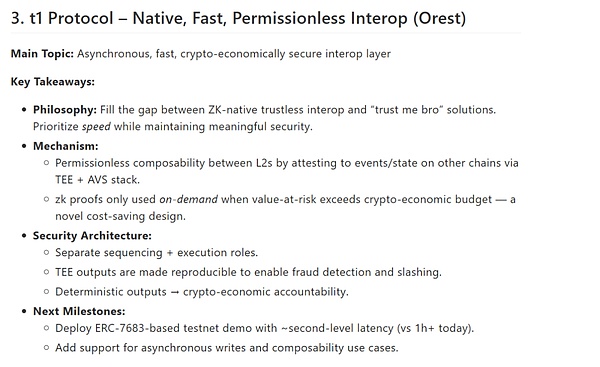
In short, this approach emphasizes "improving the user experience by 10 times for 80% of users first," and then using a cost-elastic proof system to leverage at critical moments. From an engineering implementation perspective, if it can be combined with the wallet's intent routing, risk control, and limit mechanisms, it will be a very pragmatic implementation direction. Overall, whether it's cross-chain aggregation at the application layer or atomic interoperability/ZK acceleration at the protocol layer, the common trend is gradually diluting the presence of "chain" and the perception of "cross-chain": For ordinary users, you may not need to remember names like SCOPE or ZK Interop. What really matters is that cross-chain operations are becoming faster (in seconds), more secure (mathematically guaranteed), and more invisible (completed in one go). This is also what the ultimate goal of cross-chain operations should be: allowing users to focus on the flow of value itself, rather than the barriers between chains.
The modular track has just begun, and RPC nodes are also a hard requirement. When the two are combined, I believe this project will be very promising.
JinseFinanceGas fees for BTC asset transactions are expected to drop significantly in the near future.
JinseFinanceThe partnership aims to allow cryptocurrency purchases using the CoinHub bitcoin wallet partnered with CHB Holdings and Edge at more than 20,000 stores that are part of the Green Dot network, including CVS, Walgreens, and Krogers.
 Others
The competitor to the Aptos blockchain said that developers can continue to use its devnet.
OthersJustin Sun speculated in a tweet that struggling trading firm Alameda might have started the depeg by selling its USDD holdings.
 Coindesk
Hector, one of the fastest growing platforms, has officially rebranded itself as Hector Network to reflect the recent changes made ...
 Bitcoinist
MEXC Global, a leading digital asset and cryptocurrency trading platform, has today announced a partnership with the Pyth Network, an ...
BitcoinistIn order to earn profits in crypto, one needs to have a powerful trading strategy; something the average crypto holder ...
BitcoinistInvestments have always been a risky affair, and the biggest concern among most is which platform to go for. More ...
BitcoinistThe decentralized exchange has migrated to Arbitrum to help users deal with Ethereum network congestion and expensive gas fees.
 Cointelegraph