Javier Milei's Vision: A New Economic Era for Argentina
Javier Milei assumes Argentina's presidency, promising radical economic reform amidst a severe crisis, reflecting the nation's hope for a transformative libertarian approach.
 YouQuan

During the observation window from April 20 to May 7, 2026, the global crypto market demonstrated remarkable resilience, with its overall market capitalization successfully transitioning from a "high-frequency speculation-driven" to a "structural rebalancing" paradigm amidst macroeconomic fluctuations.
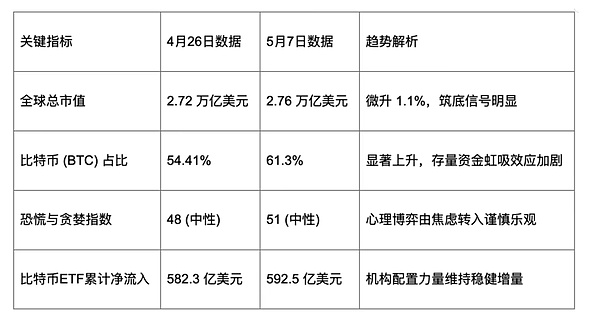
In the middle of this two-week period of zero-sum game, the overall market capitalization successfully transitioned from a "high-frequency speculation-driven" to a "structural rebalancing" paradigm amidst macroeconomic fluctuations.Despite inflation concerns stemming from geopolitical games causing a general decline in risk assets, the crypto market successfully maintained its total market capitalization benchmark of $2.7 trillion, thanks to the continued support of spot ETFs and the steady expansion of stablecoin holdings. This trend reflects the dual status of core digital assets in institutional asset allocation, namely, "alternative hedging" and "certainty premium." Macroeconomic Focus and Key Areas: 1. Bitcoin Market Changes: The market capitalization share jumped from 54.41% to 61.3%, reflecting the hedging logic of capital rapidly flowing back to consensus assets during periods of uncertainty. It is worth noting that although the fear index rose slightly to 51, its divergence from the slight increase in total market capitalization confirms that during the consolidation phase, the market has entered a psychological game of shifting from "defensive holdings" to "structural portfolio adjustments."
In the middle stage of a zero-sum game, the marginal changes in on-chain liquidity and the fluctuations in valuation and exchange rates are the core criteria for judging whether the market has entered a "recovery phase" or a "consolidation corridor". This week, the total issuance of stablecoins (3.25 billion) decreased by 23.53% compared to last week (4.25 billion). According to in-depth analysis, this decline was mainly caused by the slowdown in the issuance pace of Tether Treasury (from 2 billion USDT last week to 1 billion USDT this week), which sends a clear signal that the marginal buying power in the short-term market has reached a temporary peak and entered a period of consolidation.
Coinbase set its Q2 outlook as "neutral" in its latest strategic report, mainly based on the systemic suppression of global supply chains by geopolitical conflicts. The evolution of the situation in the Middle East has not only affected energy cost expectations, but also limited the short-term upside potential of crypto assets by tightening global risk appetite.
The total market capitalization of cryptocurrencies worldwide is $2.76 trillion, up approximately 1.1% from $2.72 trillion last week.
The total market capitalization of cryptocurrencies worldwide is $2.76 trillion, up from $2.72 trillion last week, representing a rise of approximately 1.1% this week.
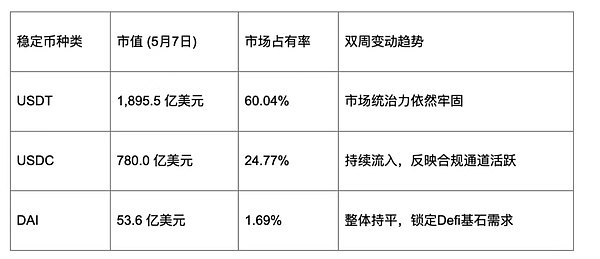
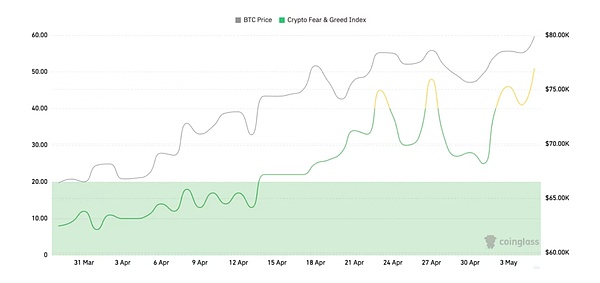
As of now, Bitcoin's market capitalization is $1.62 trillion, accounting for 58.91% of the total cryptocurrency market capitalization. Meanwhile, stablecoins have a market capitalization of $315.7 billion, accounting for 11.48% of the total cryptocurrency market capitalization. The cryptocurrency fear index is 51, indicating extreme fear.
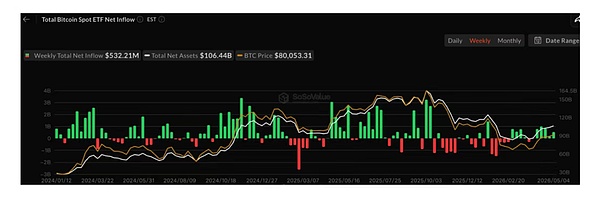
The total net inflow of US Bitcoin spot ETFs is approximately US$59.25 billion, with a net inflow of US$532 million this week; the total net inflow of US Ethereum spot ETFs is approximately US$12.08 billion, with a net inflow of US$61.29 million this week.
a16z Crypto's move to establish a new $2.2 billion fund signifies a strategic deployment of capital in the "medium cycle". The fund's explicit focus on transforming new infrastructure into everyday products reflects how top venture capitalists are using infrastructure investment to combat short-term market uncertainty during periods of macroeconomic volatility. The deep symbiosis of AI and encryption: The intensive activities of OpenGradient, Gensyn, and USD.AI confirm that encryption technology is an inevitable path to solving the "black box governance" of AI. Verifiable AI inference mechanisms will become the core standard of future decentralized computing networks. The race for high-performance scaling parameters: TON completed its Catchain 2.0 upgrade, achieving a 400ms block time and 1-second final confirmation, significantly improving social payment efficiency; while MegaETH aims for a 10ms block time. This generational evolution of extreme performance is bringing blockchain into the era of "real-time computing." RWA's institutional-grade scaling: Tether demonstrated strong strategic expansion this past two weeks, leading investments in KAIO (RWA tokenization infrastructure) and Belo (Latin American crypto payment wallet), transforming itself from a stablecoin issuer into an integrator of "RealFi + payment gateways." Meanwhile, JPYC completed its Series B funding round (raising a total of $28.93 million), further expanding the global application chain of the Japanese yen stablecoin. Project TGE and Investment & Financing Updates: MegaETH's (April 30th) TGE adopted a "KPI-linked release" mechanism, reflecting the industry's shift away from simple linear unlocking and towards incentive models driven by real growth (such as USDM size and trading volume). Financing Highlights: Fence (US$20 million funding): Led by Galaxy Digital, focusing on the digitization of asset-backed financing (ABF) back-end infrastructure. Squads (US$18 million funding): Aims to expand its Altitude stablecoin payment platform to provide 24/7 financial management for businesses. III. Macroeconomic and Regulatory Developments 1. Global Regulatory and Policy Progress US Legislative Timeline Locked: Senator Bernie Moreno publicly stated that legislation on the structure of the crypto market will be considered next week and is expected to be signed into law by the President on July 4th. Institutionalized Pathway Protection: The joint advancement of the Clarity Act and the Genius Act provides a clear definition for RWA (Real-World Assets) and institutional participation. This "institutionalized pathway protection" reflects that regulators are inducing large-scale entry of long-term capital by establishing legal boundaries. 2. Macroeconomic Risks Assessment: Concerns about slowing growth: The IMF has lowered its global GDP growth forecast for this year to 3.1%; Oxford Economics has warned that if oil supplies are severely disrupted, global growth could plummet to 1.4% in 2026. This shadow of recession reflects the macroeconomic rationale for a contraction in market valuations of risky assets. Bitcoin's "Responsible" Transformation: At the Bitcoin 2026 conference, senior analyst Tim Draper emphasized that holding Bitcoin has shifted from a simple "wealth-generating opportunity" to an "institutional responsibility." He recommended that households should reserve BTC equivalent to six months of expenses, while businesses should reserve at least one month's worth to mitigate risks to the banking system. This shift in logic confirms that digital gold is undergoing a qualitative change from a "fringe asset" to a "core strategic reserve."
Javier Milei assumes Argentina's presidency, promising radical economic reform amidst a severe crisis, reflecting the nation's hope for a transformative libertarian approach.
YouQuanTaiwan's central bank wraps up wholesale CBDC study, eyes cautious implementation in the era of 'Banking 4.0'.
 Hui Xin
Europe's Artificial Intelligence Act marks a historic step, introducing stringent regulations for ethical and responsible AI usage, balancing innovation with fundamental rights protection.
YouQuanHTX, the digital-asset trading platform associated with industry figure Justin Sun, witnessed a considerable $258 million net outflow following its reactivation after a significant security breach. Data from DefiLlama between November 25 and December 10 showcased the funds departing the exchange, signifying unease among some clients due to the prior security incident. HTX encountered a $30 million loss in crypto tokens during the breach, prompting temporary suspension of withdrawals and deposits as a precautionary measure.
 Joy
Joy3.6 million, or 6% of the total supply of 60 million BCUT tokens will be offered at a rate of 0.055 USDT per token.
 Brian
BrianGraphika's report reveals a 2,408% rise in AI undressing, sparking global concerns and calls for regulatory action against synthetic explicit content.
Hui XinThe European Union (EU) achieved a breakthrough on the AI Act, establishing a comprehensive legal framework governing the use of artificial intelligence within its jurisdictions. This pivotal agreement aims to regulate AI's deployment across various sectors and sets distinctive guidelines for different categories of AI systems.
JoyChina's Central Bank is reducing US dollar holdings, a strategic shift to strengthen the Yuan and challenge the dollar's global dominance in a move that could reshape international financial power dynamics.
YouQuanDespite a $450 million market cap and signs of a slowdown, trading activity remains robust.
BrianThailand rises as a crypto hub with strong adoption and institutional support, surpassing traditional stock investments.
Hui Xin