China Completes Testing For CBDC Blockchain
China has unveiled new developments in their central bank digital currency project
 Clement

Author: Carlos Guzman, GSR Research Analyst; Translation: @jinsecaijingxz
The past few months have been one of the most difficult periods for the Ethereum community in recent years.At least nine senior contributors to the Ethereum Foundation (EF) have left in 2026, with five departing in May alone. The list of departing members includes Protocol Cluster Leads Tim Beiko and Barnabé Monnot, senior researchers Carl Beekhuizen and Julian Ma, and former co-executive director Tomasz Stańczak. Many members left following a controversial internal mandate—“CROPS” (Censorship Resistance, Open Source, Privacy, and Security)—which many argued downplayed the importance of growth and adoption.
Former EF member Dankrad Feist publicly called for the formation of a new organization with over $1 billion in funding and economic interests closely tied to Ethereum to fill this void. Even David Hoffman, co-founder of Bankless and a long-time ETH bull, revealed that he had sold all his ETH, citing disappointment with leadership and their perceived lack of interest in growth. Market conditions have further amplified the negative sentiment within the Ethereum community. This year, the price of ETH has fallen by approximately 30%, and the ETH/BTC ratio dropped to 0.027 in May, its lowest level since mid-2025. Network revenue, a proxy for user willingness to pay, also reflects this trend: Ethereum dominated this metric during the 2021 bull market, but has since steadily given way to chains like Solana, Tron, and Hyperliquid. Revenue doesn't tell the whole story, as chains are actively lowering fees to compete and attract more users, but the overall trend still shows that Ethereum is being gradually eroded by more agile emerging competitors.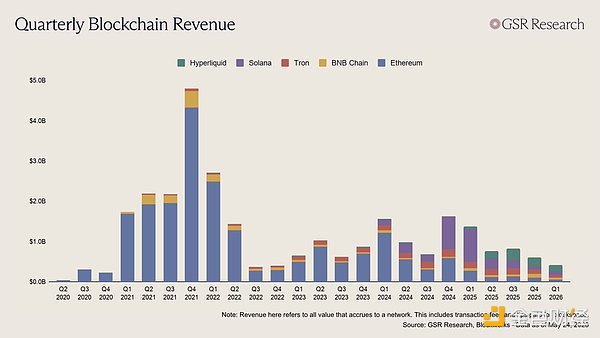
Vitalik Buterin published a lengthy article on X, intervening in this dispute and outlining his personal vision for the foundation's future. He envisions EF as a "small boat," reducing ETH sales and strictly limiting its focus to CROPS (censorship resistance, open source, privacy, and security), rather than attempting to manage the entire ecosystem.Vitalik emphasized that the foundation should be understood as "a node with a clear mission," rather than the center of Ethereum. He believes that channeling talent to roles outside of Ethereum's Effortless Framework (EF) is, in a sense, necessary to attract external capital and cultivate independent leadership in key functions. The more interesting part is his technological vision, outlining three pillars that will make Ethereum "exceptionally good" in ways that competitors cannot replicate. **First, achieving provably flawless software through AI-assisted formal verification—a method that seemed impractical not long ago but is now close to being feasible.** **Second, "available chain consensus"—a unique feature of Ethereum in Proof-of-Stake (PoS) chains: providing traditional BFT-style security in asynchronous network scenarios, while offering Bitcoin-like security in synchronous scenarios, even against attackers up to 49%. No other PoS chain can achieve both simultaneously.** **Third, minimizing intermediary dependence—reducing reliance on centralized relays and third-party infrastructure for fundamental operations such as transaction packaging and privacy through proposals like FOCIL and EIP-8141.** If progress can be made in all three areas, Ethereum will possess highly secure, decentralized, private, and censorship-resistant characteristics.
At its core, Vitalik's explanation is essentially a gamble on credible neutrality as Ethereum's sustainable competitive advantage.
The core of Vitalik's argument is essentially a bet on credible neutrality as Ethereum's sustainable competitive advantage.
China has unveiled new developments in their central bank digital currency project
ClementHong Kong's SFC explores the potential of spot crypto ETFs while navigating shifting regulations and market dynamics in the wake of recent cryptocurrency challenges.
 Hui Xin
Despite the decline, Binance remains the top exchange in many sectors.
 Alex
AlexDZ Bank in Germany launches blockchain-based digital assets platform, catering to institutional clients and paving the way for wider cryptocurrency accessibility.
Hui XinA 62-year-old Malaysian woman has fallen prey to a cryptocurrency investment scheme, resulting in a substantial financial loss. This incident highlights the dangers associated with fraudulent crypto ventures that proliferate on social media.
 Jasper
Yuga Lab's feud with OpenSea is escalating- and the platform shows that its not a case of 'all bark and no bite'
ClementCardano and Polkadot are teaming up to transform the launch and operation of new blockchains, ushering in a new era in crypto space.
 Aaron
AaronKraken is currently evaluating potential blockchain developers, including Polygon, Matter Labs, and the Nil Foundation, for their network-building project. This follows in the footsteps of Coinbase, a rival crypto exchange that initiated its own project called Base.
 Jixu
JixuKraken, the prominent U.S. cryptocurrency exchange, is contemplating collaboration with leading blockchain technology firms to create its layer 2 network, according to undisclosed sources familiar with the situation.
AaronJulia Leung, the Chief Executive Officer of the Securities and Futures Commission, revealed that the city is considering allowing ordinary investors to use spot ETFs
Clement