中国央行副行长陆磊罕见点赞中本聪,比特币逐渐脱离法币属性
中国央行副行长陆磊罕见提到比特币创始人中本聪,称其值得“高度尊敬”。他指出,比特币已演变为昂贵的数字资产,逐渐脱离传统货币的流通属性。
 Miyuki

Author: Jason Chaskin.eth Translator: Shan Ouba, Jinse Finance
A few weeks ago, the Ethereum Foundation's Application Relations team (especially Charles and Ivan, who are in charge of DeFi) published a blog post titled "The Ethereum Foundation's Commitment to DeFi." The post stated that the Ethereum Foundation believes in the spirit of DeFi Punk. DeFi Punk emphasizes these core principles: censorship resistance, security, open source, self-sovereignty, exit testing, and privacy.
After the article was published, a DeFi founder I greatly respect messaged me privately, saying that his initial protocol fully embodied these principles, but he said—this was one of the biggest mistakes he ever made.
Not because he didn't agree with these values. Since the birth of Ethereum, he has been developing smart contracts, and his entire motivation for entering this industry was precisely ideas like censorship resistance and self-sovereignty.
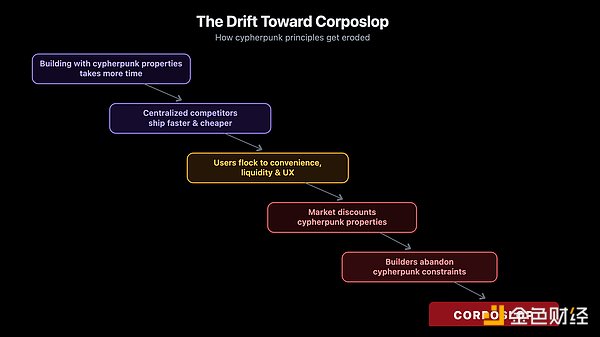
The problem is that building a protocol that satisfies these attributes requires a massive amount of time and resources. And when it's finally launched, most users don't care. Competitors who take the centralized shortcut launch faster and capture more usage. Users rarely pay directly for these underlying attributes, but they benefit from the structure in the long run. The contradiction he describes is real: building a system that conforms to cypherpunk principles requires far more work, but the market often doesn't reward this extra effort. Ordinary people wake up in the morning without thinking about censorship resistance or cryptographic safeguards. Most people choose software without considering whether the code is open source or whether the system relies on multisignature or least-trust contracts. Users tend to choose products with the best user experience, deepest liquidity, strongest network effects, and most practical functions. I wish Vitalik's blog would become required reading in schools (I hope that will happen someday), or that Erik Voorhees could speak at every university in the world, telling people why cypherpunk ideas are important. But we don't live in that kind of world. People can definitely feel it: something in society is broken. They see algorithms designed to incite emotions and chase short-term dopamine, not long-term value; rules are constantly being rewritten. They see companies collecting massive amounts of personal data, only to repeatedly abuse and resell it. They see movie studios constantly releasing 30 sequels to *The Avengers*, yet unwilling to take risks for new ideas. They see large companies loudly supporting Diversity, Equity and Inclusion (DEI) in 2021, only to openly mock it in 2025 when the tide turns. Vitalik describes this phenomenon in one word: Corposlop. On the surface, these companies present a glamorous and "respectable" brand, but at their core, they are soulless, pursuing only power, traffic, and profit. This kind of bandwagon homogenization is both evil and tedious. The cypherpunk principles of open source, censorship resistance, privacy, and trusted exits were originally designed to prevent systems from sliding into incentive mechanisms that foster Corposlops. The problem is: building systems with these attributes is more difficult, and the market usually doesn't reward this extra cost. Over time, developers have a strong incentive to completely abandon cypherpunk constraints, and the system slowly becomes locked up and exploitative, ultimately turning into a Corposlop.
Most people believe that competition makes companies follow the rules. The reality is that what truly makes a system follow the rules is the user's ability to leave. When leaving is credible, intermediaries cannot arbitrarily rewrite the rules or endlessly extract value; otherwise, users will simply leave. When the right to leave disappears, the system will slowly move towards control and exploitation, a process often so gradual that users are completely unaware.
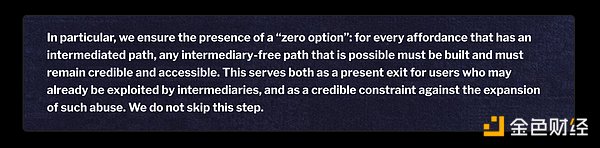
I will explain its specific manifestation in Ethereum in more detail in another article. For now, you can simply understand it as: removing the prerequisite of "requiring permission" at any layer of the entire technology stack.
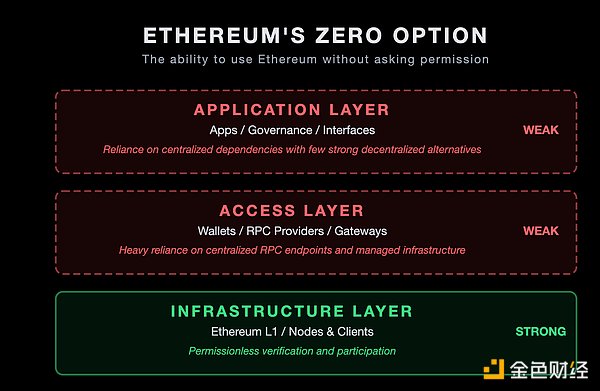
This dynamic is not unique to Ethereum. In fact, we have seen similar versions in the history of the Internet.
The Internet proves that open infrastructure alone is not enough to protect user sovereignty. The underlying layers of the Internet (HTTP, TCP/IP, DNS) are open. At the access layer, users can still switch between Chrome, Safari, Firefox, and Brave.
Even with Chrome's dominance, browsers dare not go too far (charging fees, excessive advertising, etc.) because users retain the ability to leave. The real breakdown of the internet occurs at the application layer. Social networks, video platforms, marketplaces, and communication tools have all become centralized platforms controlled by single companies. Leaving these platforms often means losing social relationships, audiences, and data. The underlying internet infrastructure remains open, but the application layer where users truly live is not. The lesson is: strong infrastructure and access layers alone are far from sufficient. If zero-options at the application layer disappear, the system will ultimately become centralized. Ethereum faces similar risks. For example, if most liquidity and integration revolve around centralized assets like USDC and USDT, then Circle and Tether will become structural control points of the network. If they freeze addresses and intercept transactions, most of the ecosystem's functionality will become unavailable to you. Decentralized alternatives may still exist, but without sufficient integration, they lose their economic viability. By then, the two companies will effectively control whether users can use most of Ethereum's features, and then the Corposlop process will begin… The Lessons of Email Email demonstrates how a powerful zero-option mechanism can constrain intermediaries. Because email protocols are open and interoperable, users can switch providers without losing access to the entire network. This constraint shapes the behavior of service providers. Even Google—a company focused on maximizing advertising revenue and even having removed its "Don't be evil" slogan—doesn't dare charge for Gmail or insert ads between individual emails. If it did, users could move to Outlook, Proton, or other providers and still communicate with everyone who uses email. But we can still do better than email. Zero options exist in theory, but are not credible in practice. Anyone can set up their own mail server, but emails sent from independent servers are often flagged as spam by large service providers. SMS demonstrates another failure model: SMS still exists today, but the social layer has abandoned it. In the US, sending a green text message can even lead to social ostracism. This illustrates that simply retaining the zero option itself is insufficient. The system must remain usable and widely adopted. If users completely abandon the infrastructure, the right to opt out becomes meaningless. The balance of power is crucial. The zero option cannot be treated as a niche ideological project reserved for the most hardcore cypherpunks. It is a structural pillar that keeps the entire system honest. This is where the Ethereum Foundation can play a unique role: it can invest in the parts that the market itself is least likely to fund: open infrastructure, permissionless access, decentralized assets, privacy tools, and applications that retain trusted self-sovereign exit paths. It can also support the intellectual and cultural work needed to sustain these systems: research, education, coordination, and explaining to the public why these principles are important. In other words: the foundation can safeguard the zero option. Some argue that the correct strategy is to first lure users in with a "Trojan horse" approach, then implant cypherpunk values later. The logic is: focus on widespread adoption first, and then decentralize once the scale is large enough. The problem is: this is almost impossible in reality. Once convenience, liquidity, and network effects are concentrated on a system that takes centralized shortcuts, these shortcuts become extremely difficult to remove, and the ecosystem gradually solidifies. What starts as a temporary compromise eventually becomes the system's permanent architecture. However, this doesn't mean everyone in the ecosystem should suddenly focus solely on Zero Option. Ethereum still needs developers to drive adoption, improve the user experience, connect with institutions, and make pragmatic trade-offs—these are unacceptable at the very edge of self-sovereignty. If no one does these things, users will simply switch to a better system. Widespread adoption isn't a distraction from Zero Option, but rather part of its power. The difficulty lies in the fact that both sides must exist simultaneously. These two roles shouldn't conflict, but rather reinforce each other, sharing a common goal—we're on the same team, the Ethereum team. If the goal is simply to recreate another fintech platform, none of this is necessary. There are already too many in the world. Ethereum is trying to do something much harder: build a system that offers convenience and innovation while always preserving the user's right to opt out. This balance is extremely fragile and requires constant maintenance. But if we succeed, we may achieve something the internet never truly achieved: a digital system that can grow and evolve without losing its core value of freedom from the outset.
中国央行副行长陆磊罕见提到比特币创始人中本聪,称其值得“高度尊敬”。他指出,比特币已演变为昂贵的数字资产,逐渐脱离传统货币的流通属性。
Miyuki在台湾金融科技协会(TFTA)主办的FinTechOn 2024论坛上,立委葛如钧与多位区块链行业领袖共同探讨台湾虚拟资产服务提供商(VASP)在自律方面的可能路径。自律的优势与风险成了业界和政府的关注焦点。
 Alex
Alex今年 5 月出任 EigenLayer 顾问的以太坊基金会研究员 Justin Drake 和 Dankrad Feist 于 10 月 2 日宣布辞去顾问职位,原因是为了避免与以太坊产生潜在利益冲突,并维护以太坊基金会的中立性。
MiyukiTelegram game Tomarket has lifted some airdrop bans on players previously accused of cheating, but key details remain unclear, such as the number of reinstated players, token listing date, and total supply. Could more adjustments be on the horizon?
 Catherine
The lawyer claims winners were chosen for their stories, not randomly, making this an unregistered lottery. It's unclear if Musk or America Pac members might face jail if charges proceed.
 Kikyo
KikyoOpenSea is planning a major relaunch in December 2024 to reclaim its position in the NFT market after facing stiff competition from rivals like Blur.
 Anais
AnaisGemini has launched an ad campaign emphasizing crypto's significance in the US election, with both Donald Trump and Kamala Harris discussing digital asset policies. This initiative reflects the increasing importance of crypto in political discourse and its potential electoral impact.
CatherineOpenAI is exploring a shift from a non-profit to a for-profit model, seeking guidance from California's attorney general on restructuring while maintaining its ethical commitments.
 Weatherly
Meta will share its open-source AI with the US and allies to maintain a “technological edge” over China. In partnership with tech giants like Microsoft and Amazon, Meta aims to strengthen national security and global tech resilience.
KikyoThe Global Dollar Network, backed by major fintech and crypto firms, has introduced USDG, a new stablecoin tied to the US dollar to promote stablecoin adoption globally. Issued by Paxos from Singapore, USDG aims to meet regulatory standards and encourage use in real-world transactions.
Weatherly