Author: Ekko an Source: Tiger Research Translation: Shan Ouba, Jinse Finance
Key Points
Democrats have secured a majority in both the Senate and the House of Representatives, with 54 seats in the Senate and 228 seats in the House. After two years of Republican dominance, control of the digital asset legislation agenda will shift to the Democrats.
Industry critics such as Elizabeth Warren, Sherrod Brown, and Maxine Waters are expected to head key committees. Their influence will make it more difficult to pass existing digital asset bills, and Congress's attention is expected to turn to the investigation into the Trump family's digital asset business, World Liberty Financial (WLF).
Even moderate and pro-crypto Democrats are calling for conflict-of-interest rules for public officials.
Negotiations surrounding these provisions could prolong the CLARITY bill's progress beyond expectations. Republicans will focus on preserving the GENIUS bill rather than pushing for new legislation. They can still leverage the 60-vote threshold required to end lengthy Senate debates and the threat of presidential veto power to obstruct Democratic proposals. President Trump's agenda supporting encryption will face greater constraints. The direction and pace of regulation will depend on how Democrats pursue the Trump family's business interests and how the White House responds.
1. What are the results of the US midterm elections?
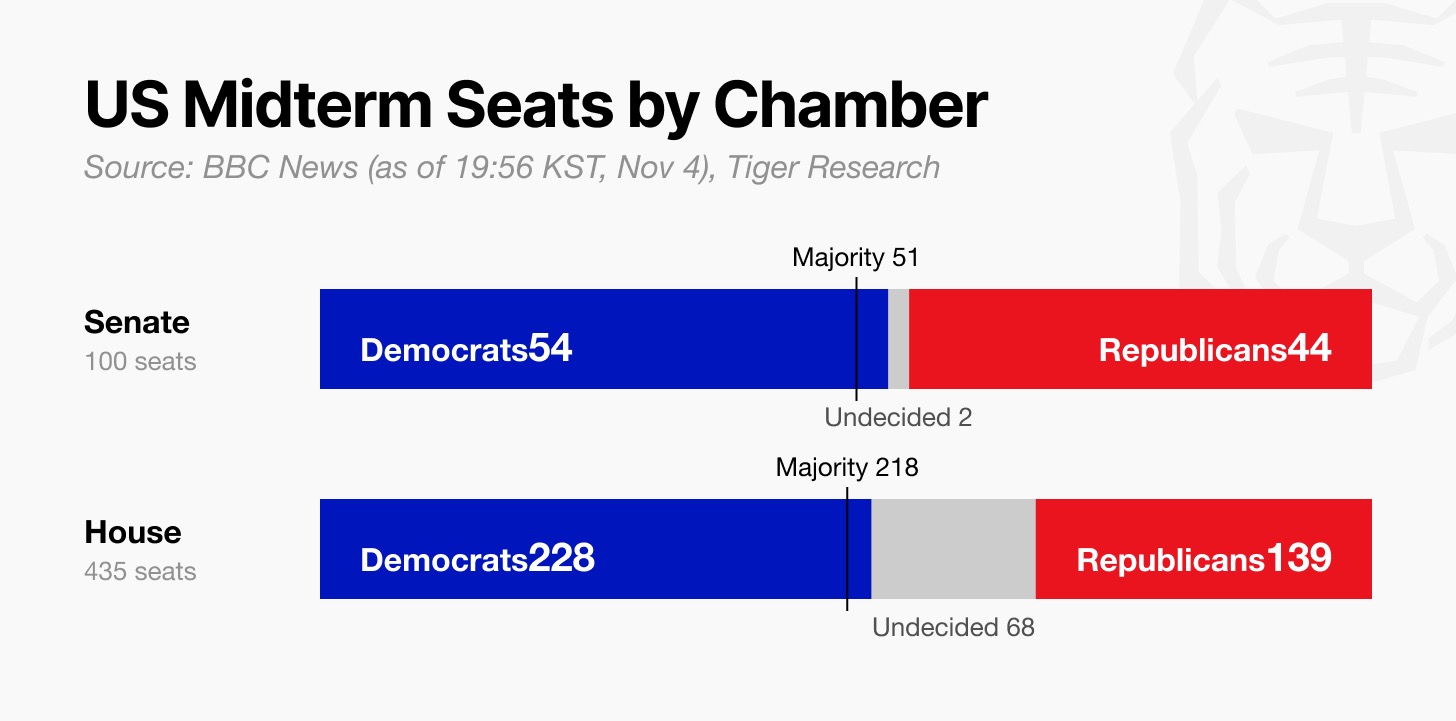
The Democrats have won 54 of the 100 seats in the Senate and 228 of the 435 seats in the House of Representatives, exceeding the majority threshold of 51 and 218 seats respectively. This result means that the Democrats have gained a net increase of 7 seats in the Senate and 25 seats in the House. Currently, there are still 2 undecided seats in the Senate and 68 undecided seats in the House, but the Democrats' control of both houses is established.
The new Congress will be inaugurated in January 2027, at which time the Democrats will control the legislative agenda and committee chair positions.
The new Congress will be inaugurated in January 2027, at which time the Democrats will control the legislative agenda and committee chair positions.
This outcome is significant for digital assets because two major pieces of legislation that shaped the market over the past two years were both Republicans: the GENIUS Act and the CLARITY Act. Democrats will now have the ability to block new legislation and re-examine the regulatory framework established by Republicans, which will have a profound impact on the market. 2. The Position of Elected Democrats on Digital Assets Based on past statements and voting records, the Democrats elected to this Congress can be roughly divided into three categories: Traditional Critics: They believe that the digital asset industry is inherently designed to circumvent regulation. Moderates: Support clear rules but insist on restrictions on conflicts of interest for public officials and stronger consumer protections. Smaller pro-crypto camp: Hope to bring the industry into a regulated financial system through a clear legal framework. For the industry, the challenge lies in the fact that critics are likely to secure chair positions on committees that decide which bills can proceed. Moderates and pro-crypto Democrats are not unconditional allies. They also want Congress to address the Trump family's digital asset business, so the current bill is unlikely to pass unchanged. 2.1. Critics May Take Control of Key Committees This election has strengthened the position of industry critics within the Democratic Party. Representatives such as Elizabeth Warren, who ran in the 2020 Democratic presidential primaries, believe that digital assets are an industry born to circumvent regulation. They have consistently opposed legislation friendly to the industry. With the Democrats becoming the majority party, these representatives are more likely to take control of the committees responsible for digital asset legislation. Newly elected Senator Sherrod Brown, a three-term Ohio senator and chairman of the Senate Banking Committee, is one of the industry's most prominent critics. During his tenure as committee chairman, he blocked the advancement of crypto legislation. At a 2021 hearing on stablecoins, Brown argued that stablecoins lacked both decentralization and transparency. He still won the election, despite crypto industry-backed political groups spending approximately $63 million to try and prevent his return to the Senate. This history makes it difficult for the industry to expect a more favorable reception. Maxine Waters, a Representative since 1991, is widely considered the leading candidate to chair the House Financial Services Committee. Waters is currently the ranking Democrat on the committee. She served as chair from 2019 to 2023, becoming the first woman and the first Black person to hold the position. With the Democrats regaining control of the House, she is expected to return to the post. When the GENIUS bill passed the Senate, Waters criticized it as "full of flaws," calling the bill a misnomer and lacking any real "genius." She also cited the recent Binance hack as a warning that the crypto industry cannot function without strong accountability. With these members of Congress leading key committees, the digital asset agenda that Republicans have been pushing forward over the past two years will face significantly greater resistance. Their primary target is likely World Liberty Financial, the Trump family's digital asset business. It was previously reported that an investor with ties to the Abu Dhabi royal family acquired a 49% stake in WLF for approximately $500 million four days before Trump's inauguration. Democrats have called for Senate hearings on this matter. Congress may also investigate why the SEC withdrew more than a dozen digital asset enforcement cases, an investigation Waters has requested. Senate Democrats may further pressure regulators by delaying the confirmation of nominees for key positions at the SEC and CFTC. Therefore, in the first half of 2027, headlines in the digital asset field will likely revolve more around investigations into WLF affiliates and the subpoena of the SEC chairman, with legislative progress taking a backseat. 2.2. Moderates Support Clear Rules, But with Conditions Moderate Democrats generally support digital asset legislation, but also want to strengthen consumer protection and impose conflict-of-interest restrictions on public officials. If the CLARITY Act returns to a Democratic-led Congress, their demands may determine the final form of the bill. Representative Ro Khanna has long been a supporter of clear rules for digital assets. In 2022, he co-introduced the Digital Goods Exchange Act, emphasizing consumer protection and transparency. In 2025, he stated that Congress could pass both stablecoin legislation and the Clarity Act that year. However, in the same forum, he also argued that elected officials should not hold memecoins. Khanna is also considered a potential presidential candidate in 2028, giving him even more reason to emphasize the conflict of interest issue for public officials. Newly elected Senator Roy Cooper, a former governor of North Carolina, has no federal voting record. However, during his campaign, he met with industry representatives and stated that the industry wanted to operate legally. He believes businesses simply want to understand the rules and be confident that they won't change overnight. His stance supports both regulatory stability and consumer protection. As these lawmakers enter negotiations, they are likely to demand amendments to existing legislation. Moderates may make provisions to prevent public officials from using digital assets for personal gain a prerequisite for their support. Khanna's "Anti-Crypto Corruption Act" is one example. He also launched an investigation demanding access to WLF's records of dealings with the UAE. Lawmakers like Cooper may push for additional safeguards against illicit finance and stronger consumer protections. However, provisions targeting the president's family could prompt Trump to veto the legislation. Therefore, the CLARITY bill may stall, with lawmakers repeatedly tug-of-war between the current text and the changes desired by moderate Democrats. 2.3. Pro-Crypto Democrats This group includes members of the House who voted for the CLARITY and GENIUS bills, as well as those who campaigned on establishing clear rules for digital assets. In a Democratic-dominated Congress, they are potential allies to the industry, but currently lack the capacity to control relevant committees. Representative Ritchie Torres is one of the most active advocates for digital asset legislation within the Democratic Party. He co-introduced the CLARITY Act and the Blockchain Regulatory Certainty Act, spearheaded a letter to his colleagues urging support for the CLARITY Act before its 2025 House vote, and voted in favor of the GENIUS Act. At an SEC oversight hearing in February 2026, Torres stated that he has always been optimistic about digital assets and emerging technologies such as blockchain. However, his support has its limits. In January of this year, after suspicious transactions betting on Maduro's removal from office appeared on Polymarket, he and 30 other members of Congress introduced legislation to prohibit public officials from using non-public information to trade in prediction markets. Newly elected Senator Chris Pappas voted in favor of both the CLARITY Act and the GENIUS Act during his tenure in the House of Representatives. After the vote, he stated that for the United States to remain at the forefront of innovation, it must embrace new technologies and establish clear rules and safeguards for digital assets. He called these two bills a starting point for protecting consumers and supporting the growth of small businesses. Meanwhile, Pappas expressed deep concern about President Trump's disregard for established ethical standards and legal requirements, calling for stronger anti-corruption rules for public officials. In May 2026, he also called on the House to launch an investigation into corruption and insider trading in the market prediction industry. These lawmakers are likely to push for a conflict-of-interest clause in the CLARITY bill to garner support from other Democrats. Torres and Pappas both support the bill, arguing for measures to prevent public officials from using their positions for personal gain. Concerns about the Trump family's digital asset business were a major obstacle in the September Senate vote, when no Democrats voted in favor. Addressing these concerns would remove one of the main reasons Democrats opposed the bill. However, their ability to steer the process remains limited. Industry critics are likely to control key committees, and provisions targeting the president's family may face White House resistance. For the industry, the next two years will largely depend on whether pro-crypto Democrats can use ethical clauses to facilitate a compromise acceptable to both sides. 3. Elected Republicans: Unchanged Agenda, Decreased Control The Republicans elected to this Congress continue to support private stablecoins, viewing them as a means to maintain the dollar's global dominance. They also oppose government-issued central bank digital currencies (CBDCs). However, with the defeats of several industry-friendly Republicans, including Senator Jon Husted and House Digital Assets Subcommittee Chairman Bryan Steil, their influence has been weakened. 3.1. The Lawmakers Behind the GENIUS and CLARITY Acts Senator Bill Hagerty and Representative Glenn Thompson, who were successfully re-elected, participated in drafting the framework for stablecoin legislation and the CLARITY Act. With Republicans losing their majority in both houses, their focus will shift to preserving the legislative gains they have made. Republican lawmakers will then spend more time defending existing policies. They are likely to focus on protecting the GENIUS Act, using the 60-vote threshold needed to end the lengthy Senate debate and the threat of Trump's veto to thwart Democratic attempts to tighten regulations. They may also support the SEC and CFTC in developing rules under their existing mandates, allowing policy work to continue without the need for new legislation. 3.2. Staunch Opponents of CBDCs Opposition to CBDCs is one of the clearest consensuses among elected Republicans. They view digital asset policy as a way to develop the industry while limiting government surveillance of financial activities. These lawmakers support private sector digital assets but are strongly opposed to a digital dollar issued directly by the government. They believe CBDCs could become tools for monitoring individual transactions and advocate for private stablecoins as an alternative. Their goal is to ban CBDCs through legislation. With Democrats controlling Congress, this path is effectively blocked for the next two years. Trump's January 2025 executive order remains the primary basis for a federal ban on the issuance of CBDCs in the United States. Because a future president could overturn the executive order, Republican lawmakers have been trying to enshrine the ban in law. Representative Tom Emmer's "Anti-CBDC National Surveillance Act" passed the House in July 2025 but failed to pass the Senate. With Democrats gaining control of both houses of Congress, their prospects have further dimmed. Therefore, these lawmakers are likely to focus on overseeing the implementation of the GENIUS Act. For example, they may review whether the Treasury Department's implementation rules will introduce mechanisms that allow the government to monitor stablecoin transactions. As long as the executive order remains in effect, the likelihood of the US launching a CBDC for the remainder of Trump's term (until January 2029) is low. Their attention may therefore shift to protecting the privacy of stablecoin users. 4. Democrats Control the Congressional Agenda Democrats have secured a majority in both houses. The remaining election results will determine the size of the majority, but control of Congress has already changed hands. From their current standpoint, investigating the Trump family's digital asset business will take precedence over passing new legislation. Democratic leaders on the relevant committees had already prioritized this business before the election. As the majority party, they will have the power to issue subpoenas. Even if Democrats revive the CLARITY bill, they are likely to demand stronger consumer protections and restrictions on conflicts of interest for public officials. Concerns about the Trump family's digital asset business were a major obstacle in the September Senate vote, when the bill received no Democratic support. Republicans will focus on defending the GENIUS bill and blocking Democratic proposals to tighten regulations. As the minority party, they face significant challenges in pushing new legislation, but still wield considerable obstruction power. Most controversial bills require 60 votes to end lengthy Senate debates, and legislation sent to the president's desk may be vetoed by Trump. The path to the CLARITY bill is now even more difficult. As a key political driver of the government's pro-crypto agenda, Trump's room for maneuver will also narrow. Republican policy goals remain largely unchanged, but the pace of progress is likely to slow. To determine the direction and pace of regulation, the industry needs to pay attention to how senior Democrats pursue the Trump family's digital asset interests and how the White House responds.


 Weatherly
