Aethir Sells $60 Million in Network Nodes in Record Time
Aethir sold $60 million of Checkers nodes in under 30 minutes, aiming for decentralization. Its low-barrier approach includes NFT licenses and easy software operation.
 Miyuki

Authors: Henry Kim, Ryan Yoon Source: tiger-research Translation: Shan Ouba, Jinse Finance
The decentralized finance (DeFi) ecosystem has all the underlying financial modules, including swaps, lending, wealth management returns, and derivatives, but it lacks a practical application layer that allows ordinary users to easily access these products. This article analyzes the crux of why past products have consistently failed to simplify wallet operations and eliminate cross-chain barriers, and details how defi.app fills this industry gap and creates differentiated products.
DeFi's underlying infrastructure is maturing, but terminal products that can retain ordinary users remain scarce; traditional financial platforms like Robinhood are constrained by regulations and cannot engage in self-custody and high-leverage derivatives businesses.
Since Ethereum's birth in 2015, DeFi has undergone ten years of development, but its popularization has stagnated. The problem is not in product functionality, but in the poor user access barrier.
A 2023 survey by Consensys and YouGov showed that 93% of respondents worldwide had heard of cryptocurrencies, but only 8% were familiar with Web3 and DeFi. Since then, the industry situation has not improved substantially.
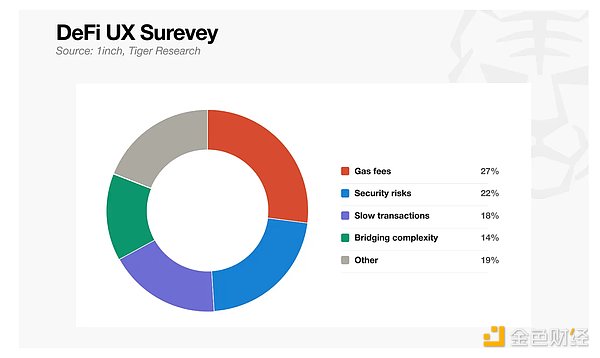
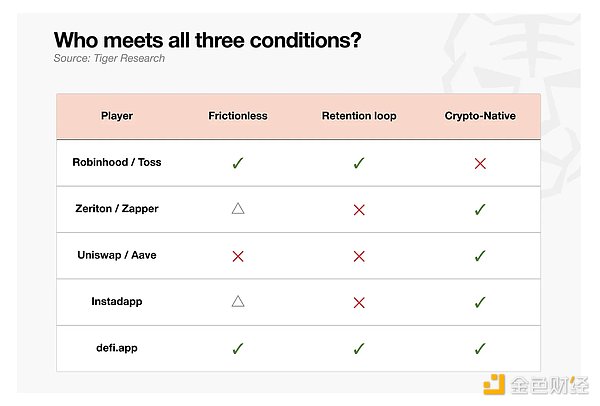
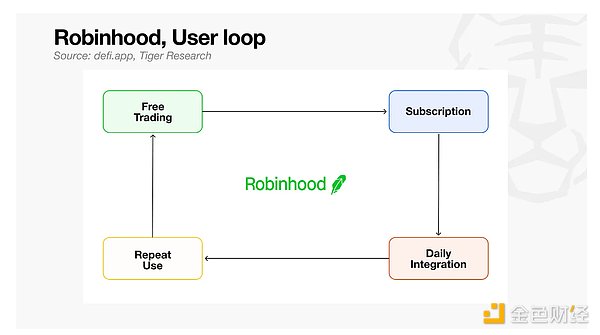
In 2025, a 1inch survey listed four major pain points in DeFi usage: Gas fees (27%), asset security risks (22%), slow transaction confirmation (18%), and cumbersome cross-chain operations (14%). These are all user experience issues, not product logic flaws. Robinhood revolutionized the traditional securities industry by achieving zero-commission stock trading and one-click mobile trading in an era of high brokerage fees and cumbersome account opening processes, lowering the barrier to entry for wealth management through a minimalist experience. However, DeFi services are inherently different, covering high-leverage derivatives, on-chain wealth management, and asset self-custody. These businesses are subject to regulatory restrictions, preventing licensed traditional financial platforms from operating compliantly. Robinhood has already launched some cryptocurrency spot trading, but self-custody and high-leverage products without access restrictions remain outside its compliant operating scope. Therefore, the goal of DeFi implementation is not to replicate Robinhood's business model, but to create an equally smooth user experience in areas where Robinhood cannot operate. II. Underlying Reasons for the Failure of Similar Products in the Past Zerion, Zapper, and Instadapp (Avocado) all simplified the entry barrier to DeFi by relying on aggregated dashboards and abstract smart accounts. Their product direction was correct, but user retention consistently fell short of expectations. The core weakness: lack of a sustainable user retention loop. After platform token and points incentive activities ended, users flocked to new airdrop reward projects. While the products overcame technical barriers, they couldn't retain users without subsidies, falling far short of the industry benchmark of 9.2% 30-day retention for traditional financial apps. Optimizing the usage threshold and cultivating users' daily opening habits are two independent product logics. Robinhood's user retention relies not only on zero commissions, but also on push notifications, asset statement analysis, and daily activity rewards to form a self-returning loop. Past DeFi products lacked corresponding product design capabilities and could only rely on subsidies to maintain user activity. To gain a foothold in the application market, platforms must meet three conditions: Zero-barrier access: no chain distinction, no separate gas payment, and no more complex cross-chain operations; Long-term retention mechanism: driving users to return spontaneously even after subsidies end; Fully encrypted native business: Fully launching self-custodied and high-leverage products that licensed financial institutions cannot operate compliantly. Only by simultaneously meeting these three standards can a platform become an industry benchmark.
defi.app integrates cryptocurrency exchange, wealth management with interest, and perpetual contracts into a single client. It leverages the EIP-4337 smart account to abstractly manage gas payments, eliminating the need for users to manually store gas. The platform connects to aggregators such as 1inch and Jupiter, automatically routing transactions between EVM-based public chains and Solana, shielding users from complex on-chain logic while enabling one-click access to all types of financial products.
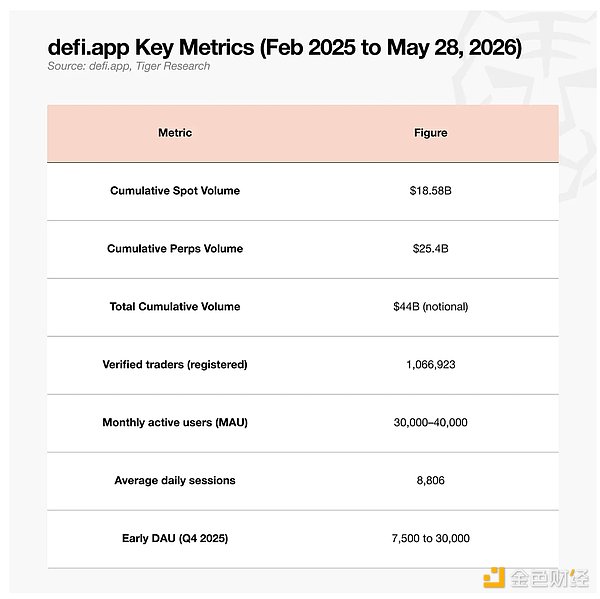
Operational data since launch: 1.06 million registered users, demonstrating outstanding new user acquisition capabilities; monthly active users stable at 30,000 to 40,000. Before the official launch of Rocket Perpetual Contracts, a considerable number of users had already been retained. The full online launch of Perpetual Contracts on June 4th has become crucial for the platform's user base to further expand.
Previously, defi.app focused on optimizing the user experience and building a retention system to compete with Robinhood, but it still lacked a third core element: exclusive crypto-native business. The Rocket Perpetual Contract fills this gap.
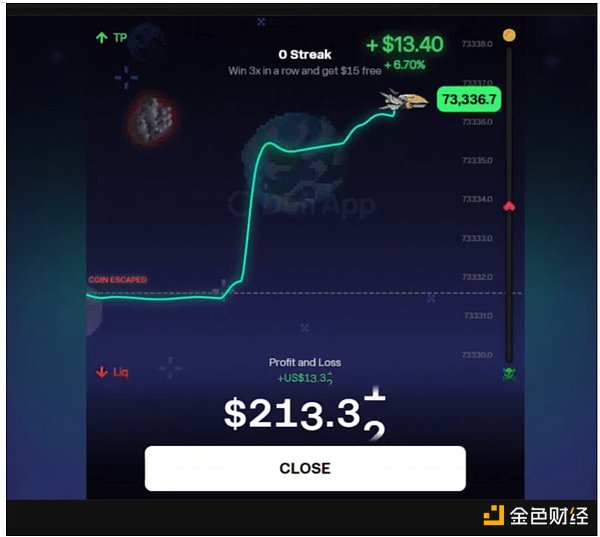
Rocket perpetual contracts support up to 1000x leverage, feature a pixelated arcade game interface, and rely on the Aark Digital oracle for instant transactions without matching. Users accumulate experience points by hitting small planets on the screen, which can be exchanged for $HOME tokens, using gamified gameplay to increase user repurchase frequency.
The 264 traders in the internal testing phase were all high-risk investors who actively entered the market. The public beta test on June 4th was the first major test to examine the retention of mass users. Whether the platform's existing 30,000-40,000 monthly active users can steadily expand is crucial.
Aethir sold $60 million of Checkers nodes in under 30 minutes, aiming for decentralization. Its low-barrier approach includes NFT licenses and easy software operation.
MiyukiDespite Ethereum's recent decline, a rare CryptoPunks NFT, Punk #7804, fetched $16.42 million, highlighting the enduring appeal of digital collectibles.
 Weiliang
Coinbase's Base blockchain faces challenges amid Ethereum's network surge, exacerbated by the meme coin craze, causing transaction disruptions and rising fees.
 Alex
AlexCCData's report highlights stablecoin market growth, with USDT surpassing $100 billion and Ethena's USDe emerging as a significant player.
MiyukiAcademics have uncovered a severe vulnerability in Apple's M-series chips, allowing hackers to access encryption keys. This "unpatchable" flaw poses a significant challenge to Apple's security infrastructure.
AlexSchwartz's cryptic tweet suggests a future XRP price of $5. SEC victories and a new trading bot add intrigue. XRP's price shows volatility.
MiyukiAIOZ Network partners with Alibaba Cloud, becoming the leading blockchain ally in their Innovation Accelerator program, aiming to revolutionize southeast Asia's blockchain landscape.
WeiliangA Binance executive, detained in Nigeria over a tax evasion case, reportedly escaped using a fake passport. The incident has raised questions about security and regulatory oversight in the crypto space.
AlexIndonesian student Sultan Gustaf Al Ghozali, known for earning $1M from selfie NFTs, raises $1.8M in a memecoin presale comeback.
MiyukiElon Musk questions Vitalik Buterin's departure from X, prompting discussions about Farcaster and the cultural impact on cryptocurrency platforms.
Weiliang