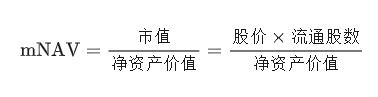
mNAV > 1 → Indicates that the market is optimistic about the company's prospects or believes the company has growth potential. The market values the company higher than its assets on its balance sheet, typically taking into account expected future growth per token.
mNAV > 1 → Indicates that the market is optimistic about the company's prospects or believes the company has growth potential. The market values the company higher than its assets on its balance sheet, usually taking into account expected future growth per token.
mNAV < 1 → Reflects market skepticism. Investors may worry about equity dilution, question management discipline, or believe that the company's digital asset exposure is failing to effectively translate into shareholder value. Essentially, mNAV is a sentiment multiplier built on fundamentals, revealing the market's belief in DAT's ability to accumulate digital asset holdings.
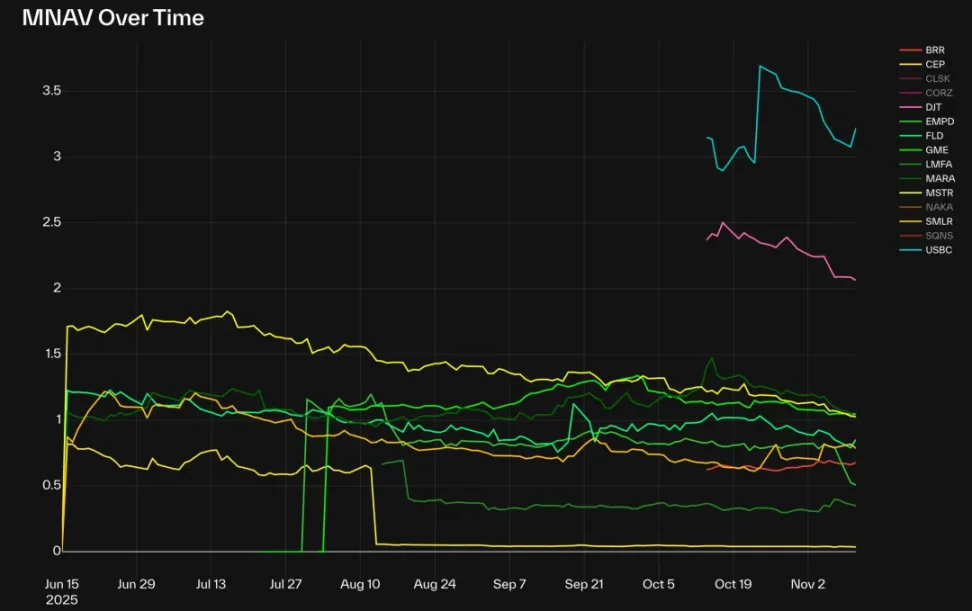
BTC DATs' mNAV Multiples (excluding CLSK, CORZ, NAKA, and SGNS)
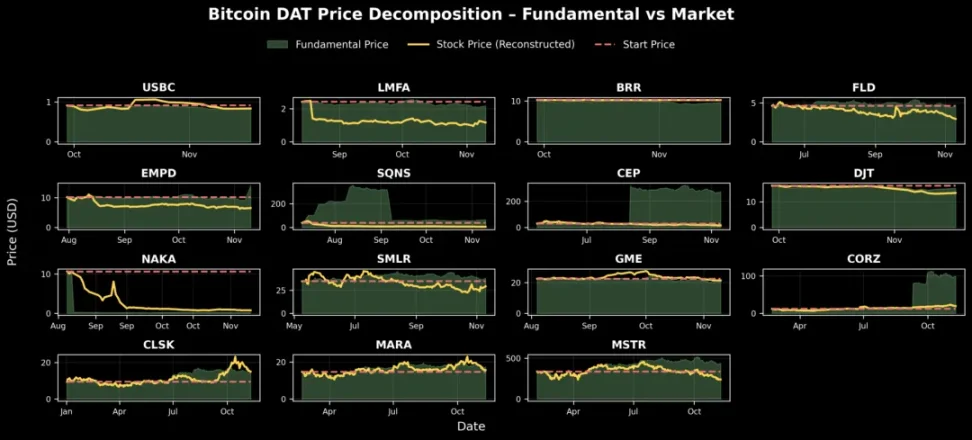
As of today, in the BTC DAT category, Strategy (MSTR), GME, and MARA are all close to 1.0 after the recent market correction. However, most other BTC DATs have mNAVs below 1.0, with EMPD having the lowest at around 0.5.
Newer DATs such as DJT and USBC currently have mNAVs of around 2-3, reflecting the speculative nature of early DATs.
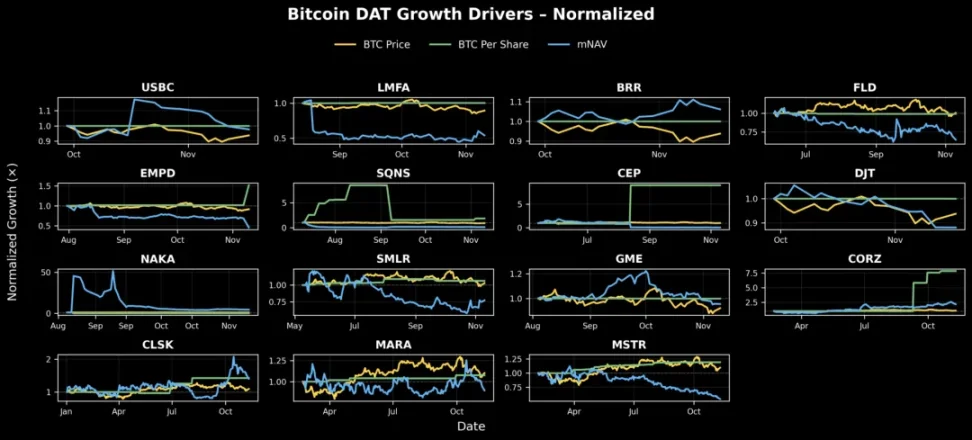
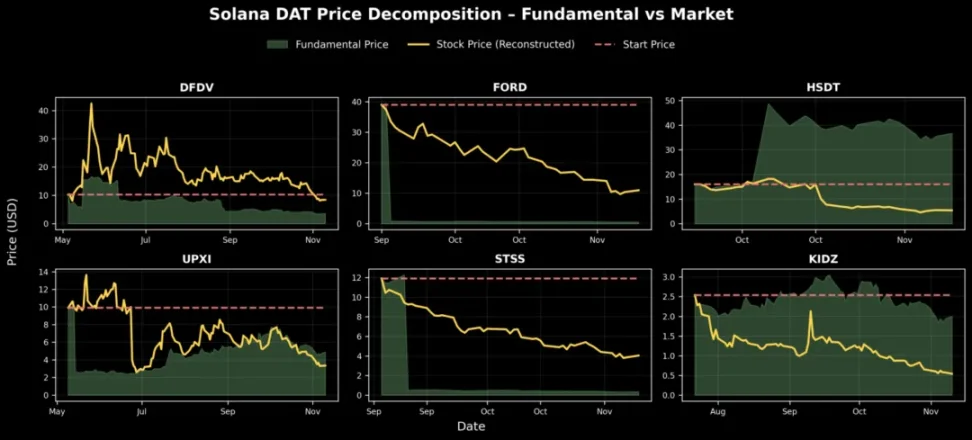
A few exceptions: CLSK is around 4 and CORZ is close to 7, both AI data center companies (formerly BTC miners), indicating that specific narratives or structural factors are still driving premiums despite overall market normalization. The ETH DAT market is similar: BMNR, SBET, and GAME are trading around 1x mNAV, reflecting fair value pricing; BTBT and COSM have higher multiples because these companies have profitable business lines beyond digital asset holdings, and the market may not consider them purely DAT-based valuations. Among the Solana DATs registered with PIPE shares, only HSDT is trading at a slight premium of 1.12x (as of November 12, 2025), while the rest are slightly below 1, indicating that market movements are largely consistent with fundamentals and have cooled down from earlier cycles. Premiums and Discounts Premiums/discounts are essentially another representation of mNAV, measuring the market's confidence in or speculation about a company's treasury value, expressed as a relative price rather than a multiple. High premiums indicate leverage, strong sentiment, or excess operating returns, while discounts typically reflect concerns about equity dilution or weak capital discipline. The data dashboard reveals extreme premium cases of approximately 800% for companies like COSM and CORZ, largely due to market valuations based on their existing core businesses, rather than their DAT (Data, Aid, and Technology) attributes. Assessing DAT's intrinsic growth requires tracking both digital asset holdings and the number of outstanding shares. A healthy DAT aims for growth in two metrics: increasing digital asset holdings to expand the underlying asset base and raising funds through new share issuances to support growth. While new share issuances dilute existing shareholders' equity, this dilution can be beneficial if asset growth outpaces new share issuance. A key derivative metric, digital asset per share, measures how much digital asset is effectively represented per share, reflecting the extent of shareholder exposure amplification. An increase in digital asset per share indicates that proceeds from issuance are used for asset growth rather than offsetting equity dilution. Of the 30 DATs tracked, few have managed to grow their digital assets per share along a steady upward trend. Notable exceptions include Strategy (MSTR), BMNR, HSDT, ETHM, BTCS, CEP, and UPXI. Experience shows that many DATs, even those with strong early performance, experience sharp equity dilution due to large-scale new share issuances. In contrast, the aforementioned companies have maintained consistent growth without significant declines, indicating a more prudent strategy in balancing capital issuance and asset accumulation.
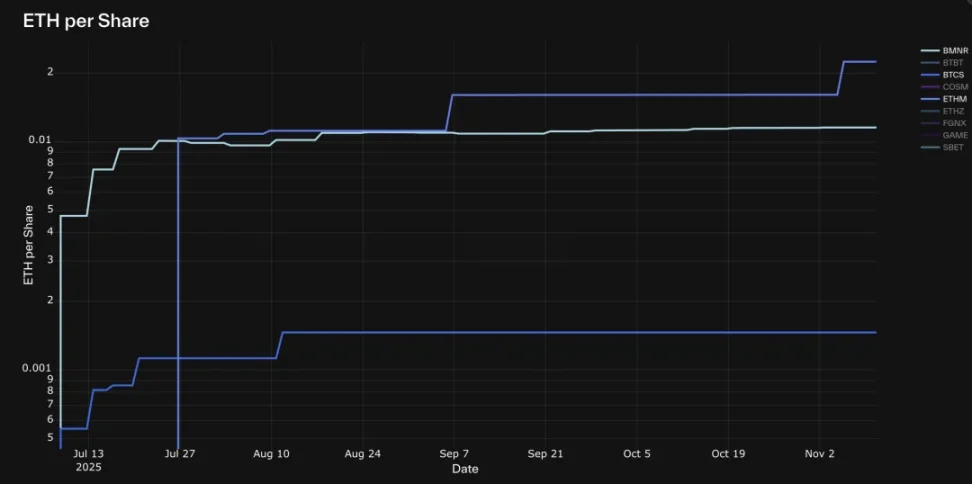
ETH DATs with continuously increasing assets per share: BMNR, ETHM, BTCS
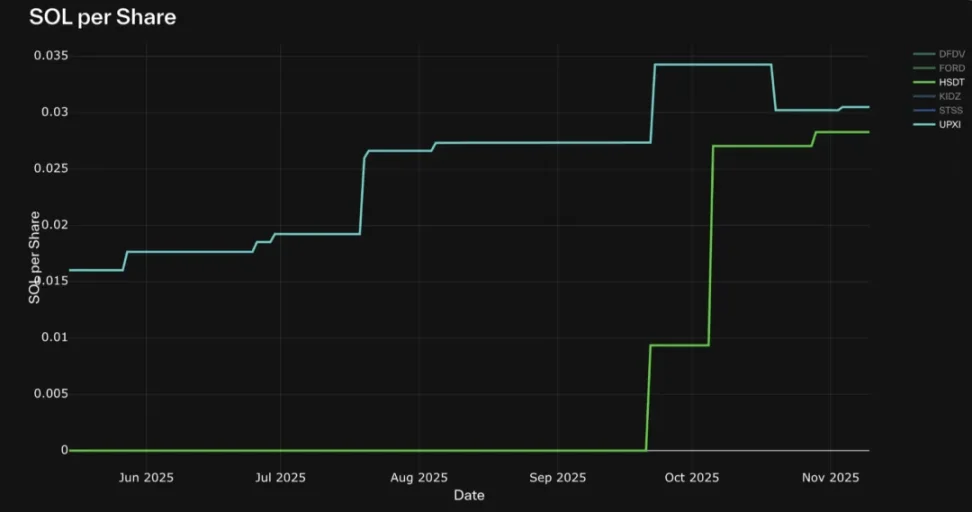
SOL DATs with continuously increasing assets per share: HSDT, UPXI
Other market indicators
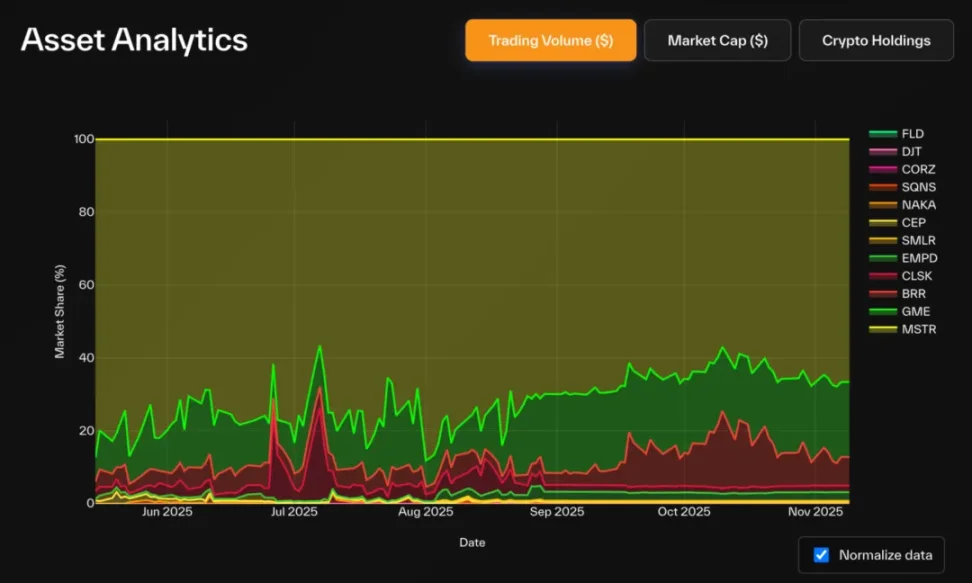
BTC DATs Trading Volume (USD) Market Share
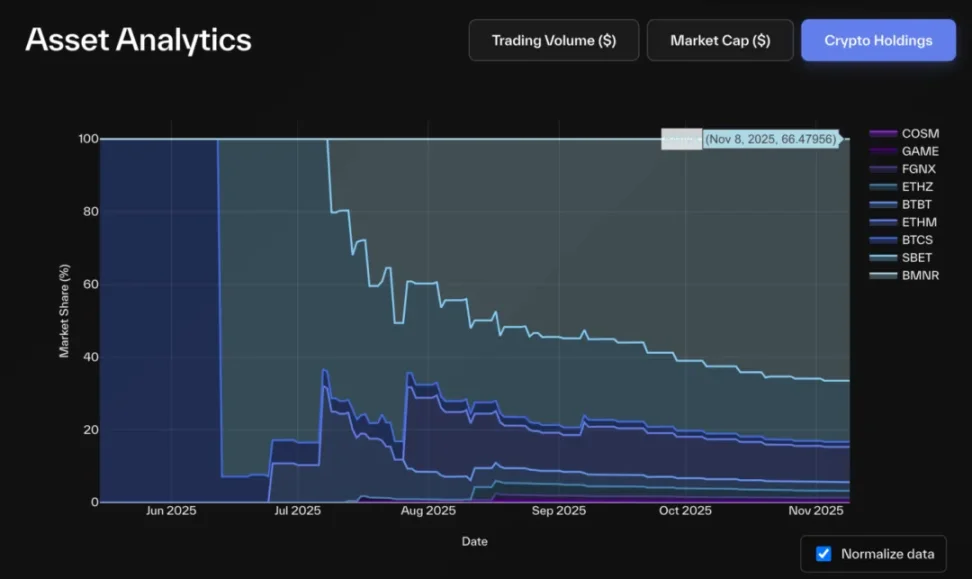
ETH DATs Crypto Asset Holding Market Share
In the ETH DAT sector, Bitmine also dominates: holding over 66% of the total ETH DAT holdings (approximately 2.9% of the ETH supply), accounting for...
Solana DAT has a 68% market capitalization and 85% trading volume. SBET, the second largest player, holds approximately 16-20% of ETH's holdings and market capitalization, while BTBT ranks third (approximately 6%). The Solana DAT market has relatively low concentration: FORD leads with 45% market capitalization and 44% SOL holdings. HSDT, DFDV, STSS, and UPXI each hold approximately 13-14% of the holdings, but Solana Company (HSDT) leads its peers with approximately 22% market capitalization. 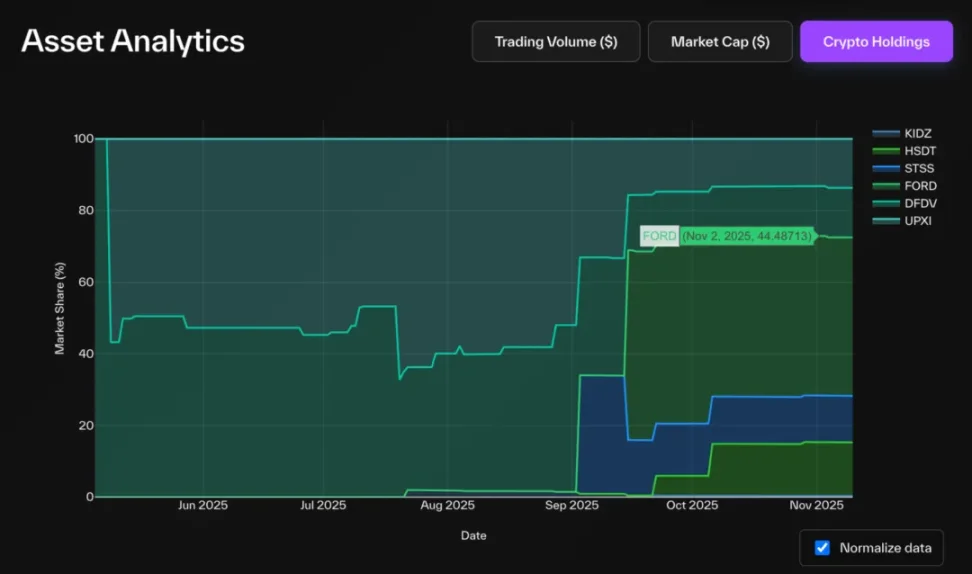
SOL DATs Crypto Asset Holding Market Share
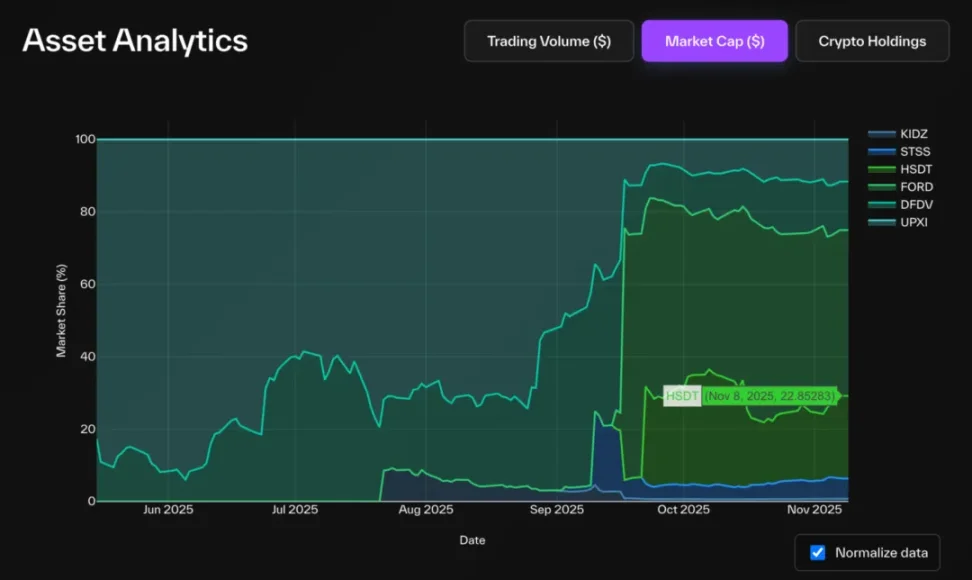
SOL DATs Market Cap Market Share
Interestingly, in terms of trading volume, the situation is the opposite: DFDV and UPXI are more active than FORD.
SOL DATs Market Cap Market Share
Interestingly, in terms of trading volume, the situation is the opposite: DFDV and UPXI are more active than FORD.
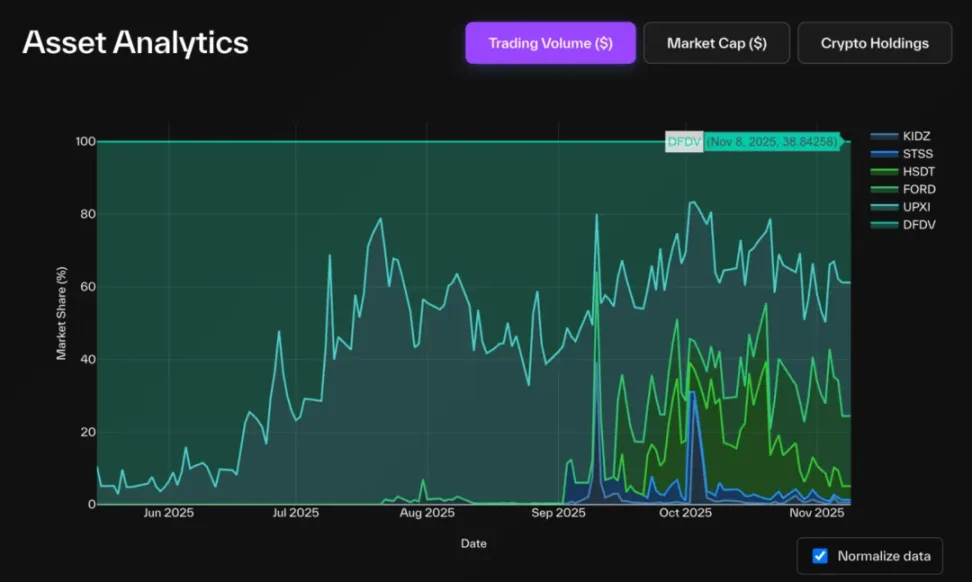
SOL DATs Trading Volume (USD) Market Share
2. Limitations and Misconceptions
While the definitions are simple, tracking these basic metrics is not easy—mainly because the data in the SEC filings is neither real-time nor as standardized as on-chain data.
The best source for balance sheet accounting format is the 10-Q form, but it's only published quarterly. Many companies use custom-designed or branded PDFs, making extraction more difficult. Even when data is consistently reported in the same format, it's often embedded in text files requiring semantic parsing. Furthermore, the formatting of reporting items varies from company to company, which is understandable given differences in equity structures and financial assets. Sources for holdings updates can be highly fragmented—some companies don't even file with the SEC, instead disclosing changes via Twitter, press releases, or media interviews. Nevertheless, most stock market metrics (such as price and volume) are fairly standardized. However, the number of outstanding shares remains difficult to track—companies don't need to report daily through filings, and many data dashboards rely on third-party APIs that retrieve data from market makers or banks, often with delays of several days. One best practice comes from Bitmine, which reports its digital asset holdings weekly (sometimes more frequently) via 8-K filings. When interpreting DAT data, be aware of how these data challenges can distort metrics: Low-frequency (monthly/quarterly) updates cause NAV to become outdated, inflating mNAV or premiums. Some DATs hold DeFi tokens, NFTs, other stocks, or semi-liquid assets, complicating asset valuation. Share updates: Failure to file large-scale issuance or buyback declarations will affect estimated market capitalization, mNAV, premium/discount, and digital assets per share. 


 Anais
Anais


