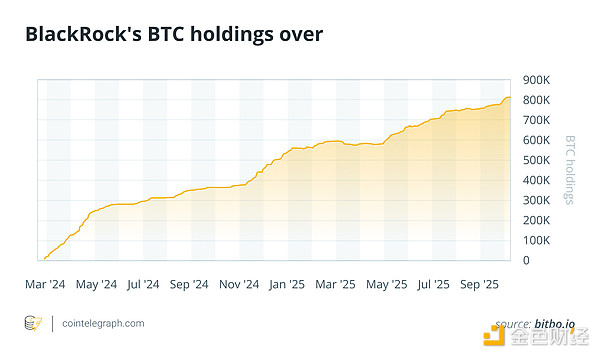
Everyone "knows" that whales trade Bitcoin, and they can still shake up prices. Since the advent of spot exchange-traded funds (ETFs), Bitcoin's price movements have often depended on the inflows and outflows of ETFs. It also depends on the actual supply of Bitcoin available for trading on exchanges, rather than the intentions of any single wallet. For example, BlackRock's iShares Bitcoin Trust ETF (IBIT) currently holds over 800,000 Bitcoins on behalf of thousands of investors. The liquidity of this ETF is comparable to that of any single holder. Taking derivatives contracts and broader risk appetite/risk aversion into account reveals the true picture. This article discards the myths surrounding whale trading, explains the truly important market mechanisms, and provides a quick checklist so you don't have to chase every trending news item about "whales just made a move" to understand market trends.
What kind of investor is considered a "whale"?
In the cryptocurrency space, a "whale" refers to an on-chain entity holding at least 1,000 Bitcoins. Many dashboards specifically track Bitcoin holders in the range of 1,000 to 5,000 Bitcoins.
An entity refers to a group of addresses controlled by the same owner, not a single wallet. Analytics firms use heuristics such as common spending and change detection to group addresses to ensure that the same holder is not counted twice in different deposits.
This distinction is crucial because the raw number of addresses on a "whale" list can exaggerate concentration. Large service providers such as exchanges, ETF custodians, and payment processors operate tens of thousands of wallets, and tagging clusters helps differentiate these wallets from end-investors. Research from academia and industry has long cautioned against drawing conclusions solely from address data. Methodologies vary. Some whale metrics include service entities and companies such as exchanges, ETFs, or custody pools. Others exclude known exchange and miner clusters to focus on genuine investor whales. In this article, we use an entity-based convention (≥1,000 BTC) and explicitly indicate whether service wallets are included or excluded to understand exactly what each metric means. How concentrated is Bitcoin currently? Who holds it? Since the launch of U.S. spot ETFs, a significant portion of the visible Bitcoin supply has shifted to custodial pools. BlackRock's IBIT alone holds approximately 800,000 Bitcoins, making it the largest known holder. However, these Bitcoins are not held in a single account but are held in custody on behalf of numerous investors. Issuers collectively hold approximately 1.66 million Bitcoins in U.S. spot ETFs, representing about 6.4% of the total supply of 21 million Bitcoins. While underlying ownership remains widely distributed, this execution model has led to the centralization of trading. Enterprises are another large group. Strategy recently disclosed holding approximately 640,000 Bitcoins. Miners, exchanges, and undisclosed long-term holders constitute the remaining largest groups. Meanwhile, the tradable liquidity on centralized exchanges continues to shrink. Glassnode's tracking data shows that its circulating supply fell to approximately 2.83 million Bitcoins in early October 2025, a six-year low. With fewer tokens on exchanges, large orders are more likely to influence prices. Note that "top address" rich lists often exaggerate cryptocurrency concentration, as large service providers operate tens of thousands of wallets. Clustering at the entity level and labeling wallets of ETFs, exchanges, and enterprises provides a clearer picture of the actual controllers of cryptocurrencies. Can whales reverse market trends intraday? Large, aggressive orders can dramatically impact price volatility, especially when order book depth is insufficient. During periods of market volatility, liquidity often dries up, allowing large sell orders to penetrate the order book and create significant shocks. This is a fundamental market microstructure. For this reason, many large holders avoid "market impact." They split orders or quietly execute large trades through over-the-counter (OTC) channels, minimizing the impact of their trading activity and information leakage. In fact, a significant portion of large trading activity occurs outside of exchanges, reducing the visible impact of a single wallet on public trading venues. Whales don't always "buy" at different times. Research combining trading and on-chain data suggests that large holders tend to sell during periods of market strength, especially when smaller investors are buying. Their fund flows may dampen, rather than lead, price increases. The 2025 price chart conforms to this pattern: as prices broke through $120,000 driven by strong ETF inflows and widespread buying, some "whales" took the opportunity to take profits. Intraday price movements are often more influenced by ETF inflows and available liquidity than by the movements of any single "whale" wallet. What, most of the time, truly dictates market movements? Since January 2024, spot ETF inflows have become one of the most reliable signals of Bitcoin's daily price movements. Strong weekly inflows tend to coincide with new Bitcoin price highs, while weak or negative inflows tend to coincide with price declines. Combined with a real-time inflow dashboard, it's possible to track the inflows of US ETFs every trading day. Exchange liquidity is equally crucial. With centralized exchanges holding approximately 2.83 million Bitcoins, a six-year low, the tradable supply of Bitcoin has significantly decreased. This lack of liquidity means even regular buying and selling will impact the order book, amplifying price volatility across all participant types. Contracts and leverage are often the primary drivers of intraday price volatility. The path of least resistance can shift rapidly when funds are plentiful or severely depleted, and when open interest (OI) is rebuilding after a crash. Continuously monitor fund flows and OI volume to assess market congestion. Recently, approximately 97% of the supply has become profitable, and dividends for long-term holders have slowed slightly, making the market more sensitive to new fund flows and news. Finally, macroeconomic factors continue to drive cryptocurrency volatility. The US dollar's performance, US Treasury yields, and overall risk appetite typically move in tandem with Bitcoin's intraday price movements. On days with less data, trading ranges tend to narrow; conversely, when macroeconomic factors heat up, the cryptocurrency market typically heats up as well.
Quick Data List
ETF Fund Flows: Track yesterday's net inflows/outflows and total volume.
Liquidity: Observe balance trends and order book depth on major exchanges.
Positions: Review post-liquidation funding rate heatmaps and open interest rebuilding.
Macroeconomic Dynamics: Monitor the US Dollar Index, 10-year Treasury yield, and stock market breadth. Will whales still determine Bitcoin's daily price movements? Whales can influence price movements, but they rarely determine the final transaction price. When liquidity is insufficient, a single large order can cause price fluctuations beyond normal levels. Currently, most whales break their trades into smaller portions or trade through over-the-counter (OTC) platforms, thus mitigating the impact of public trading on prices. Since 2024, fund flows in spot ETFs and the massive trading volumes of these funds have been a major factor influencing daily market direction. Observing the previous day's net fund flows and trading volume provides a clearer understanding of this trend. With exchange-traded supply near multi-year lows, even small buyers or sellers—whales, market makers, or retail investors—can influence prices more significantly than usual. Large holders tend to sell when prices rise, rather than "push" them up; this pattern often limits, rather than drives, price increases. Macroeconomic factors continue to significantly influence market movements. Changes in the US dollar and US Treasury yields affect risk appetite, which in turn affects Bitcoin's price action.


 Weatherly


