In the evolution of blockchain technology, scalability has always been a difficult problem that cannot be bypassed. Ethereum, as the main platform for smart contracts and decentralized applications (dApps), realized early on that relying solely on the throughput and performance of the main chain is far from supporting large-scale applications in the future. As a result, Rollup, a second-layer expansion solution, came into being. It transfers the burden of transactions and calculations to the off-chain and only submits the final status or proof on the main chain, which not only greatly increases the transaction throughput of the network, but also effectively reduces transaction fees. This innovation has allowed Ethereum to continue to maintain its core position in the crowded DeFi and NFT markets for a long time, while maintaining the decentralization and security of the network. So, how does Rollup do this? Why can it find a delicate balance between scalability and security?
The answer lies in the design of Rollup. By moving the calculation off-chain, Rollup can reduce the pressure on the main chain and only submit concise data or proofs to the main chain, ensuring the validity of the transaction. This not only greatly improves throughput, but also relies on the consensus mechanism of the Ethereum main chain for security, thus avoiding possible centralization or security vulnerabilities in the second-layer network. In short, Rollup allows the Ethereum main chain to carry more transaction burdens through "delayed verification" while maintaining the advantages of decentralization. The core value of this mechanism is that it achieves scalability improvement in an efficient and low-cost way without sacrificing the security of the network.
However, with the development of DeFi on the Bitcoin network, people gradually began to wonder whether the successful model of Rollup can be replicated by Bitcoin? Bitcoin, as the world's first blockchain, is simple and conservative in design, emphasizing security, decentralization and value storage. It has long been regarded as "digital gold" rather than a programmable smart contract platform. So, in the face of increasingly complex functions and higher transaction requirements of other chains, how does Bitcoin cope with all this? What will happen if we introduce Ethereum's Rollup concept into the Bitcoin network? Can it solve the scalability bottleneck faced by Bitcoin?
To answer the above questions, we need to clarify a premise. The success of Bitcoin lies not only in the robustness of its technical architecture, but also in the philosophy it has always adhered to: keep it simple, conservative and decentralized. The challenges faced by Rollup in the Bitcoin network are far more complex than those of Ethereum. Bitcoin's UTXO model is completely different from Ethereum's account model, which means that the implementation of Rollup in the Bitcoin network not only requires breaking through the technical difficulties at the protocol level, but also requires solving the unification of cross-chain timing, the security verification of transactions, and how to expand without compromising decentralization.
Finally, we discovered a concept called "MetaBitcoin Network (MBN)". The core idea of this concept is to integrate all UTXO networks into a unified ecosystem, so that assets and data can flow seamlessly between various UTXO networks, fundamentally breaking the current situation of "fighting each other" between different networks. In this vision, Bitcoin and its sidechains will no longer be isolated "parallel universes", but a large network that can achieve true interconnection. To achieve this goal, a solution that can break boundaries technically is needed, and for MBN, this key mechanism is the Meta-Rollup they proposed.
Meta-Rollup is a Rollup solution tailored for the UTXO model, which aims to solve the timing inconsistency problem between Bitcoin and its sidechain. It uses a specific data format to effectively and securely upload key block data and transaction information on the Bitcoin sidechain to the Bitcoin mainnet. The introduction of this mechanism connects Bitcoin and its sidechains, and even other UTXO networks, into a dynamic and scalable integrated network, pushing the entire Bitcoin ecosystem in a unified and coordinated direction. In this process, the core role of Meta-Rollup is to achieve the unification of block timing between the Bitcoin mainnet and the sidechain, so that transactions on the sidechain can be packaged and verified like mainchain transactions through Merkle hashing and other methods. In this way, MBN connects Bitcoin and its related sidechains into a unified time-synchronized world, rather than being separated and isolated from each other. This not only greatly enhances the scalability of the Bitcoin network, but also improves the fluency of its cross-chain operations, taking a key step in Bitcoin's transformation from "digital gold" to "digital economic infrastructure."
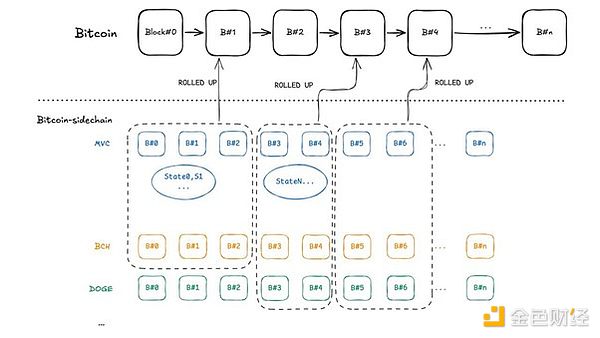
Meta-Rollup Timing Unified Diagram
One of the biggest highlights of Meta-Rollup is that it supports multiple UTXO networks to submit data and transactions to the Bitcoin main chain at the same time. In the past, the Bitcoin main chain was always isolated and could only operate in a closed environment. Through Meta-Rollup, we can enable the Bitcoin main chain to achieve seamless data connection with other UTXO networks, which not only greatly improves the scalability of Bitcoin, but also provides possibilities for more side chains and derivative chains.
Of course, Meta-Rollup's innovation is not only reflected in supporting multiple chains. MBN has specially designed a flexible mechanism that allows the interval of Rollup blocks to be adjusted according to demand. Specifically, Meta-Rollup can set the block interval to the common divisor of 144 blocks, thereby achieving more efficient block synchronization. This means that whether it is the Bitcoin main chain, side chain or other UTXO network, transactions can be packaged and verified more quickly and stably, avoiding performance problems caused by inconsistent timing or block congestion. This is not only a technological innovation for the entire Bitcoin network, but also brings real flexibility to the Bitcoin network.
Of course, for the convenience of development, if it is similar to Ethereum, it will undoubtedly increase the difficulty for developers. To this end, the MBN team provides Meta-Rollup with Rollup as a Service (RaaS), allowing third-party developers to call and use the services provided by Meta-Rollup without permission. The implementation of this function has greatly reduced the technical threshold and enabled more decentralized applications to be implemented on the Bitcoin network. This is the goal we have been pursuing - to make the Bitcoin network not only a value storage tool, but also an open and dynamic innovation platform.
Meta-Rollup uses the MetaID protocol, which is not only a format for transmitting data, but also brings digital identity and asset management capabilities to Bitcoin. This technology will provide strong support for applications such as decentralized finance (DeFi) and digital identity authentication in the future. Through the MetaID protocol, MBN can ensure that the data on the Bitcoin network is not only secure and private, but also flexible to support a variety of application scenarios to meet the different needs of users.
The author believes that as the Bitcoin ecosystem continues to grow, Meta-Rollup is transforming from a simple technological innovation to a new architectural thinking aimed at solving the long-term gap between Bitcoin and its sidechains. It not only achieves time synchronization and asset mapping, but also lays the foundation for future multi-chain collaboration. The following core application scenarios show how Meta-Rollup leads the Bitcoin network into a more complex, efficient and decentralized future.
First, Meta-Rollup solves the timing synchronization problem between different Bitcoin sidechains and the Bitcoin mainnet, which has long plagued multi-chain applications in the Bitcoin ecosystem. The traditional sidechain architecture faces a "fragmented" state, with transactions on each chain being conducted on its own timeline, lacking a global time synchronization standard. Meta-Rollup introduces a cross-chain timing synchronization mechanism to ensure that transactions on different sidechains and the Bitcoin mainnet can be verified and packaged according to a unified timeline. In this way, any cross-chain transaction will not fail or lose assets due to timing disorder.
Imagine if we have a decentralized financial platform based on the Bitcoin mainnet and its sidechains, where users conduct transactions between multiple chains on the platform at the same time. Assuming there is no Meta-Rollup, the order of transactions on different chains cannot be guaranteed, and users may encounter problems such as transaction delays and fund misalignment. Meta-Rollup ensures that all transactions are smoothly executed between different chains through precise timing control, thereby greatly improving the stability of the platform and user experience.
Secondly, Meta-Rollup implements the asset mapping function between Bitcoin and all its related side chains. Through this mechanism, we can accurately record the flow status of assets in each UTXO network, making the flow of assets between different chains transparent and traceable. In traditional cross-chain operations, when assets flow from one chain to another, they often need to rely on central validators, which is prone to single point failure risks and weakens the decentralized characteristics. Under the architecture of Meta-Rollup, asset mapping information is directly recorded and verified through the Bitcoin main chain, eliminating the reliance on central validators and ensuring data consistency and security.
For a specific example, suppose we build an asset bridge between the Bitcoin mainnet and a sidechain. If we don't have Meta-Rollup, the mapping information of assets may only exist on the sidechain, resulting in information islands between the mainchain and the sidechain. In this case, the verification of assets will become very complicated, and the credibility of cross-chain transactions will be affected. Through Meta-Rollup, the asset information on the sidechain will be synchronized to the Bitcoin mainchain in real time, allowing the Bitcoin mainnet to confirm and track the status of all assets, and any asset transfer can be clearly seen in the entire network. This not only enhances the security of asset circulation, but also provides a seamless foundation for the construction of cross-chain asset bridges in the future.
In the current blockchain ecosystem, there are already some cross-chain bridges (such as Thorchain and RenVM) that attempt to solve the problems of asset circulation and interoperability between different chains. Traditional cross-chain bridges often rely on intermediary nodes or intermediary platforms to verify transactions, which makes them lack in security and decentralization. In contrast, Meta-Rollup provides a completely decentralized solution. It eliminates the centralization risk of these cross-chain bridges through timing synchronization and asset mapping between the Bitcoin mainnet and the sidechain, while ensuring the transparency and security of cross-chain transactions.
From another perspective, Meta-Rollup also provides a foundation for the Bitcoin mainnet to realize the ability to execute cross-chain smart contracts. Although the Bitcoin mainnet itself does not directly support smart contracts, through Meta-Rollup, the execution results of smart contracts on the sidechain will be synchronized to the mainchain through hashing. This mechanism lays a solid technical foundation for the Bitcoin mainnet to be able to execute complex cross-chain smart contract tasks in the future.
Imagine that there is now a decentralized cross-chain lending platform. Without Meta-Rollup, the execution results of smart contracts can only take effect in the sidechain and cannot be effectively connected to the Bitcoin mainchain, which brings multiple problems. First, the results of cross-chain contracts cannot be verified by the Bitcoin mainchain, lacking transparency and security, and increasing trust risks. Secondly, key information such as lending conditions and fund security cannot be synchronized to the mainchain in real time, resulting in uncertain operations, which may cause a decline in user trust, loss of funds or system crashes.
After using Meta-Rollup, the execution results of smart contracts are synchronized to the Bitcoin mainchain through hashing, solving the above problems. In this way, the contract execution process and results can be verified by the mainchain, greatly improving transaction transparency and security. In the cross-chain lending platform, the results of lending behavior will be synchronized to the main chain in real time to ensure that each transaction has reliable confirmation, improve transparency and reduce trust risks, and ensure that the contract terms are automatically executed.
Based on the examples mentioned above, I believe that MetaBitcoin Network and Meta-Rollup can be summarized as follows: The emergence of MetaBitcoin Network and Meta-Rollup not only brings unprecedented cross-chain capabilities to Bitcoin, but also paves the way for multi-chain collaboration and decentralized finance in the Bitcoin ecosystem. It solves many technical problems between Bitcoin and its side chains through various innovative functions such as timing synchronization, asset mapping, and cross-chain smart contract execution, allowing the Bitcoin network to carry more complex application scenarios while maintaining decentralization.

Through Meta-Rollup, Bitcoin is no longer an isolated digital asset, but has become the core hub of global decentralized finance and multi-chain ecology, moving towards a more open and interoperable future. It allows the Bitcoin network to truly transform from "digital gold" to "programmable network"; it also allows many Bitcoin side chains and most UTXO networks to glow with stronger vitality.


 Brian
Brian


