Source: TRM Team; Compiled by: Jinse Finance Claw
Key Points
1. On October 30, 2026 (Beijing Time), attackers transferred approximately $6.36 billion from Binance wallets across ten blockchains, with most of which was completed within approximately 20 minutes starting at 20:05 UTC. This makes it the largest crypto theft on record, approximately four times the $1.5 billion Bybit theft in February 2025. Binance has confirmed the security incident and suspended withdrawals on multiple networks. 2. Based on solid on-chain and off-chain intelligence, TRM attributes the attack to the North Korean elite hacking group TraderTraitor with high confidence. TRM is tracking these funds and alerting partners through the Beacon Network. 3. On Ethereum, the attackers used EIP-7702 delegation to turn a Binance hot wallet into a payment contract under their control, and pre-prepared 50 pre-signed authorizations. During the same time window, Binance wallets on nine other chains sent funds to the attackers via regular signature transfers. TRM's assessment indicates that Binance's hot wallet signature infrastructure has been compromised. 4. Tether, Circle, Ripple, and World Liberty Financial collectively froze approximately $2.67 billion in stablecoins, while the Arbitrum Security Committee froze 8,426 ETH and 74.6 million ARB on its network, totaling approximately $2.7 billion. The attackers raced against the freezes, selling USDT to market makers and borrowing ETH on Aave using USDT as collateral. The hackers currently hold over 420,000 ETH and 18,270 BTC, equivalent to approximately $2.4 billion, exceeding the limits that any issuer could freeze.
Event Summary
In the early hours of October 30th, Beijing time, billions of dollars in crypto assets began flowing out of wallets on Binance, the world's largest cryptocurrency exchange. Within minutes, Binance wallets on XRP Ledger, Ethereum, Bitcoin, Tron, Solana, and four other networks sent balances to addresses controlled by the same attacker. A second wave of attacks, around 23:05 UTC, affected Binance wallets on Avalanche and Polygon.
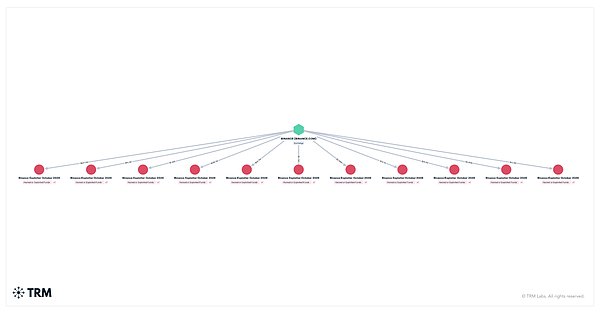
Binance stated that it was investigating a potential security issue and subsequently announced that withdrawals on multiple networks had been suspended as a precaution. Binance maintains that user funds are safe.
The situation is still evolving, and the figures in this article reflect TRM's on-chain observations as of October 30th, UTC 00:30.
Who is the hacker behind this?
TRM attributes this attack to TraderTraitor, a top North Korean hacking group.
Our judgment is based on solid on-chain and off-chain intelligence sources. The FBI previously identified this group as responsible for the $1.5 billion Bybit theft in February 2025.
Several characteristics of this attack are consistent with previous North Korean-related thefts, including the Bybit case and the KelpDAO case in April 2026: funding the operating wallet through small Tornado Cash withdrawals, planning long before the theft, and executing the attack in a concentrated manner after obtaining signatures in advance.
The money laundering methods observed so far differ from those following the Bybit case, which primarily relied on cross-chain bridges. They mainly depend on large-scale exchanges completed through market makers and lending protocols. TRM will share more findings as the investigation progresses. The stolen amount was traced across ten blockchains, from wallets owned by Binance to addresses controlled by the attackers. The total amount, valued at the price of each asset at the time of transfer, is approximately $6.36 billion. Ethereum accounts for approximately $3.79 billion, comprising 200,630 ETH and 185 other tokens, including 1.875 billion USDT, 823 million USDC, and 88.5 million RLUSD. Bitcoin outflow totaled 18,270 BTC, approximately $1.47 billion. Tron outflow totaled 612.7 million USDT and 46.4 million TRX, approximately $628 million. XRP Ledger outflow totaled 233.46 million XRP, approximately $296 million. Solana outflow totaled 970,500 SOL, approximately $96 million. Arbitrum, Optimism, and Base outflow totaled approximately $39 million, including 74.6 million ARB transferred on Arbitrum. Avalanche saw an outflow of approximately $28 million, and Polygon saw an outflow of approximately $10 million. Overview of the Binance hack on October 30, 2026. [Image of Binance hack] How the attack unfolded: Preparations began at least 36 hours before the theft. On October 29, the attacker's operational wallet received three small withdrawals from Tornado Cash, a service used to conceal the origin of crypto assets. On October 30, the attacker deployed the first version of the attack code and tested it on two wallets. Later that day, it practiced the final version on a third wallet before transferring the test funds back to its own account. Four hours after the practice, the same code was installed on a Binance hot wallet. The first theft occurred in the early hours of October 30 in the XRP Ledger. Between 20:05 and 20:09 UTC, five Binance wallets sent 233.46 million XRP to the same attacker address, each leaving only the minimum balance. These XRP remained in place thereafter. Binance wallets on Solana and Optimism followed suit shortly after 20:10 UTC. At 20:20 UTC, a Binance Bitcoin hot wallet sent 18,270 BTC to an attacker's address, which then began splitting the funds into whole shares of 1,000 BTC and 100 BTC within the same block. This technique, known as peel chaining, makes the funds harder to trace. Within two minutes, a Binance hot wallet on the Tron network sent 612.7 million USDT and 46.4 million TRX to the attacker. How the attacker took over Binance's hot wallet: Hot wallets are networked wallets used by exchanges to process customer withdrawals. The Ethereum hot wallet in this case was one of Binance's most well-known wallets. Introduced in the Ethereum Pectra upgrade in May 2025, EIP-7702 allows ordinary wallets to relinquish control of their actions to a smart contract by signing an authorization. Every subsequent call to the wallet executes the contract's code, and this arrangement remains in effect until the wallet signs a new authorization. At 20:20 UTC, the operator submitted a transaction containing 50 authorizations. Each authorization was signed by a Binance hot wallet and points to a sweep contract that only accepts instructions from the operator. Each wallet increments its own transaction nonce count, and an authorization is only valid up to the count reached when that wallet executes it. Binance's hot wallet continuously processes withdrawals, constantly advancing its nonce. By pre-preparing signatures for 50 consecutive nonces, the attacker ensured that at least one signature would still be valid when the transaction was executed. Just one match was sufficient. These signatures were generated in a pre-batch.
3 minutes and 24 seconds after the authorization took effect, the operator instructed Binance's hot wallet to send the entire balance to an address controlled by the attacker. This transaction transferred 167,464 ETH and 63 other tokens, including 1.615 billion USDT.
The authorization was retained.
As new funds entered the Binance hot wallet, the attackers repeatedly swept them away at 20:41, 20:59, 21:04, 21:44, 22:39, and 23:56 UTC. This wallet also acted as the executor of another Binance smart account, allowing the attackers to withdraw 823 million USDC. Circle subsequently froze this USDC.
Evidence points to Binance's signature infrastructure
Early indications on Ethereum activity led some to believe the attackers had obtained these authorizations through phishing. This explanation works for Ethereum but not for other chains.
Within the same window, five Binance wallets on XRP Ledger, Binance wallets on Arbitrum, Avalanche, Optimism, and Base, a Binance Bitcoin hot wallet, a Binance hot wallet on Tron, and a Binance wallet on Solana all sent funds to the attackers via standard signature transfers.
Another Binance hot wallet on Ethereum transferred out 28,006 ETH, 55.7 million USDT, and 25.9 million RLUSD in the same manner, without using delegation. Approximately two and a half hours later, at 23:05 UTC, Binance wallets on Avalanche and Polygon followed suit. These wallets used different chains, key types, and signature schemes, yet all generated valid signatures for the attacker within about half an hour. In TRM's assessment, the most likely explanation is that the attacker gained the ability to have Binance's hot wallet signing system sign selected transactions, and this could be done across chains. The 50 pre-signed authorization hints suggest that this access might be time-limited, or that signing must be requested through a system. Binance has not yet released the underlying reason. Stablecoin Freezes and Exchanges
Stablecoin issuers acted swiftly, with freezes spreading rapidly overnight. Binance stated at 23:35 UTC that the verified total amount frozen had reached $2.54 billion. Including subsequent freezes, TRM statistics show that approximately $2.7 billion was frozen on-chain as of 00:30 UTC:
Tether, approximately 1.77 billion USDT. Tether froze 971.1 million USDT in the main receiving wallet at 21:01 UTC, 37 minutes after the main sweep. Subsequent sweeps fell into this frozen wallet, which now holds 1.175 billion USDT. Tether also froze 205 million USDT from two other attacker wallets on Ethereum, 378.7 million USDT from two attacker wallets on Tron, and 8.4 million USDT on Avalanche. An additional 6.2 million USDT was frozen on Polygon. Circle, approximately 825 million USDC. Circle, in collaboration with law enforcement, froze 823 million USDC in its main receiving wallet at 21:04 UTC. It subsequently froze 1.56 million USDC that the attackers exchanged using AVAX and crossed from Avalanche to Ethereum. Ripple, 40.5 million RLUSD. Ripple froze wallets holding stolen RLUSD at 22:01 UTC, with 40.5 million of the 88.5 million RLUSD still remaining. It also froze RLUSD in compromised Binance hot wallets, preventing newly deposited funds from being swept away. Binance co-CEO He Yi stated that Ripple helped prevent the transfer of approximately $200 million; TRM has confirmed the freezing of the 40.5 million RLUSD on-chain. World Liberty Financial, 27.8 million USD1. World Liberty Financial froze 27.8 million USD1 in its main receiving wallet at 22:10 UTC and froze USD1 in compromised Binance hot wallets at 22:26 UTC. Arbitrum Security Committee, 8,426 ETH and 74.6 million ARB. The Arbitrum Security Committee is an authority that can take emergency action on the Arbitrum network. At 00:08 UTC, it exercised this authority to forcibly transfer two assets—8,426 ETH and 74.6 million ARB, approximately $30 million—from the attacker's Arbitrum wallet, removing them from the attacker's control. Within the initial hours, the attacker exchanged the freezeable stablecoin for assets inaccessible to any issuer at an extremely high cost. Approximately 325 million USDT were sold to professional traders and market makers through UniswapX and other intent-based contracts, in exchange for approximately 122,300 ETH. This means the transaction price was close to $2,650 per ETH, while ETH was between $2,300 and $2,350 at the time, representing a discount of over 10%. The remaining 175 million USDT in this batch was frozen. The second attacker's wallet provided 60 million USDT to the lending protocol Aave, which then lent out approximately 19,760 ETH, after which Aave froze the affected market. On Tron, 300 million USDT was transferred to a wallet that began offering it to the JustLend lending protocol. Another 200 million USDT was exchanged on Uniswap via a chain of intermediary wallets, with 30 million USDT frozen on that chain. 88.5 million RLUSD arrived at a wallet after two intermediaries, which sold 48 million via a decentralized exchange between 21:42 and 22:01 UTC until Ripple froze the remaining 40.5 million. With ETH consolidated into a few wallets and 18,270 BTC transferred via the stripping chain, the attackers controlled approximately $2.4 billion in assets inaccessible to any issuer. Based on past large-scale thefts, TRM anticipates the next phase will involve cross-chain bridges, exchange services, and OTC brokers. TRM is monitoring these movements in the Bitcoin stripping chain and staking wallets. What Exchanges and Compliance Teams Should Do Now: Exchanges and compliance teams should use the attacker addresses flagged by TRM to screen incoming funds and counterparties. Funds from the Bitcoin stripping chain and ETH staking wallets are likely to flow to exchanges, exchange services, and OTC trading desks in the coming days. Funds management teams should monitor Ethereum-compatible wallets for EIP-7702 delegation, which manifests as code appearing on addresses that shouldn't have it. Any such delegation on a funds wallet should trigger an immediate alert. The team should also have a tested, pre-approved method for revoking signatures. The signature policy should reject unexpected EIP-7702 authorizations. Multiple authorizations involving multiple transaction counts in a single request should be considered an indicator of compromise. The signature infrastructure and approval path should be isolated at the chain and wallet levels. In this incident, a single actor obtained valid signatures from ten on-chain wallets within hours. Market makers and solvers should screen counterparties before executing large orders. Approximately 325 million USDT was sold to market makers and solvers by an address that had received the hacker's funds just minutes earlier; real-time address screening should have flagged this. 5 Quick Questions to Understand 1. What happened on Binance? On October 30, 2026, attackers transferred approximately $6.36 billion from Binance wallets across ten blockchains, including Ethereum, Bitcoin, Tron, XRP Ledger, Solana, Arbitrum, Avalanche, Optimism, Base, and Polygon. Binance confirmed the security incident and suspended withdrawals on multiple networks. 2. Who is behind the Binance hack? Based on solid on-chain and off-chain intelligence, TRM attributes the attack to TraderTraitor, a North Korean state-sponsored hacking group. This group was also behind the $1.5 billion Bybit theft in February 2025. 3. What is EIP-7702 and how is it exploited? EIP-7702 allows ordinary Ethereum wallets to run code from a smart contract by signing an authorization. The attackers used a pre-signed authorization to make Binance's hot wallet run a sweep contract that only the attackers could call, then used it to empty the wallet and continuously sweep away any new funds that subsequently entered. 4. How much of the stolen crypto assets have been frozen? Tether, Circle, Ripple, and World Liberty Financial have frozen approximately $2.67 billion in stablecoins, and the Arbitrum Security Committee has frozen approximately $30 million in ETH and ARB, totaling approximately $2.7 billion. The attackers still control over 420,000 ETH and 18,270 BTC, worth approximately $2.4 billion, as well as other smaller amounts of on-chain assets. 5. How does this compare to other major hacks? The approximately $6.36 billion heist makes it the largest crypto theft on record, roughly four times the $1.5 billion Bybit theft in February 2025. Even after the stablecoin freeze, the amount the attackers still hold exceeds that of any previous theft.


 JinseFinance


