When Backpack betrays the community
Once trust is fundamentally broken, the price Backpack will have to pay to repair it will likely be far more expensive than the profits it previously "harvested" through transaction fees.
 JinseFinance


Tao Zhu, Jinse Finance
Summary:On September 21, 2026, Backpack's native token BP continued its recent upward trend, with a 24-hour increase exceeding 42% and setting a new all-time high. This surge is not only related to the overall recovery of the crypto market, but also to Backpack's expansion of its tokenized stock business, coinciding with the SEC's new crypto regulations.
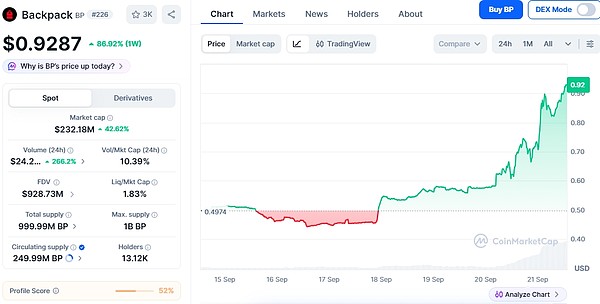
According to Coin Market Cap data, BP reached a high of $0.93 today, with a 24-hour increase of up to 42.82%. As of press time, BP was trading at $0.9287, with a 7-day increase of 86.92%.
BP's strong performance has not always been consistent; before September 18, BP fluctuated below $0.50. Since September 18, BP has entered a continuous upward trend, more than doubling in value.
According to the BP official website, BP is the native token of the Backpack Exchange on the Solana blockchain. The total supply is fixed at 1 billion, with no pre-sale, and staking is supported to obtain staking rights. Backpack currently consists of three main business parts: Backpack Exchange, Backpack Wallet, and Mad Lads.
BP has four main uses in the Backpack and Solana ecosystem: trading, staking and on-chain applications, and self-custody.
**Staking:** By staking BP through the Backpack Participant Program, users can unlock various platform benefits, including fee discounts, wire transfer benefits, and eligibility to participate in the Equity Exchange program. **Trading:** BP is available for spot trading on the Backpack Exchange (BP/USD), allowing users to buy, sell, or hold it like any other asset on the platform. **Solana Ecosystem Applications:** As a Solana-based token, BP is compatible with various on-chain applications within the Solana ecosystem. **Self-Custody:** BP can be stored in any Solana-compatible wallet (including Backpack Wallet), giving users complete control over their assets outside of exchanges. The total supply of BP tokens is 1 billion, distributed in three phases to support the platform's long-term growth. The team will not receive any tokens unless the company successfully conducts an Initial Public Offering (IPO). TGE (Token Generation): 25% (250 million BP). Completed. Airdropped to Points holders (240 million BP) and Mad Lads NFT holders (10 million BP) at project launch. Pre-IPO Phase: 37.5% (375 million BP). In progress. This portion of tokens will be unlocked gradually as Backpack achieves regulatory, product, and market milestones. Each unlocked token will be directly distributed to users. Post-IPO Stage: 37.5% (375 million BP). Locked. Held as the company's treasury reserve, fully locked for one year after the IPO. No separate team allocation. III. From Exchange Tokens to On-Chain Brokers 1. Backpack Exchange Backpack's core business was its cryptocurrency trading platform, Backpack Exchange. Backpack Exchange is a global cryptocurrency trading platform offering spot, perpetual, and margin trading products, supporting various assets and trading pairs. According to official data, as of February 2026, Backpack's cumulative trading volume exceeded $400 billion, covering more than 150 countries and regions. As time went on, traditional financial assets gradually entered the blockchain, and Backpack began to further expand its business to stocks and tokenized securities.In June 2026, Backpack launched the Backpack Securities public beta.
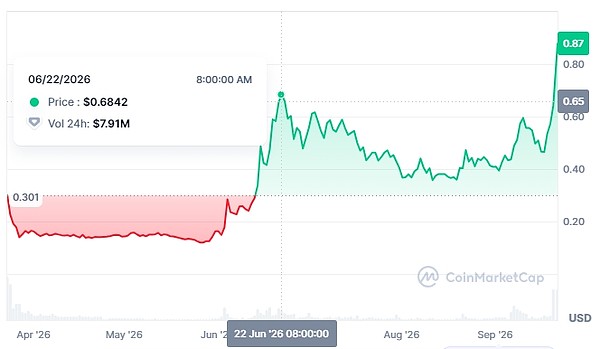
After the platform went live, BP experienced a surge in price. It rose from below $0.30 to around $0.68, approximately 2.27 times its original value.
Backpack Securities is a securities platform that integrates cryptocurrency and traditional securities trading into a single account system.
Users can trade stocks and ETFs directly within the Backpack platform without needing to switch to traditional brokerages. Backpack officially states that stocks, ETFs, crypto assets, and perpetual contracts are all within the same account system, emphasizing "one account." Backpack Securities achieves true ownership through traditional brokerage platforms; enables blockchain-native distribution through tokenization; and unifies capital through Backpack's portfolio infrastructure. Upon launch, Backpack Securities will combine US stock and ETF trading, offering 24/7 trading services, instant execution, traditional exchange liquidity, and seamless fund deposits and withdrawals via fiat currency and stablecoins. Furthermore, Backpack Securities also includes US stocks and ETFs from emerging markets such as Europe and South Korea. On September 19th, the trading volume of Backpack's tokenized stock DEX increased by $193.3 million compared to the same period in the previous seven days, ranking first among similar issuers in terms of increase. Coinbase ranked second with a $106.1 million increase in trading volume, while st0x ranked third with a $38.6 million increase, further highlighting the gap in on-chain trading liquidity among different issuers in the tokenized stock sector. Backpack has continued to expand its tokenized securities offerings, launching assets such as SpaceX (SPCX) and Micron Technology (MU), and recently listing Forward Industries (FWDI). Backpack officially stated that SPCX, MU, and FWDI can all be converted to their corresponding real-world stocks and traded 24/7 on Solana. This signifies that Backpack's business scope is extending beyond traditional crypto asset trading to include securities trading and on-chain finance. From crypto exchanges to stock trading and now to tokenized securities, Backpack is attempting to integrate traditional financial assets with the crypto market into a single infrastructure.The catalyst for BP's recent surge is precisely the new crypto policy introduced by the US Securities and Exchange Commission (SEC).
On September 17, the US SEC issued an "Innovation Exemption," providing temporary, conditional regulatory exemptions to eligible Tokenized Securities Venues (TSVs), allowing them to trade tokenized NMS shares under a specific framework. The SEC stated that this exemption allows eligible on-chain trading venues to use automated market makers and liquidity pools to trade a portion of the tokenized shares, while also providing corresponding regulatory exemptions to relevant liquidity providers. This exemption is valid for five years.
SEC Chairman Paul Atkins pointed out that eligible tokenized shares need to represent real securities interests and provide holders with the same rights as traditional securities, including receiving dividends and exercising voting rights; issuers can also object to their shares being listed on relevant on-chain trading venues.
Backpack's tokenized securities emphasize real securities backing and a 1:1 exchange mechanism, aligning with the US SEC's "real securities on-chain" policy.
Backpack's tokenized securities emphasize real securities backing and a 1:1 exchange mechanism, which is consistent with the US SEC's "real securities on-chain" policy.
For details, please see "5 Questions and Answers: SEC Commissioner Hester Peirce Interprets the SEC's Innovation Exemption Policy"
When Backpack's token price surges, the market generally focuses on whether it can rise further and how long this rally can last.
For Backpack, whether the rally can continue depends on several factors, including whether Backpack's tokenized stock trading volume can continue to grow, whether it can continue to expand its securities assets, whether its user base and ecosystem applications can further expand, and whether this business growth can ultimately create stronger use cases and value capture capabilities for Backpack.
In short, the rise in Backpack is not simply a token-driven market trend, but rather the market is repricing expectations of Backpack's transformation from a crypto trading platform to on-chain financial infrastructure.
Once trust is fundamentally broken, the price Backpack will have to pay to repair it will likely be far more expensive than the profits it previously "harvested" through transaction fees.
JinseFinanceWhen the top Web3 players collectively tear up the old script and modify Tokenomics, it's not just a technical fix about buybacks or emissions reduction, but a leap towards sustainable business entities.
JinseFinanceMeme, from doubt to recognition: How does Meme redefine Tokenomics 2.0? Golden Finance, Meme coin is becoming a "new entrance to the crypto market"
JinseFinanceA deep dive into the different factors of a project’s token economics and their impact on token valuation and on-chain activity.
JinseFinanceSky Strife, a full-chain game developed by the Lattice team, was launched on the Redstone mainnet yesterday.
JinseFinanceI think it’s time for Web3 Degens to pay attention to this kind of exploitation. Through unremitting efforts, we have taken back the ownership of the network and avoided the ruthless monitoring and exploitation of Web2 oligarchs. Don’t lose what Web3 is proud of. fundamental.
JinseFinanceDo governments have a legitimate reason for fighting crypto with CBDCs?
 Clement
Where do stablecoins get their stability from, and how can they be made more stable?
Clement Coinlive
Aptos has teething problems hours after mainnet deployment. VCs and team control majority of token supply.
 Beincrypto