Author: David C Source: Bankless Translation: Shan Ouba, Golden Finance
As the tariff storm leads to broader market turmoil, Bitcoin's performance has also attracted much attention. Bitcoin has always been known for unexpected performance, and this time it has carved out its own path with relative outperformance and steady performance, keeping pace with high-growth technology stocks.
But the recent tariff incident is just the latest example of a shift that has been accelerating throughout the market cycle - digital gold is behaving... more like digital gold. In other words, institutional activity and promising policy developments are testing Bitcoin's maturity in real time, leading many to believe that the asset's market behavior is entering a new era.
But before we get too optimistic, let's review what has changed, what it may mean for the future, and why some core dynamics remain unchanged.
What's different now?
In earlier Bitcoin cycles, halving events (mining rewards cut in half) triggered massive price increases because the reduction in supply was huge compared to Bitcoin's total supply. But that is not the case now. The 2024 halving supply shock is far smaller than in previous cycles and occurs in a more efficient overall market.
Trading bots can bridge price gaps between exchanges in seconds, and large investors use advanced strategies to prevent price swings from being too volatile. Currently, $BTC is trading over $10 billion per day, and it takes about $250 million in spot orders to move the price by 2%. As a result, Bitcoin volatility has dropped significantly compared to previous cycles. While this has suppressed crashes, it has also suppressed price spikes, making them far less dramatic than in past cycles.
However, this stability is a good thing! This means our dear $BTC has a larger pool of liquidity to draw from, ultimately making it more attractive to institutions - who are undoubtedly already interested in Bitcoin.
Institutional Capital Flows
The most obvious evidence of institutional entry? The change in the composition of Bitcoin holders after the ETF approval.
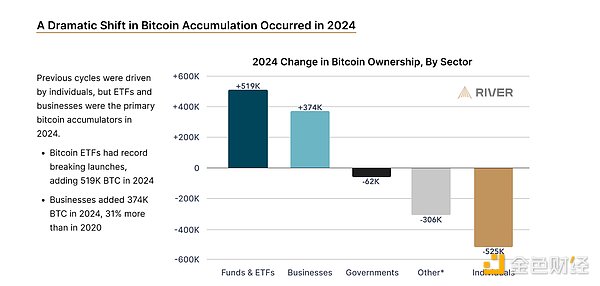
In 2024, funds and ETFs were the largest net increasers, adding more than 519,000 BTC. Corporate holdings increased by 374,000 BTC, a 31% increase from 2020, with a large portion coming from MicroStrategy and Tether. Just five companies control 82% of all corporate BTC holdings, indicating that corporate holdings remain highly concentrated.
Meanwhile, retail investors actually sold a net 525,000 BTC - the opposite of the typical bull market pattern (retail leads).
This signals a broader handoff from retail to institutions, from short-term speculation to holding on balance sheets, where deeper pools of capital can develop new ways to profit from assets.
The expansion of global regulatory access has contributed to this increase in institutional activity. Since 2020, 47 countries have increased access to Bitcoin, while only 4 countries have restricted it. 34 countries have approved Bitcoin ETFs or ETPs, while the United States allows banks to custody Bitcoin in 2025.
A new cycle
This cycle is unfolding under different macroeconomic conditions compared to previous bull runs. From 2015 to 2017, global M2 (a measure of global money supply) grew by 19.3%, while from 2018 to 2021, the figure soared by 33.0%. But this time, global M2 grew by only 6.8%, meaning that this rally was not driven by stimulus measures or excess liquidity. Instead, it is driven by new sources of demand such as ETFs and excitement about increased “legitimacy” and adoption.
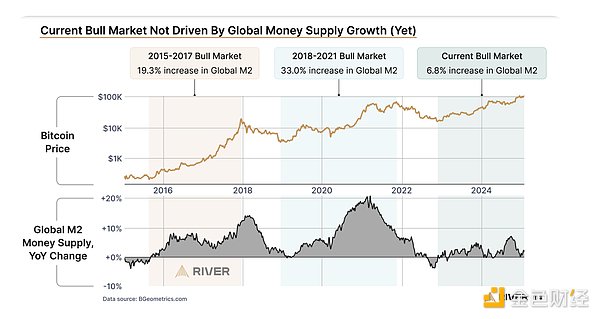 The lower inflation environment, combined with the stabilizing effect of institutional capital, explains why Bitcoin volatility continues to decline while steadily climbing on the back of excitement and macro sentiment.
One clear consequence is the continued rise in Bitcoin dominance – its share of market capitalization relative to altcoins – which has been climbing steadily since January 2022, a pattern not seen in previous cycles. Rather than peaking and falling back into altcoin seasons as it has in the past, Bitcoin’s dominance continues to strengthen, reflecting the different way capital is flowing now:
In previous cycles, Bitcoin’s dominance would eventually give way to a rotation of capital — into ETH, majors, and microcoins. But this time, at least not as expected, that rotation never happened. The money stayed mostly in Bitcoin. Why?
Because ETF flows are segregated: More than $129 billion of new inflows have flowed through ETFs this year. But those profits don’t rotate into altcoins — they remain segregated inside structured products. The ETF model builds a wall around Bitcoin capital.
Because institutions replaced retail investors: Remember, in 2024, individual investors were net selling $BTC, while funds and corporates were accumulating. These players don’t chase altcoins, they hold Bitcoin. Their risk appetite is lower, and their presence limits capital spillover.
Retail investors skip the middle: Those who are still involved are not flowing into ETH or SOL - they are flocking directly to Meme coin casinos like Pump.fun. As a result, capital has completely skipped the majors and concentrated at the top (BTC) and bottom (microcoins), while the middle of the market remains empty.
As a result, many believe that the old four-stage cycle model [BTC → ETH → majors → microcoins] may no longer exist. Capital either sits in ETFs, is firmly held by institutions, or circulates in on-chain casinos.
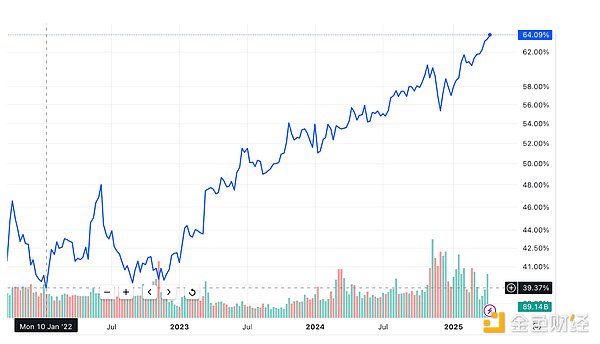
Bitcoin Dominance Chart
Where We Might Be Heading
If this cycle tells us anything, it’s that Bitcoin may be taking on a new role.
In the past, its biggest gains occurred when liquidity poured into the system and interest rates fell. But this time, something different is happening: Bitcoin is reacting more directly to global events — sometimes even leading the market reaction, rather than just following the herd.
We’ve seen this scenario before. During the 2019 U.S.-China trade war, when tariffs escalated in May, stocks fell, but Bitcoin soared. Now, with tariff threats, shifts in U.S. policy, and global tensions, Bitcoin’s steady outperformance and lack of correlation with tech stocks suggests it’s being taken more seriously as a “chaos hedge.”
Here are three trends that could define where we’re headed:
Bitcoin Evolves into Digital Gold: Bitcoin is beginning to behave more like a macro asset in the face of global volatility. Its recent resilience following the tariff news hints that it could truly become the go-to store of value in uncertain times in the future. As of the 2024 halving, Bitcoin’s inflation rate is officially lower than gold’s—further solidifying its claim as the scarcest currency ever created.
Altcoin cycles are shorter and more dramatic: If Bitcoin responds to macro catalysts — and ETF inflows remain locked into structured products — then altcoin rallies could become more brief and narrative-driven. This is reflected in the Leveraged Market Data. We may no longer see long-term rotations, but rather sudden bursts related to specific themes such as meme coins, artificial intelligence, or RWAs.
No more 90% drawdowns: Bitwise Chief Investment Officer Matt Hougan believes this cycle could mark a break from Bitcoin’s familiar rhythm. The new U.S. executive order positioning cryptocurrencies as a national priority, combined with inflows into spot ETFs, could bring trillions of dollars into the space. Future bear markets may still occur, but they may be shallower, shorter, and more driven by macro factors.
A Timeless Story
However, while many things may be changing, the core of Bitcoin remains unchanged.
Yes, the halving may no longer trigger an immediate rally, and institutions may bring in more capital inflows than retail investors, but the fundamentals haven’t disappeared—they’ve just evolved. Bitcoin is still capped at 21 million. Scarcity remains its core story, continuing to attract capital, curiosity, and excitement.
As we know, it’s not just institutional capital that drives markets. Retail FOMO, meme-driven momentum, and influencer hype can still trigger sudden surges. Communities can rally around a narrative—whether it’s the halving, a viral trend, or geopolitical shifts—and drive prices up much faster than fundamentals can. Like previous halvings, this one remains a cultural rallying point — a financial holiday that reminds everyone why Bitcoin exists. Even if its supply shock is priced in, the event itself still contributes to the sentiment that drives the market.
So what happens next?
Bitcoin is clearly more influenced by global macro forces. The four-year cycle may be breaking down. ETF channels may be reshaping how capital flows. But while many things are changing, some things still feel familiar. Scarcity, sentiment, and network belief remain Bitcoin's core engines. Are we entering a new era, or just the next version of the same old game? The answer is still being revealed.


 Jixu
Jixu


