Federal Reserve Chairman Warsh: Bitcoin ends bank profiteering; AI ignites productivity.
On January 30, Kevin Warsh was nominated as the next chairman of the Federal Reserve.
 JinseFinance

Author: Jack Inabinet, Source: Bankless, Translated by: Shaw Jinse Finance
Bitcoin mining stocks are experiencing an AI-driven resurgence. Investors are flocking to the sector, hoping to profit from the modern world's continued demand for data centers.
Data center construction delays are now severe, and despite soaring AI computing demand, the number of new data centers has declined for the first time since 2020. This makes Bitcoin miners the fastest way to acquire new computing power and prompts the market to once again view these companies as key investments in the AI economy.
Today, we'll explore why the increasing congestion of AI data centers is creating new positive factors for listed crypto mining companies.
Early AI Bets on Crypto Mining Companies ChatGPT launched in November 2022, and the market almost immediately recognized the potential synergies between the Bitcoin mining industry and artificial intelligence. In the first half of 2023, the valuations of listed Bitcoin mining companies rose sharply, experiencing exponential growth after the summer, as investors began pricing in the industry's newly discovered value. Following the collapse of FTX, many Bitcoin miners have transitioned from cryptocurrency experts to all-rounders in the high-performance computing (HPC) field to solidify their revenue streams. With the accelerating growth in demand for AI computing power, many of these all-rounder miners have begun explicitly marketing infrastructure and launching customized services for this emerging field. Early efforts have largely been disappointing: Mining firm Applied Digital reportedly spent 10 times more to build a new AI-compliant facility in North Dakota than a similarly sized cryptocurrency mining facility. Upgrading the facility was equally challenging. The dedicated computing power provided by mining-specific GPUs and ASICs is largely incompatible with the diverse needs of AI applications, necessitating the replacement of existing hardware and upgrades to the facility's infrastructure. While some miners attempted to repurpose some of their GPUs for training large language models (LLMs), early gains were disappointing, suggesting limited potential demand for low-quality AI computing power.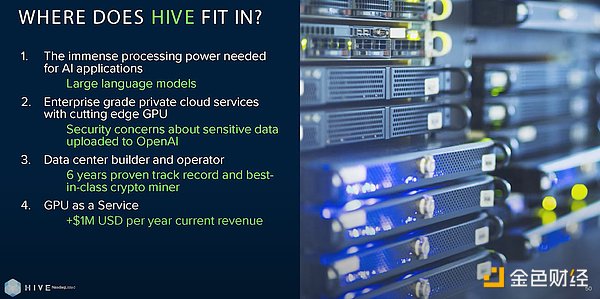
Since cryptocurrency miners began exploring how to capitalize on the artificial intelligence boom more than three years ago, the industry's demand for computing power has exploded, unleashing trillions of dollars and fueling a growing need for more data centers.
Despite record-breaking funding in the field of artificial intelligence and exponential growth in computing power demand, the industry has encountered a less noticeable bottleneck: physical infrastructure. Building a new data center can take up to eight years in total. The most volatile part of this timeline is the licensing and approval process, often seen as a problem of "pessimism" and bureaucracy. However, the reality is that these projects are frequently unpopular with local communities who may block them on environmental, economic, and quality-of-life grounds: Compared to a similarly sized factory that creates thousands of permanent jobs, a data center typically creates only a few hundred, making it extremely difficult to gain traction in the communities where the proposed data center will be built. A hyperscale facility could require ten million gallons of water and one hundred megawatts of electricity per day, placing a demand on municipal water and electricity equivalent to the water and electricity consumption of 100,000 new homes. Beyond resource consumption, data centers are frequently criticized for their appearance and noise pollution, which not only impact quality of life but also typically negatively affect local property values. In short, the structural obstacles to rapidly expanding data center scale in the United States are very real and unlikely to change in the short term. In the US, despite soaring demand for AI computing power, delays in approvals and power procurement have become so severe that the number of new data centers has declined for the first time since 2020. LLM companies with high power demands are eager to find quick solutions. Elon Musk pioneered some of these approaches, including an ambitious plan to launch data center satellites into low Earth orbit. Meanwhile, on Earth, to meet the growing data center demands of xAI, he even attempted to circumvent lengthy permitting processes using truck-sized mobile gas turbines (but was ultimately shut down by the EPA). The pressing need for various elements of the physical infrastructure surrounding artificial intelligence has made cryptocurrency miners with mature data centers prime targets for permissioned arbitrage. The value of miners is increasingly reflected in their acquisition of natural resources (especially electricity and water) rather than their core business operations. Generative AI applications require enormous computing power, and cryptocurrency miners are poised to provide this capability; the industry boasts 6 gigawatts of grid-connected capacity and plans to double that by 2027. Some investment firms have recognized a new investment narrative emerging and have begun heavily betting on cryptocurrency miners, purchasing significant amounts of stocks like CORZ, IREN, and RIOT, attempting to profit from the intrinsic value of their power contracts and development licenses. A New Paradigm? The idea that Bitcoin miners can ride the AI wave is not new. While the first round of similar deals ultimately failed, the theory has evolved this time. There's no doubt that mining stocks experienced a long bull market between June and October last year, but the industry has shown little improvement since then. Whether this latest narrative will ultimately deliver sustainable value for miners remains to be seen, but if the AI arms race continues, licensed computing power could soon become one of the scarcest assets in the computing economy.
On January 30, Kevin Warsh was nominated as the next chairman of the Federal Reserve.
JinseFinanceMalaysia’s YTL Group and Singapore’s Sea Limited have launched Ryt Bank, described as the world’s first AI-powered digital bank. It offers daily savings interest, PayLater credit, and cashback rewards, with deposits insured under Malaysia’s banking rules.
 Weatherly
Tether AI’s crypto payment support will be enabled through a newly launched wallet development kit that supports self-custodial wallets for Bitcoin and Tether’s USDt.
JinseFinanceThey see the growing demand, interest, and appeal of Bitcoin, and they are developing the tools, systems, and methods to start combating it.
JinseFinanceThe combination of AI on BTC will occur on Bitcoin L2.
JinseFinanceThe FDIC said early estimates showed that Silicon Valley Bank's failure cost its Deposit Insurance Fund around $20 billion.
 CryptoSlate
Signature Bank has found a buyer after a week long financial odyssey, the New York Community Bancorp, Inc.
CryptoSlatePeter Schiff’s bank closure highlights why Bitcoin is crucial for financial freedom as the nascent asset class has already helped nearly 4 million unbanked in El Salvador to gain banking facilities.
 Cointelegraph
Bank of America launched crypto custody for institutional investors in October as part of a partnership with New York-based Digital Investment Group.
CointelegraphThe “Oracle of Omaha” now has more direct/indirect investments in Bitcoin and similar cryptocurrencies in his portfolio.
Cointelegraph