Bitcoin Remains Bullish: Exchange Supply Dips as USDT Wallets Grow
Bitcoin's value climbs steadily above $37,000, with increasing self-custody and a surge in Tether holdings indicating a potential bullish trend.
 YouQuan

Decentralization: Relying on computational work as proof of individual participation in Bitcoin production, without relying on gold or governments;
Trustlessness: Relying on social relationships, opening up to the outside world under the principle of minimizing trust, creating network effects.
While Satoshi Nakamoto was influenced by Bit Gold, he remained noncommittal about smart contracts. While retaining the possibility of complex operations through opcode combinations, his overall approach revolved around peer-to-peer payments.
This is also what Nick Szabo said in PoW ETH.
Vitalik at least resisted. Before surrendering to the data center blockchain model in 2025, although he switched to the PoS model, he still tried his best to ensure the existence of individual nodes.
Although PoW is equated with computing power + electricity consumption to determine its basic production cost, in the early days of the cypherpunk movement, the combination of proof-of-work and timestamps was used to confirm transaction time, thereby forming an overall consensus and developing mutual recognition on this basis.
Therefore, Ethereum's switch to PoS will fundamentally remove individual nodes from the production system. Coupled with the "cost-free" ETH accumulated from ICOs, and nearly 10 billion US dollars of VC investment in the EVM + ZK/OP L2 ecosystem, a huge amount of institutional costs have been accumulated, which can completely destroy ETH.
DAT is seen as a form of OTC exit for institutions. After the failure of disintermediation at the technical level, although it controlled the node explosion, it also led to mining pool clusters and hash power competition. Ethereum went through several iterations of L1 (sharding, sidechains) -> L2 (OP/ZK) -> L1, ultimately effectively embracing large nodes. It must be objectively pointed out that Bitcoin lost the "personalization" of smart contracts and hash power, while Ethereum lost the "personalization" of nodes, but retained the ability of smart contracts and ETH to capture value. Subjectively, Bitcoin achieved minimal governance but heavily relied on the "conscience" of a few developers to maintain consensus. Ethereum ultimately abandoned the DAO model and turned to a centralized governance model (theoretically not, but in practice, Vitalik...). It can control the Ethereum Foundation, and the Ethereum Foundation can guide the direction of the Ethereum ecosystem. This isn't about belittling ETH to inflate BTC's value; from a wealth effect perspective, early investors in both have been successful. However, from a decentralized practice perspective, there's no sign of either changing course. Bitcoin will almost never support smart contracts; the Lightning Network and BTCFi are still focused on payments. Ethereum retains smart contracts but abandoned the PoW pricing benchmark, and beyond trustlessness/trust minimization, it has chosen to build a centralized governance system—a historical regression. Its merits and demerits are for future generations to judge. The Middleman Economy: The Fall of the World Computer
“As long as there is organization, there will inevitably be internal strife; as long as there is unity, there will inevitably be a center, and then bureaucracy will naturally arise.
In terms of token pricing mechanisms, there are two types: narrative and demand. For example, Bitcoin's narrative is application-oriented—peer-to-peer electronic cash, but people's demand for Bitcoin is digital gold. Ethereum's narrative is "world computer," but people's demand for ETH is application-oriented—gas fee.
In terms of token pricing mechanisms, there are two types: narrative and demand. For example, Bitcoin's narrative is application-oriented—peer-to-peer electronic cash, but people's demand for Bitcoin is digital gold. Ethereum's narrative is "world computer," but people's demand for ETH is application-oriented—gas fee.
In terms of token pricing mechanisms, there are two types: narrative and demand ... The wealth effect is more favorable to the PoS mechanism. Participating in Ethereum staking requires ETH, and using Ethereum's DeFi also requires ETH. ETH's value capture capability, in turn, enhances the rationale for PoS. Driven by real-world needs, Ethereum's decision to abandon PoW is correct. However, on a narrative level, the transaction volume x Gas Fee model is highly similar to SaaS and Fintech, failing to align with the grand narrative of "computing everything." Once users who don't use DeFi leave, ETH's value cannot be sustainably supported. Ultimately, if no one uses Bitcoin for transactions, someone will always want to use Ethereum to calculate everything.
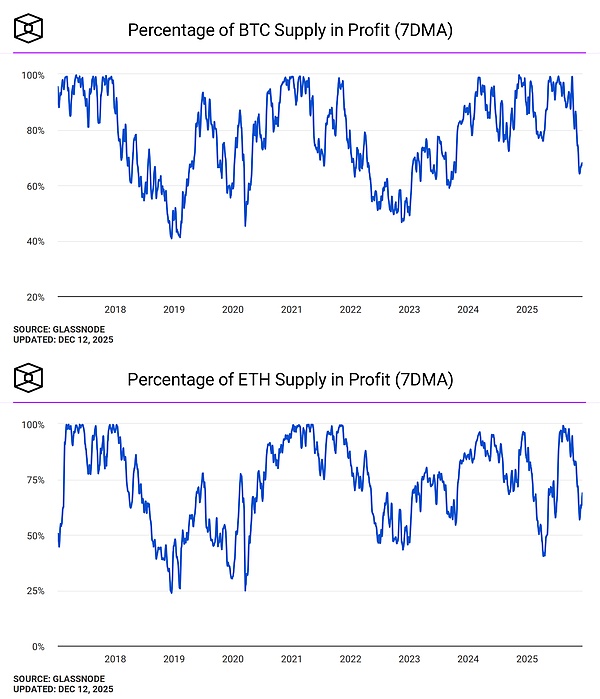
Image description: BTC and ETH addresses profit
Image source: @TheBlock__
Decentralization ≠ wealth effect, but after Ethereum switched to PoS, ETH has been implicitly considered as a wealth effect.
“From the Second International to LGBT, from the Black Panther Party to Black Panthers, from Bitcoin to Ethereum.
After The DAO incident, Nick Szabo began to hate everything about Ethereum. After all, Satoshi Nakamoto has largely disappeared from the public eye, but Ethereum's performance cannot be said to be bad. I am not schizophrenic, criticizing Ethereum and then praising V.
Compared to Solana and HyperEVM Among next-generation public chains, Ethereum remains the best player in balancing decentralization and wealth effect. Even Bitcoin's biggest flaw is its inherent lack of support for smart contracts. As a 10-year-old chain, ETH and Ethereum have transformed from "opponents" to "official opponents," needing to periodically revitalize decentralization and cypherpunk, and then continue striving for the realistic future of financial computing. Even Minerva's owl can only take flight at night; the debate over wealth effect and decentralization will be buried in Königsberg. The truly cruel historical practice has already buried both narratives together.
Bitcoin's value climbs steadily above $37,000, with increasing self-custody and a surge in Tether holdings indicating a potential bullish trend.
YouQuanA wallet linked to Su Zhu, co-founder of Three Arrows Capital (3AC), recently saw movement for the first time following months of dormancy since his arrest. Etherscan records unveiled multiple transactions involving ERC-20 tokens to and from an address labelled suzhu.eth on Nov. 29.
 Joy
JoyAmazon's Titan AI suite on AWS introduces a powerful image generator and the "Q" language model, enhancing business-focused AI applications with realism and versatility.
YouQuanSwiss firm Pando Asset AG joins the competitive race for a Bitcoin ETF, aiming for a Nasdaq listing amidst a crowded field of industry giants.
YouQuanCEO Sam Altman remains at the helm, with immediate priorities revolving around advancing research, bolstering safety measures, and refining customer-centric products.
 Brian
BrianA clandestine operation in Malaysia exposed a fraudulent investment syndicate that operated under the guise of an independent bungalow, once a foreign consulate, employing armed guards to obfuscate its true intentions. However, despite their efforts to evade detection, law enforcement agencies thwarted their activities, apprehending 28 individuals, comprising both locals and foreigners, aiding in the investigation.
JoyPizza Hut and Spark Foundry have clinched the esteemed title of Best Brand Experience of the Year at The Drum Awards for Metaverse. This recognition stems from their exceptional collaboration with End of the World Pizza (EOWP), delving into the Metaverse with an innovative approach.
JoyRevised figures for Q3 disclosed the fastest quarterly expansion in almost two years, with consumer spending rising at a healthy 3.6% annual rate, albeit slightly lower than the initial 4% estimate.
BrianAmir Hossein Golshan, a 25-year-old Los Angeles resident, has been sentenced to 96 months in federal prison for orchestrating various scams, including "SIM swapping" to hijack Instagram accounts. Golshan's schemes, resulting in over $1.2 million in losses, involved impersonating individuals, fraudulent advertising, and exploiting two-step authentication vulnerabilities, showcasing the escalating sophistication of digital fraud.
 Jixu
JixuLouis Vuitton unveils the VIA Tile Trunk, a €6,000 NFT symbolizing its bold move into Web3, blending high fashion with the digital landscape. This marks the brand's pioneering step into direct digital sales, showcasing a unique fusion of NFTs and physical luxury products, setting the stage for a dynamic future in the digital luxury market.
Jixu