Author: Daren Matsuoka, a16z CCrypto Data Science Partner, Translator: AIman@Golden Finance
I believe that stablecoins now present the first credible opportunity to introduce 1 billion people into the cryptocurrency field.
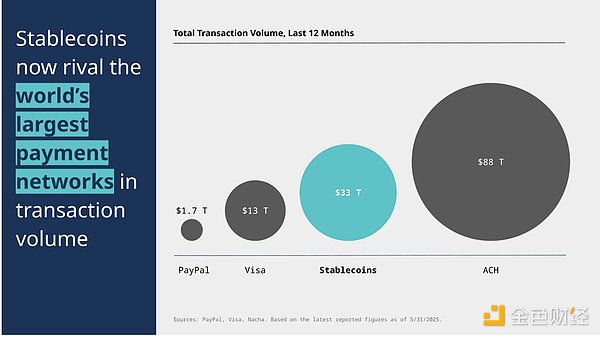
If you haven't paid attention to the latest data on stablecoins recently, you may be surprised. In the past 12 months, the transaction volume of stablecoins has reached 33 trillion US dollars, continuing to set new historical highs.
For comparison: This volume is nearly 20 times that of PayPal, nearly 3 times that of Visa, and is rapidly approaching the size of the U.S. Automated Clearing House (ACH).
It is amazing that stablecoins have joined these large global payment networks that have existed for decades.
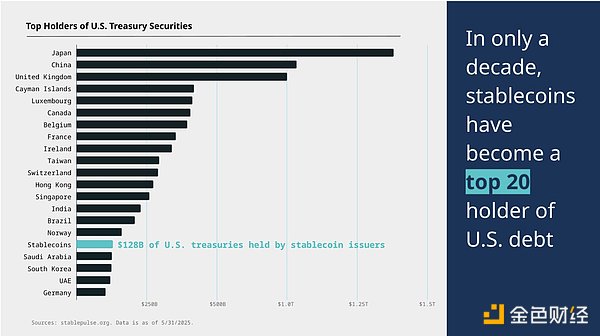
One result of the growth of stablecoins is that they hold $128 billion in U.S. Treasuries. This makes stablecoins the top 20 holders of U.S. Treasuries, ranking above countries such as Saudi Arabia, South Korea, the UAE and Germany.
And all this happened in just ten years. Citibank recently predicted that by 2030, stablecoins could hold $3.7 trillion in U.S. Treasuries, making it the largest holder on the list.
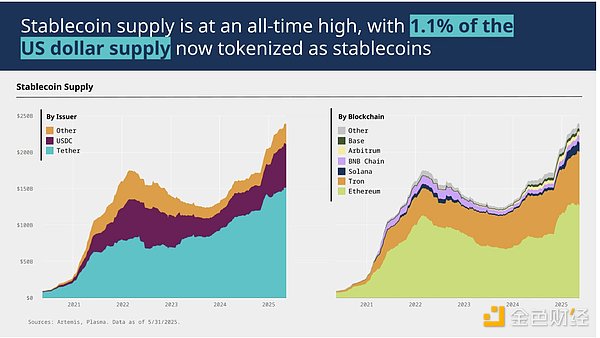
The supply of stablecoins is at an all-time high, and another data worth noting is that more than 1% of the total supply of U.S. dollars has been tokenized as stablecoins.
At the issuer level, the two giants USDC and Tether dominate.
On the infrastructure side, Ethereum and Tron continue to dominate. But if we focus on recent months, we will find that stablecoin activity on public chains such as Solana, Arbitrum, and Base has also grown significantly.
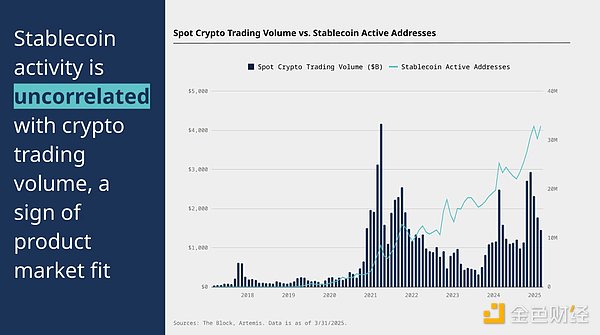
What excites me most about stablecoins is that all of this activity does not seem to be correlated with overall cryptocurrency trading volume, which is a sign of organic use and product-market fit.
Stablecoins have long been criticized for being used only to settle speculative cryptocurrency transactions, but this data shows that this is not the case. If you look closely at the patterns in these two charts, you can see that stablecoin activity forms a “viral loop” that is independent of trading.
This may be my favorite chart when telling the stablecoin story today.
It’s no surprise that stablecoins are only now starting to rise.
Over the past few years, we have made significant progress in blockchain infrastructure. With high-throughput L1 public chains like Solana and new Ethereum L2 scaling solutions like Base, we are finally able to make stablecoins a high-quality product suitable for payments.
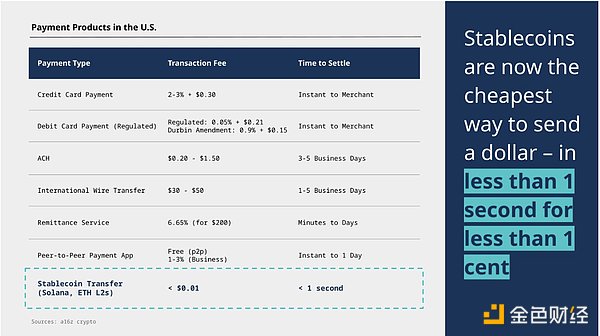
Today, stablecoins are the cheapest way to transfer $1—taking less than a second and costing less than a cent. If you compare this to other payment methods available in the U.S., some of which are cumbersome and expensive, it’s easy to see why stablecoins are the logical choice.
This is a great example of how infrastructure improvements can unlock new applications, and I’m excited to see what else will be unlocked.


 Weatherly
