Author: Naly Source: moneyverse Translation: Shan Ouba, Jinse Finance
Ethereum's 2025 wasn't glamorous, but rather marked by maturity and stability.
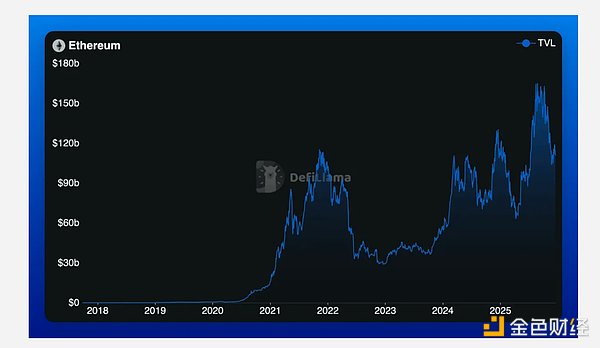
Its total value locked ultimately settled at approximately $68.8 billion, a slight decrease of over 7% year-over-year. In previous cycles, this figure alone would have fueled widespread claims that "Ethereum is declining." But this time, such claims failed to resonate—because they ignored the real changes.
While the balance sheet hype has cooled, the network engine has become increasingly robust. In 2025, the Ethereum network generated over $4 billion in transaction fees, an increase of over 45% compared to 2024. This divergence is precisely the core narrative of this year: efficiency-driven ecosystem maturity.
Application-Dominated Landscape
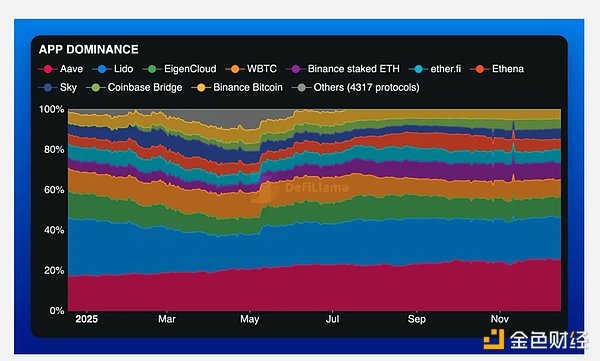
Currently, a few protocols form the cornerstone of Ethereum's balance sheet.
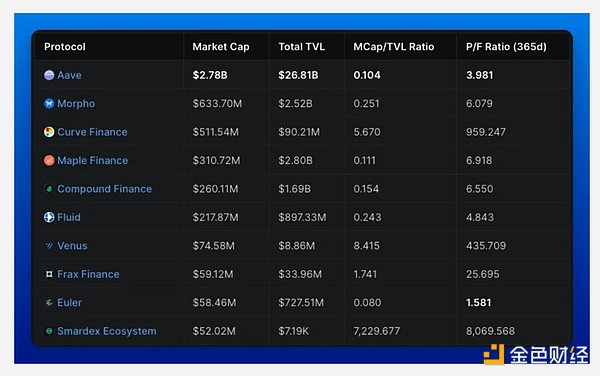
Aave remains the core of DeFi's gravity, accounting for over 26% of the total value locked across the network. Following closely behind is Lido (slightly over 20%), and EigenLayer, which has quietly grown to approximately 10% through restaking. These three protocols alone account for more than half of the capital deployed on the Ethereum network. Beyond them, other protocols, while still possessing some liquidity, exhibit significant tiering. Binance's ETH staking products, EtherFi, Ethena, Sky, Spark, and Uniswap constitute the second tier of liquidity—relevant and active, but no longer the core force shaping the ecosystem. This is the true meaning of industry consolidation: capital is increasingly favoring familiarity, trust, and established distribution channels over blindly pursuing innovative experiments.
Transaction Fee Performance
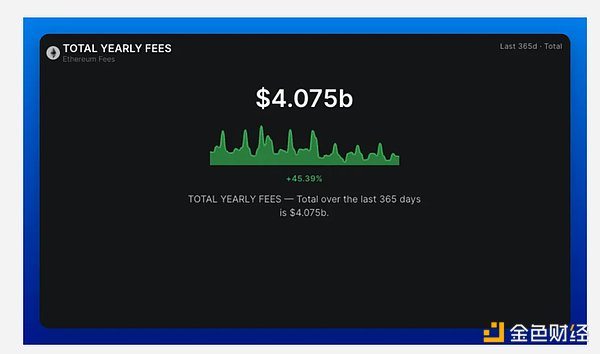
Despite a contraction in total value locked (TVL), Ethereum still generated over $4 billion in transaction fees this year, a 45% year-over-year increase. This divergence is one of the most significant features of 2025.
Ethereum holds less capital (or at least its value in USD), but its monetization efficiency for network activity has significantly improved. The network is realizing more value with less capital, marking a shift in the entire system from speculative expansion to sustainable use.
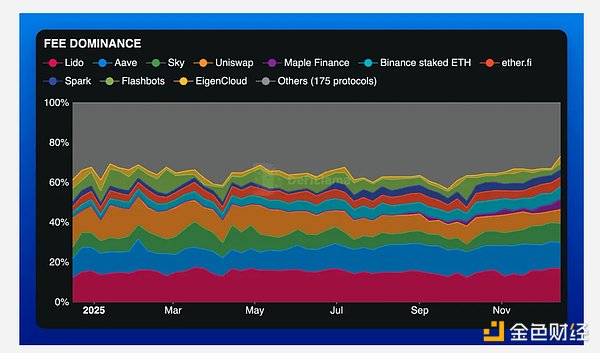
Three major protocols dominate the transaction fee ecosystem: Lido accounts for approximately 17% of Ethereum's total transaction fees, followed closely by Aave at 13%, and Sky contributes nearly 10%. Together, they generate nearly 40% of the network's economic throughput.
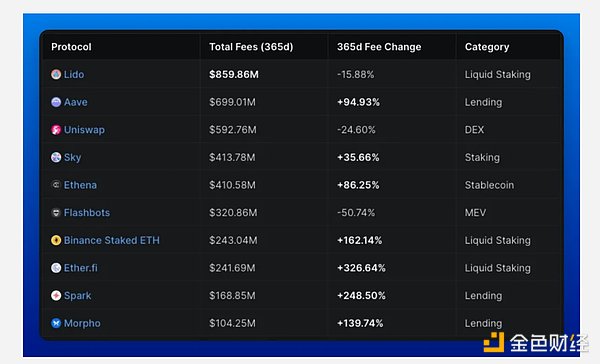
However, even within this dominant structure, changes are still visible. Although Lido and Uniswap remain at the top of the cumulative transaction fee rankings, their year-on-year transaction fee growth has slowed or even declined. Their market share hasn't collapsed, but it's being gradually eroded by faster-moving competitors.
Agreement Revenue
If transaction fees are separated into actual agreement revenue, the industry ranking will change.
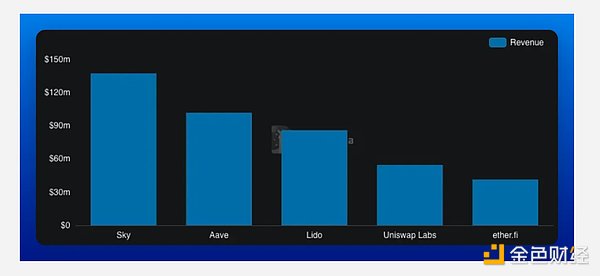
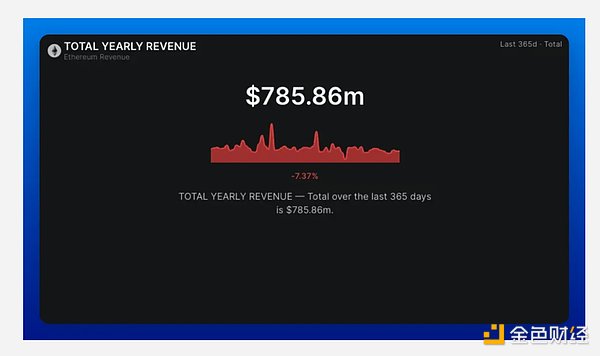
... Ethereum's total application protocol revenue for the year was approximately $786 million, a slight decrease year-over-year. The gap between transaction fee expenses and protocol revenue reflects that more and more revenue is flowing to validators or being burned, rather than going into the protocol treasury. Within this relatively narrow revenue pie, Sky stands out as the most prominent monetization engine. It accounted for approximately 22% of the total protocol revenue this year, far exceeding Aave and Lido (both approximately 11%). Sky's $137 million in revenue dwarfs Aave's $92 million and Lido's $86 million. The gap between the first and second place is obvious, reflecting that Sky's business model is better at extracting value from network activities than simply hosting them.

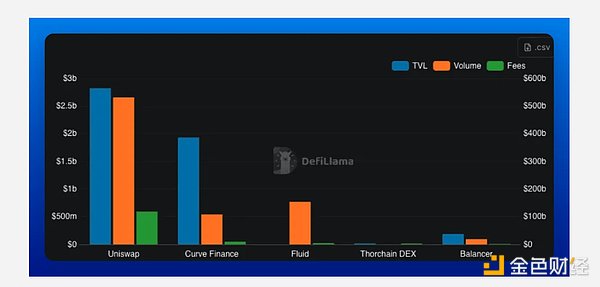
Decentralized Exchange Dominance

Uniswap remains the king of the swap space.
LST Dominance
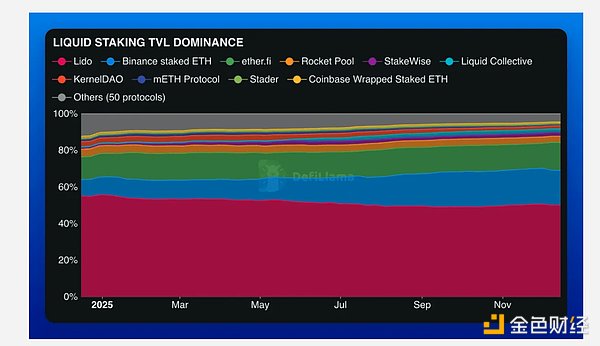
Lido remains a giant in the field.
... With a total value locked (TVL) of over $25 billion, it holds more than twice the capital of Binance's ETH staking products and boasts the "triple crown" in the LST sector: highest TVL, highest transaction fees, and highest revenue. However, its competitive moat is narrowing. Over the past year, Lido's market share has dropped by nearly 10 percentage points, while Binance's ETH staking share has increased by over 12 percentage points, climbing to approximately 23.5%. Centralized exchanges' distribution channels have made a strong comeback, and with significant results. Lido's fee dominance remains highly volatile, fluctuating between 60% and 75% depending on ETH price and network activity; in contrast, Binance's fee share shows a stable linear growth. The difference between the two lies not in product quality, but in distribution capabilities. Despite its strategic importance, the trading performance of the LST token shows that the market does not view it as a cash flow generating asset. The overall market capitalization to total value locked ratio is low, and even compared to other DeFi verticals, Lido's relative premium is not significant—this is mainly because most LST tokens are structurally governance and utility tools rather than revenue-sharing rights. In short, the staking layer can generate substantial transaction fees, but token holders often cannot directly access these returns. Unless a clear value accumulation mechanism, more transparent buyback rules, or credible governance enables control over monetization, the market will continue to view LST tokens more as protocol "access keys" than ownership certificates of the economic engine. This valuation discount also has a deeper structural reason: LST's fees and revenue are almost entirely dependent on the underlying asset it tracks. When the price of ETH rises, staking revenue increases; when ETH network activity slows, staking revenue decreases. This makes LST's economic performance highly correlated with the underlying asset, rather than stemming from any unique protocol alpha. For users, this raises a simple question: since holding ETH directly captures the same upside potential, why hold a riskier governance or utility token with no direct cash flow claim? Unless the LST token can clearly decouple its value from the price movement of the underlying asset, or provide differentiated returns beyond passive correlation, this trade-off will continue to limit the market's valuation of it. The kingmakers not only hold assets, but also drive core economic activities in their respective fields. Aave accounts for 58.65% of the lending share in the DeFi space ($21.26 billion), making it the primary source of credit in the ecosystem; Lido dominates with 46.69% of the total value locked in liquidity staking ($25.74 billion), serving as the cornerstone of liquidity for staking ETH; Uniswap captures 20.75% of the total DEX trading volume ($2.53 billion daily), remaining the most active platform in DeFi. The data indicates that Aave and Lido have achieved "rapid growth" in their respective fields, controlling nearly half or more of the market share. However, Uniswap's trading volume-to-total value locked efficiency, Maple's capture of institutional lending, and Curve's regaining control of stablecoin liquidity all point to the same trend: market share is increasingly being won through specialized features, rather than simply relying on passive asset accumulation. What did 2025 truly reveal about Ethereum? Ethereum in 2025 didn't become noisier, but more compact. The total value locked (TVL) is cooling, transaction fees are soaring, and power is concentrating—the network is shifting from speculative, disorderly expansion to a more difficult-to-fake state: economic density. Aave, Lido, and Uniswap remain at the core of the ecosystem, the default choices for lending, staking, and price discovery. But the changes at the periphery are the real signals: Curve is regaining its grip on the stablecoin space, Fluid is attracting funds with a different architecture, and Maple has demonstrated a real demand for on-chain lending outside of the 2021 DeFi model. In 2025, Ethereum's core narrative will no longer be attracting capital, but generating returns on existing capital.