China's AI computing power counterattack
Artificial intelligence, computing power, chips, DeepSeek, Nvidia, China's AI computing power counterattack - Jinse Finance, What kind of computing power independence does China's AI really need?
 JinseFinance


In 1947, the Danish Royal Family bestowed a knighthood upon Niels Bohr.
This founder of quantum mechanics designed a very special family coat of arms for himself: instead of a lion, crown, or shield in the center, it features a yin-yang symbol. Around the design is inscribed a Latin phrase: 'Contraria sunt complementa,' meaning 'immediately complementary.'. This is one of Bohr's most important ideas: electrons are like both particles and waves; light has both particle and wave properties. These two seemingly conflicting descriptions are not mutually exclusive, but rather jointly describe the same world. Interestingly, 100 years later, when we revisit quantum computing, we still can't avoid this yin-yang symbol. Quantum computing isn't about making old computers faster; it's about acknowledging that the underlying world isn't simply black and white, 0 or 1. It's more like opening up a gray, fluid, and potentially limitless space between 0 and 1. For a long time, quantum computing seemed like a science far removed from reality. It has Nobel Prize-level physics foundations, countless papers and laboratory breakthroughs, but it always seemed shrouded in mystery, remaining distant from ordinary people's lives and its impact on capital market pricing. Now, the situation has changed. On May 21, 2026, the U.S. Department of Commerce announced that, pursuant to the Chip and Science Act, it had signed letters of intent with nine quantum-related companies to provide $2.013 billion in federal incentives. In return, the U.S. government would acquire a minority, non-controlling stake in each company. This is another strategic sector in which the US government has entered through equity investment, following key industries such as Intel, rare earths, and lithium mining. Its impact extends far beyond the surge in the stock prices of related quantum companies; more importantly, the US has officially moved quantum computing from a "future technology" to a national industry that it "must secure a foothold in." When private and state capital simultaneously invest, and when the US government begins to participate in this field through equity participation, quantum computing is no longer just cutting-edge research in laboratories, but also a new industry that investors must understand: How will it change the real world? Who controls the key technological routes? Which companies are already at the table? I. What is Quantum Computing? 1. Limitations of Classical Computing Before discussing quantum computing, we should first understand classical computing—from personal PCs to supercomputers—around which our entire world is built. The smallest unit of a classical computer is called a bit, which can only be 0 or 1. Like a switch, it's either on or off. A photo, a video, a bank transfer, an AI model—all can ultimately be broken down into a massive number of 0s and 1s. For example, when we see the word "Apple" on a computer, the computer doesn't directly "recognize" the word. It first breaks down A, p, p, l, e into individual characters. Each character has an encoding; for example, in early ASCII encoding, A corresponds to the number 65, written in binary as 01000001; p corresponds to the number 112, written in binary as 01110000. Thus, the word "Apple" at its core becomes a string of 0s and 1s. Next, the computer uses font files to determine what each letter should look like; and uses screen pixels to decide which dots are lit, which are dark, and what color to display. Finally, we see a complete "Apple" on the screen. Therefore, classical computers do not understand text, images, or videos themselves. They simply translate everything into 0s and 1s and then process these 0s and 1s at extremely high speeds. The modern digital world relies on this "clumsy method." This method is very powerful; for the past few decades, all of humanity's internet, mobile phones, games, cloud computing, and AI have been built on 0s and 1s. However, bits have their own limits, because some problems are not "not calculated fast enough," but rather the number of possibilities is so large that even if a classical computer used all the computing power on Earth, it would be difficult to complete the calculation in real time. For example, a 100-bit binary password has 2 to the power of 100 possibilities. Even with a top-of-the-line personal computer in a highly idealized, lightweight hashing scenario, the brute-force search time would be approximately 180 billion years. However, if the password were upgraded to 128 bits, and using the world's fastest supercomputer, El Capitan, and assuming an extremely optimistic assumption that "each password attempt requires only one computation," it would take approximately 6 trillion years. The age of the universe is 13.8 billion years, meaning the time required to crack it would be 430 times the age of the universe. If we upgrade to 256 bits, it would require 1.45 × 10⁴¹ times the age of the universe, roughly 145 followed by 39 zeros—the universe can't afford to wait that long. Further acceleration in chip development is already making it difficult to solve these kinds of problems. Faced with such exponentially expanding problems, classical computers typically have only two options: either try everything until the time becomes unacceptable; or use approximate algorithms on certain problems, accepting a result that is "not necessarily optimal, but good enough." Thus, just as in countless years of evolutionary history, humanity has been searching for a paradigm shift in computation. 2. The Astounding Aspects of Quantum Computing The smallest unit of a quantum computer isn't called a bit, but a qubit. Unlike the 0s and 1s of classical computing, a qubit in a quantum computer is in a superposition of 0s and 1s before a measurement occurs. This sounds strange. To understand it with an analogy, imagine blindly choosing one of two cards, the King and the Queen, and placing it face down on the table. We haven't revealed it, but it's already determined whether it's the King or the Queen—the card is fixed regardless of whether we reveal it or not. But superposition is different. Before we observe it, it's in a state where it's both the king and the queen, so we can't answer whether it's the king or the queen. Only when we turn over the cards and see them can we determine the answer—yes, it's so anomalous it's terrifying; our observation actually affects the result, which is drastically different from our understanding of the world. Of course, the above example is just for ease of understanding. In reality, "observation" in quantum mechanics doesn't mean we "took a glance," nor is it the so-called "human consciousness changing the universe." Rather, it means that the measuring device and the environment participate, changing this microscopic system and leading to different results. A regular bit is deterministic; it is either 0 or 1. A regular qubit is probabilistic; its value is determined only through observation. In a classic computer, two bits can only represent one of the following four states at any given moment: However, two qubits in a superposition state can simultaneously represent four states: 00, 01, 10, and 11. Three qubits can correspond to eight states. 10 qubits can correspond to 1024 states. 50 qubits can correspond to approximately ten quadrillion states. 300 qubits correspond to a number of states exceeding the total number of atoms in the observable universe. How can this quantum property be translated into computation? This requires quantum algorithms to weaken incorrect answers and strengthen correct answers until, at the final observation, the amplified correct answer is more likely to appear. A contrasting example: Classical computers are like finding a path in the dark. Given a million paths, they follow them one by one; if one is wrong, they turn back and try another. Quantum computers, on the other hand, connect all the paths into a single ripple. Quantum algorithms are like releasing these ripples to interact, deriving the answer from possibilities. Quantum computing offers a completely different way of finding answers: Classical computing relies on trial and error. Quantum computing relies on superposition, interference, and probability amplification. This is the most fundamental difference between it and a regular computer. No matter how fast a regular computer is, it's essentially still performing mechanical calculations between 0 and 1. Quantum computers utilize the inherent laws of the microscopic world: superposition, interference, and measurement. For the same task of cracking codes, a classical computer can only try each possibility one by one. A quantum computer, however, directly knows a large number of possibilities at once, and its algorithm finds the possible answers, which can become a shortcut in certain scenarios. Moreover, quantum computing is more like the "theology" of nature. Classical computing can approximate a storm, but it's very difficult. Quantum computing, however, is inherently part of nature, and when it tries to grasp possible rules, it's closer to the language of nature. Feynman famously said, "Nature is not classical. If you want to simulate nature, you'd better make it quantum." The underlying world is quantum, and sooner or later humanity will need a machine that operates according to quantum laws to compute this quantum world. 3. How will quantum computing change the world? Quantum computing is not omnipotent. For everyday calculations, such as watching videos, running spreadsheets, playing games, and training large models, classical computers are still the optimal solution. Quantum computers won't be faster at these tasks; in fact, they might be slower. Their true value lies in a specific class of problems: problems with enormous state spaces, answers hidden within an astronomical number of possibilities, and problems themselves possessing structures that can be exploited by quantum interference. In such cases, the speedup isn't 2x, 10x, or 100x, but a leap from "unsolvable" to "solvable." The most typical examples are three types of problems. The first type is cryptography. Today, the security foundation of the global internet, including online banking logins, encrypted chat, and government communications, largely relies on public-key cryptography systems like RSA and ECC. In 1994, Peter Shor of Bell Labs proposed Shor's quantum algorithm. This algorithm proved that if a sufficiently large fault-tolerant quantum computer were to emerge in the future, it could theoretically break encryption systems like RSA in a much shorter time than a classical computer. This is known as Q-Day, or the quantum apocalypse. When sufficiently powerful quantum computers appear, many encrypted communications, financial data, and government documents relying on RSA and ECC today will face the risk of being cracked. What's particularly frightening is the "intercept now, decrypt later" scenario: attackers can save encrypted data today and then decrypt it in reverse once quantum computers are fully developed—people will lose the protection of their passwords while believing they are secure. This is a huge danger because current human civilization relies on various cryptographic methods for maintenance. Once quantum computing is implemented, the security foundation of the entire digital world will need to be replaced in advance. The second type is molecular simulation. In 1981, physicist Feynman's initial motivation for proposing quantum computing was molecular simulation. How electrons interact within a molecule is essentially a quantum mechanical problem. The computational power required to simulate a molecule using a classical computer increases exponentially with system complexity. In areas such as new drug development, new material design, and novel batteries, quantum computers have a natural advantage because they are themselves quantum systems. Simulating one quantum system with another makes the state space more physically consistent. Theoretically, it can more accurately calculate the electronic structure, energy level changes, and reaction pathways of molecules. If successful, it could significantly reduce the time required for early discovery and candidate molecule screening, improving the efficiency of new drug development, novel battery development, novel catalyst development, and novel material development. In the future, we could cure cancer with a single injection, create unprecedented materials, and reach unprecedented heights. The third category is combinatorial optimization. Combinatorial optimization sounds abstract, but it's everywhere in reality. For example, logistics routes, chip wiring, flight scheduling, financial investment portfolios, and production scheduling are all essentially about finding a better solution from a massive number of options. The most classic example is the Traveling Salesman Problem: A courier starts from his company, delivers packages to multiple locations, goes to each location only once, and finally returns to his company. What is the shortest total distance he can travel? With a large number of locations, the number of routes can explode. Routes to 20 locations are already in the trillions; with 30 locations, the number can balloon to over 10 to the power of 30. If a classic computer were to check each route individually, it would quickly reach the real-world computing power limit. In these types of problems, quantum computing may increase the probability of finding a better solution through superposition, interference, and quantum approximation optimization algorithms. In general, quantum computing is not intended to replace mobile phones, computers, or GPUs, nor is it used to directly train large models. It is more like a special machine specifically designed to solve a class of problems that classical computers find most challenging, problems involving many important fields: cryptographic security, drug development, energy materials, financial systems, and defense capabilities, impacting the underlying order of the entire digital world. 4. Key Challenges Overcome by Quantum Computing Quantum bits are too fragile; temperature, electromagnetic noise, and mechanical vibration can all cause them to malfunction. To make quantum computers truly usable, engineers must combine many "physical qubits" into a more stable "logical qubit." Here, there's a crucial dividing line called the error correction threshold. Think of it like many people copying a passage. If everyone makes too many mistakes, peer review is useless because there are too many wrong answers to distinguish right from wrong. The more people involved, the more errors there are. However, if everyone only makes occasional mistakes, having several people copy together becomes useful. The majority's answers will outweigh the few errors, resulting in a more accurate overall result. Quantum error correction works similarly. When the error rate of a physical qubit exceeds a certain threshold, adding more qubits only introduces more noise; the larger the system, the more errors it produces. When the error rate falls below this threshold: adding more qubits allows them to cross-check each other, creating more stable logical qubits. The larger the system, the lower the logical error rate. This is what is meant by "crossing the error correction threshold"—quantum computing shifts from "becoming increasingly chaotic" to "becoming increasingly stable." Humanity first crossed this threshold in December 2024. Google's Willow chip has an error suppression factor Λ = 2.14, meaning that for every 2 increases in code distance, the logic error rate is reduced by approximately 2.14 times, bringing the system into a region below the threshold. A year later, Quantum, Zu Chongzhi 3.2, and QuEra successively crossed this line with different technological approaches. After crossing this line, the discussion about quantum computing began to shift—from "Can it be done?" to "When can it be done?" Over the next year or so, the inflection point began to form.
It has been about a year and a half since Google Willow was released, not a long time, but a lot of big things have happened.
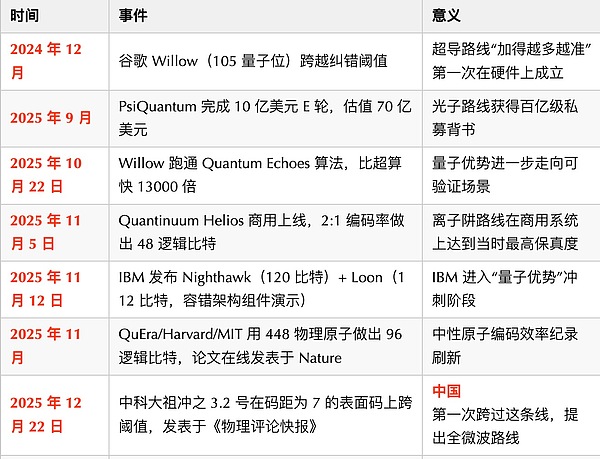
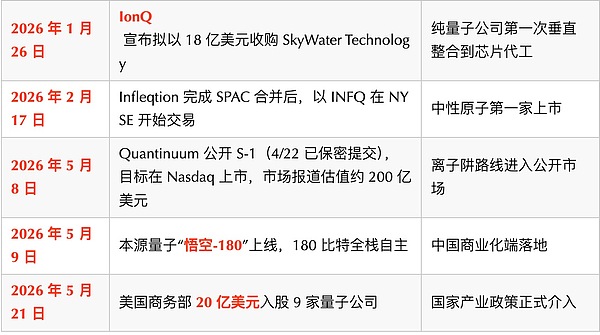
The structural inflection pointis very clear! 1. Simultaneous Investment by Private Equity and Policy Capital The figures from the capital market are more intuitive. QED-C data shows that by the end of 2025, the cumulative public funding commitments for the global quantum industry reached US$56.7 billion. In the same year, global venture capital investment in the quantum field reached US$4.9 billion, of which US-based companies took US$2.7 billion, an increase of nearly 60% from US$1.7 billion in 2024. The figures above are from before the US government's $2 billion investment on May 21st. The private equity funding for quantum computing companies over the past five years has primarily been for basic research by scientists. The $2 billion on May 21st is different; it's for industrial infrastructure: IBM took $1 billion to build the first dedicated quantum wafer foundry in the US, GlobalFoundries took $375 million to build a low-temperature CMOS control chip and packaging line, and simultaneously established the "Quantum Technology Solutions" business unit to take on foundry orders from other companies. These two companies took $1.375 billion, accounting for 68% of the total. The remaining $638 million was distributed among seven companies pursuing different technological approaches, with six receiving $100 million each and Diraq receiving $38 million. 2. What impact will this have on the AI revolution? The answer goes back to Feynman's 1981 assessment: classical computers can never accurately simulate the quantum world because the physical rules governing their operation are not quantum in nature. AI, especially large-scale models, is essentially the ultimate engineering of statistical inference. It learns statistical patterns in human language, images, and videos with increasing precision, but it cannot solve quantum problems faster than classical computers in physics. GPT-5 can tell you roughly what a molecule looks like, but it cannot precisely calculate the electron cloud distribution of that molecule; the latter is a problem of quantum mechanics. AI solves the problem of "statistical pattern extraction," while quantum computing solves the problem of "simulating the physical essence." These are two different things, each with its own limitations and application scenarios. The next generation of breakthroughs in pharmaceuticals, energy, materials, and cryptography does not require "faster GPUs," but rather a machine that is isomorphic to the quantum world at the physical level. This is why on May 21st, IBM took $1 billion to build a foundry, rather than another AI data center. 3. Time is of the essence for everyone. The first end is opportunity. If quantum computing truly enters the practical application stage between 2029 and 2033, whoever masters the upstream of the industry chain (chip manufacturing, key materials, control systems) will have a 10-year window of opportunity. This is an industry-level opportunity comparable to TSMC and ASML. It's time for entrepreneurs, investors, and countries to research and invest. The second end is threat. If any country were to reach Q-Day first, the so-called "quantum doomsday," and be the first to crack the strongest encryption, the current global internet encryption system would become obsolete overnight. Theoretically, all previously encrypted data, once intercepted and stored, could be decrypted on Q-Day. The implications are indescribable, ranging from small-scale banking systems and encrypted mnemonic phrases to potentially endangering missiles and nuclear weapons. This money from the US is not a "subsidy," but a "bet + defense." 4. The Three Stages of the Industry: After quantum computing crosses the inflection point, who will win? Predicting the future is the most difficult thing, but the difficulty can be reduced using methods and logic. There will be three main phases: First, the verification phase. Whoever proves their machine can outperform classical computers on a real-world problem first will get the first ticket to the game. This is what companies like IBM, Google, Quantum, and IonQ are vying for, and it's something we need to pay close attention to. This will be a moment similar to the launch of ChatGPT—the difference being that you, reading this article, will begin to prepare yourself from today. Second, the application phase. Quantum computing will first enter a few high-value scenarios: drug development, materials simulation, chemical reactions, cryptographic security, financial portfolio optimization, and defense computing. These scenarios share a common thread: the problems are narrow, but the value is high. The moment when players can effectively utilize quantum computing and produce significant results will be the GPT moment at the application layer. Thirdly, there's the platform stage. If a particular approach can be further expanded, if the number of logical qubits continues to increase, if the error rate continues to decrease, and if the software ecosystem gradually matures, then quantum computing will transform from a "dedicated machine" into a "computing platform." On that day, quantum computing will no longer be a matter of a company selling a few machines, but rather a matter of cloud services, development tools, algorithm ecosystems, and industry solutions all developing together. It will be an explosion similar to the current AI industry chain, with countless opportunities awaiting us. Focus on quantum computing; don't get too hung up on which stocks rose today. First, understand its development steps and the main players at the table. III. Who are the players at the table? Similar to the AI industry chain, quantum computing will also be stratified in the future. I roughly divide it into three layers: 1. Hardware Manufacturing Layer This layer is similar to the computing infrastructure in AI, including quantum chips, wafers, packaging, cryogenic control, control chips, laser systems, photonic devices, dilution refrigerators, etc. It determines whether quantum computing can move from the laboratory to industrialization. Companies like IBM, GlobalFoundries, SkyWater, Origin Quantum, and Diraq are all highly relevant to this layer. However, quantum computing differs from traditional chips; its underlying hardware currently lacks a unified approach. Multiple approaches exist, including superconducting, ion trap, neutral atom, photonic, silicon spin, and topological methods. The winner is uncertain, but essentially, all approaches answer the same question: What should be used to make qubits? Who can create the most, most stable, and most controllable logic qubits at the lowest cost? The superconducting approach involves cooling a chip to extreme cold and then using special circuitry to create qubits. The leading players are IBM, Google, Rigetti, and Origin Quantum, and this is currently one of the most mainstream and mature approaches. The ion trap route involves suspending individual atoms in a vacuum and then using lasers to direct their calculations. Leading players are Quantinuum and IonQ; its advantage is accuracy, but its disadvantages are slowness and difficulty in scaling. The neutral atom route involves using laser tweezers to pick up atoms and arrange them into a quantum chessboard. Leading players are QuEra, Atom Computing, and Infleqtion; this has seen the fastest progress in recent years. The photon route involves guiding individual photons through optical paths within a chip, interfering with each other, and ultimately calculating the answer. Key players in this approach include PsiQuantum and Xanadu. While it offers immense potential, it presents extremely high engineering challenges. The silicon spin route, on the other hand, uses the spin direction of a single electron to create qubits within a traditional silicon chip. Key players in this approach include Diraq and Intel. Its biggest appeal lies in leveraging the semiconductor supply chain. The topology route attempts to create a type of qubit that is inherently less prone to errors. The main player is Microsoft, and it's not currently part of the main industry trend; it's more like a long-term trump card. Therefore, the technological roadmap is important, but it should be discussed within the context of the underlying hardware and manufacturing layer, rather than being separated into a separate layer. 2. Software and Algorithm Layer Quantum computing doesn't automatically create value simply by having machines. Just as Nvidia has more than just GPUs—it also has CUDA—quantum computing requires programming frameworks, compilers, error correction software, industry algorithms, and cloud access. IBM's Qiskit, Quantum's software stack, and IonQ's cloud access are essentially all vying for this layer. 3. Application Layer This layer will be the last to mature, but it has the greatest potential. New drugs, materials, batteries, finance, cryptography, and defense—each scenario will generate stories. However, the application layer is most prone to bubbles. The phrase "future applications in drugs, materials, finance, and defense" is tempting, but it doesn't equate to current revenue. From an investment perspective, the application layer hinges on three key questions: Are there real customers? Are customers consistently paying? Is quantum computing absolutely necessary to solve this problem? But this layer is still far off. IV. How Should Quantum Companies Be Valued? First, let's look at the reality: Using traditional financial metrics, almost all pure quantum companies are expensive. A price-to-sales ratio of tens of times is considered moderate; hundreds of times is not uncommon. Revenue is only tens of millions of dollars, yet market capitalization can reach billions or even tens of billions of dollars. From the perspective of a mature company, this is even more insane than a bubble. However, simply calling it a bubble is too simplistic. The valuation of early-stage hard technology is not about pricing current profits, but about pricing future industry position. In the midst of a boom, everything is galloping; after the tide recedes, the few companies that remain may grow into towering giants. The difficulty in making this judgment is significant. From an investment perspective, the primary goal is to reduce risk and protect principal, so at least two layers of logic must be established: 1. Check if there is a core business to support it. This mainly applies to IBM and GlobalFoundries. Even if IBM's Quantum business fails, it won't go to zero. It has software, consulting, mainframe, hybrid cloud, enterprise customers, and free cash flow. For IBM, Quantum is a huge long-term call option. Its valuation logic should be: The core business's cash flow provides the lower limit, while the quantum business provides the upper limit. These types of companies may not necessarily grow the fastest, but they have an advantage: investors don't have to worry daily about whether the company will collapse before the next round of financing. This is very important in hard technology. Many great technologies didn't lose to physics, but to cash flow. GlobalFoundries follows a similar logic. It was originally a chip foundry, and the quantum business was just a new direction. If quantum control chips, low-temperature CMOS, and advanced packaging truly generate demand in the future, GlobalFoundries will benefit. If the quantum industry is delayed, it still has its original foundry business. These types of companies are suitable for being valued using "core business valuation + quantum option." 2. Assess the Value of Options This applies to companies like IonQ, Quantum, D-Wave, Rigetti, and Infleqtion. The core of valuing these companies isn't how much they'll earn this year, but whether their investment strategy is likely to materialize. From an investor's perspective, consider or track a set of questions: Does the strategy it's betting on have a physical advantage? Does the company have the ability to survive to the next critical juncture? Are there real clients? Are the technical indicators continuously improving? Has the valuation overdrawn several years of the future? A great industry does not equal a great investment return. Buying too expensively may take many years to digest the valuation. The most difficult thing about quantum investing at the current stage is: identifying the right direction, but potentially buying at the wrong price or into the wrong target. Among the companies mentioned above, research reports were simultaneously released today from IBM and GlobalFoundries—the two most noteworthy targets in the quantum computing field. More targets will be added later. At this point, the quantum computing game is roughly clear. Some are building the machines, some are repairing the infrastructure, some are writing the software, and some are waiting for applications to explode. Some will become the next generation of infrastructure, while others will disappear after the tide recedes. Classical computing built the digital world of the past, while quantum computing reminds us that the underlying structure of the world is older and deeper than 0 and 1. It hasn't fully arrived yet, but it will surely come, in the way most in accordance with the rules of creation.
Artificial intelligence, computing power, chips, DeepSeek, Nvidia, China's AI computing power counterattack - Jinse Finance, What kind of computing power independence does China's AI really need?
JinseFinanceAn alleged Bitcoin ransom demand has injected new urgency into the search for Nancy Guthrie, the 84-year-old mother of Today show anchor Savannah Guthrie, as authorities investigate what they now believe may be a targeted abduction rather than a routine missing-person case.
 XingChi
Since the birth of Bitcoin, the blockchain system has always faced an unavoidable core problem: capacity expansion.
JinseFinanceWhat if the Internet could not only store your data, but also keep it forever? What if there were supercomputers built into the network, ready to help you create, calculate and innovate?
JinseFinanceWill quantum computing destroy Bitcoin? This topic, which has a folk-scientific quality, always causes widespread discussion/FUD every once in a while.
JinseFinanceJinseFinanceBlockchain Scalability Through Verifiable Computing
 Stanford Blockchain Review
Many experts believe that the introduction of blockchain technology and cryptocurrency is a giant leap in human evolution. For some ...
 Bitcoinist
1,000 Gen 0 Cryotags Offered Via Free ‘Invite Only’ Mint; Play ‘The End’ ARG For Last Remaining Chance at Exclusive ...
BitcoinistThe basic premise for making a profit in cryptocurrencies is to buy cheap and sell high. There is no certain ...
Bitcoinist