Deng Tong, Jinse Finance
As 2025 draws to a close, Jinse Finance presents a series of articles titled "Looking Back at 2025" to mark the New Year. This series reviews the progress of the crypto industry throughout the year and expresses the hope that the industry will overcome its winter and shine brightly in the new year.
In 2025, the global crypto regulatory landscape underwent significant changes. Regulation in various regions no longer relied on enforcement actions to shape the industry structure but instead established different regulatory frameworks. This article reviews the regulatory achievements of the crypto industry in major countries and regions around the world in 2025.
Summary of Cryptocurrency Policies in Major Countries/Regions Worldwide in 2025
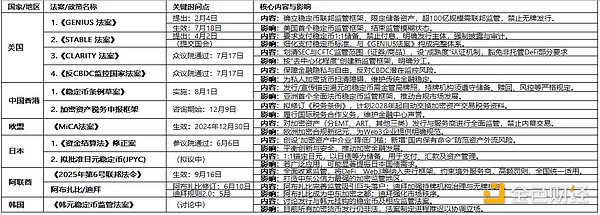
I. United States
The United States' cryptocurrency regulation has benefited from favorable policies after Trump's return to the White House, making significant progress after years of legislative stagnation.
I. United States
The United States' cryptocurrency regulation has seen significant progress after Trump's return to the White House, with policy support following Trump's return to the White House.
"What Impact Will the 'US Stablecoin Act' Have on the Crypto Industry?"
2. The Stablecoin Transparency and Accountability for a Better Ledger Economy Act (The STABLE Act)
This bill was formally introduced on April 2nd by Republican Representatives Bryan Steil of Wisconsin and French Hill of Arkansas, aiming to establish a federal framework for the issuance of stablecoins for payments. It was submitted to Congress by the House Financial Services Committee.
The bill refines the regulatory standards for payment-based stablecoins, requiring issuers to allocate licensed reserve assets at a 1:1 ratio and prohibiting interest payments to users; it clarifies that legitimate issuers include three categories: federally regulated banks, approved non-bank entities, etc.; it also mandates that issuers disclose redemption procedures and monthly reserve reports, which must be reviewed by a certified public accountant firm, and false certification will face criminal penalties. This bill complements the GENIUS Act, jointly constructing a comprehensive regulatory system for stablecoins across the entire supply chain. For more details, please see
"Is a Turning Point for Stablecoins Coming?" US House Makes Major Adjustments to STABLE Bill
3. The Clarity Act on Digital Asset Markets
On May 29, French Hill, Chairman of the House Financial Services Committee, introduced the Clarity Act on Digital Asset Markets, aiming to eliminate long-standing ambiguity in digital asset regulation by clarifying the responsibilities of the Securities and Exchange Commission (SEC) and the Commodity Futures Trading Commission (CFTC). On June 23, the House Financial Services Committee and the Agriculture Committee submitted the bill, which defines digital commodities as digital assets whose value is "intrinsically linked" to the use of blockchain. It was passed by the House on July 17.
The core of the bill is to define the regulatory scope of the SEC and CFTC: the SEC regulates "digital asset securities," and the CFTC regulates "digital commodities." The bill classifies Bitcoin, Ethereum, etc., as digital commodities, considers tokens in the ICO stage as investment contract assets, and establishes a blockchain "maturity" certification mechanism, allowing projects that meet the standards to subsequently be regulated by the CFTC.
Furthermore, it exempts non-custodial DeFi services from traditional registration requirements and relaxes SEC registration restrictions for small-scale fundraising projects. The CLARITY Act no longer focuses on whether a cryptocurrency is a security, but rather on maturity—"How decentralized is it?" It clarifies the division of labor between the SEC and CFTC, creating a new framework for digital asset regulation. For details, please see
"Focusing on the CLARITY Act: A Comprehensive Analysis of its Content, Significance, and Industry Evaluation"4. Anti-CBDC Surveillance National Act
In February 2023, U.S. House Majority Whip Tom Emer first introduced it.
On March 26, 2025, Texas Senator Ted Cruz introduced a bill of the same name in the Senate. On July 17, the House of Representatives passed the bill by a vote of 219 to 210. The core significance of this bill lies in protecting citizens' financial privacy and freedom. It also plays a positive role in clearing obstacles to the development of private cryptocurrencies, maintaining the stability of the traditional US financial system, and mitigating the risks of politicizing monetary policy. For details, please see
"Detailed Explanation of the US Congressional Crypto Week: Summary of Three Bills, Market Trends, and Industry Views"II. Hong Kong
1. Stablecoin Bill
On May 21, the Hong Kong Legislative Council formally passed the Stablecoin Bill at its third reading. It officially came into effect on August 1, and is the first comprehensive regulatory framework in Asia targeting fiat-backed stablecoins.
The regulations stipulate that any entity issuing fiat currency stablecoins in Hong Kong, or any entity outside Hong Kong that claims to peg the Hong Kong dollar to fiat currency stablecoins, must apply for a license from the Hong Kong Monetary Authority. Licensed issuers must comply with requirements such as reserve asset segregation and redemption at par value, as well as a series of regulations concerning anti-money laundering, risk management, and information disclosure. Furthermore, only licensed institutions may sell fiat currency stablecoins in Hong Kong, and only stablecoins issued by licensed issuers can be sold to retail investors; the promotion and marketing of unlicensed stablecoins is illegal. The Hong Kong Monetary Authority has also issued corresponding regulatory guidelines, clarifying the license application process and transitional arrangements. For details, please see
"Hong Kong's Compliant Stablecoins Are Coming: A Quick Look at Their History and Main Contents"2. Public Consultation Launched on the Crypto Asset Reporting Framework and Amendments Related to the Common Reporting Standard
On December 9, the Hong Kong Special Administrative Region Government launched a public consultation on the implementation of the crypto asset reporting framework and amendments related to the Common Reporting Standard. Secretary for Financial Services and the Treasury Christopher Hui stated that, to demonstrate Hong Kong's commitment to promoting international tax cooperation and combating cross-border tax evasion, and to fulfill its international obligations, we will amend the Inland Revenue Ordinance (Chapter 112) (the "Ordinance") to implement the reporting framework and the newly revised Common Reporting Standard. This measure is also crucial to maintaining Hong Kong's reputation as an international financial and business center.
The government plans to complete the necessary local legislative amendments by next year, aiming to automatically exchange tax information related to crypto-asset transactions with relevant partner tax jurisdictions from 2028, and to implement the newly revised Common Reporting Standards from 2029. Hong Kong will automatically exchange tax information with appropriate partners on a reciprocal basis, where partners must meet standards related to protecting data confidentiality and security. For details, please see
“Hong Kong: Proposed Automatic Exchange of Tax Information Related to Crypto-Asset Transactions with Relevant Partner Tax Jurisdictions from 2028”III. European Union
On December 30, 2024, the EU's Crypto-Asset Market Regulation Act (MiCA Act) officially came into effect, marking a new era for the European crypto-asset compliance framework.
The bill establishes a refined regulatory system, setting clear requirements for the issuance of crypto assets and related service providers, while also establishing regulatory exemption rules and market integrity protection clauses. MiCA defines crypto assets as digital representations of value or rights transmitted and stored through distributed ledger technology, and classifies them into three categories: Electronic Money Tokens (EMTs); Asset Reference Tokens (ARTs); and other crypto assets, such as non-stablecoins like Bitcoin. The bill emphasizes differentiated regulation of crypto asset issuance, stipulates entry and operational standards for Crypto Asset Service Providers (CASPs), defines the scope of regulatory exemptions to avoid over-regulation stifling innovation, and explicitly prohibits insider trading to prevent market misconduct. For details, please see
“EU MiCA Regulation Officially Takes Effect: A Comprehensive Explanation of the New Norms for Web3 Enterprises”IV. Japan
1. Amendment to the Payment Services Act
In March of this year, the Japanese Financial Services Agency submitted an amendment to the Act to the Diet, the core of which is to strengthen market security and appropriately lower industry entry barriers.
On June 6, the Japanese House of Councillors passed the amendment to the Payment Services Act, establishing a new system for “crypto asset intermediaries,” allowing companies to engage in matching services without registering as crypto asset exchange operators, aiming to lower market entry barriers and promote crypto financial innovation.
The amendment also added a “domestic retention order” clause, granting the government the power to order platforms to retain a portion of user assets within Japan when necessary, to prevent the risk of asset outflow caused by events like the FTX bankruptcy. The new law is expected to take effect within one year of its promulgation.
For details, please see
“Japan’s House of Councillors Passes Amendment to the Payment Services Act, Establishing a New System for Crypto Asset Intermediaries”2. Proposed Approval of the Issuance of a Yen Stablecoin
The yen stablecoin will be named JPYC, with 1 JPYC fixed at 1 yen (approximately 0.05 yuan), backed by highly liquid assets such as yen deposits and Japanese government bonds. Individuals, businesses, and institutional investors can apply to purchase JPYC stablecoins and make payments, after which the stablecoins will be transferred to their e-wallets. Application scenarios include remittances to overseas students, corporate payments, and blockchain-based asset management services.
The yen stablecoin may have a significant impact on the Japanese bond market. If JPYC is widely used, it will boost demand for Japanese government bonds, and JPYC is likely to begin purchasing Japanese government bonds in large quantities in the future.
For details, please see
“Japan Plans to Approve the Issuance of Yen Stablecoins”V. UAE
On September 16, Federal Decree No. 6 of 2025 came into effect, marking a major consolidation in its financial regulatory history and comprehensively tightening regulations on crypto and related fields.
Specific policies include: For the first time, the decree brings all blockchain infrastructure, including DeFi, Web3 projects, stablecoin protocols, decentralized exchanges, and cross-chain bridges, under the central bank's regulatory framework; even if a crypto service provider is located outside the UAE, it must comply with the law and apply for relevant licenses if its clients include UAE residents; entities conducting related business without a license may be fined 50,000 to 1 billion dirhams (approximately US$13,600 to US$272 million), with some cases involving imprisonment; the decree provides a one-year transition period for existing crypto and related operators, requiring relevant projects to complete compliance licensing applications and other adjustments by September 2026, with the central bank having the discretion to extend the transition period; previously, financial free zones in places like Dubai could issue virtual asset licenses independently, but the new decree explicitly states that its provisions also apply to financial free zones, and licenses issued by free zones cannot be exempted from the compliance requirements of the new law. The UAE is striving to become the most comprehensive and internationally credible cryptocurrency regulatory region in the Middle East. 1. Abu Dhabi On June 10, the Abu Dhabi Global Markets Financial Services Authority (ADGM) announced revisions to its digital asset regulatory framework, effective immediately. The revisions focus on modifying the process for Abu Dhabi Global Markets (ADGM) to accept Virtual Assets (VAs) and use them as Accredited Virtual Assets (AVAs), and setting corresponding capital requirements and fees for authorized persons (virtual asset companies) engaged in regulated activities related to virtual assets. The revisions also introduce specific product intervention rights for virtual assets and establish rules to affirm existing practices prohibiting the use of privacy tokens and algorithmic stablecoins within ADGM. Finally, the revisions expand the investment scope of venture capital funds. Due to Abu Dhabi's increasingly robust crypto regulatory environment, numerous crypto companies, including Circle, Tether, Binance, Ripple, Animoca Brands, GFO-X, and Bitcoin Suisse, have obtained licenses in Abu Dhabi this year. Abu Dhabi is becoming the crypto capital of the Middle East. For details, please see
"Is Abu Dhabi the Real Crypto Capital? Why Are Crypto Giants Like Binance, Tether, and Circle Choosing Abu Dhabi?"2. Dubai
In May of this year, the Dubai Virtual Asset Regulatory Authority (VARA) released its rulebook version 2.0, expanding the governance and reporting standards for all licensed virtual asset activities. VARA also continued to take significant civil enforcement action against unlicensed operators in Dubai, issuing cease-and-desist orders and fines on multiple platforms.
VI. South Korea
In May of this year, Lee Jae-myung formally proposed a plan to issue a stablecoin pegged to the Korean won at a policy discussion meeting.
In early December, South Korea's ruling party called on all ministries and the Financial Services Commission (FSC) to submit a bill regulating won-denominated stablecoins by December 10th, but the FSC failed to do so. An FSC spokesperson stated that the FSC needed more time to coordinate its position with relevant agencies, and rather than rushing to complete the proposal before the deadline, it chose to publish it simultaneously with its submission to the National Assembly. The FSC stated that this move was to protect the public's right to know. Therefore, the issuance of all forms of cryptocurrencies and stablecoins remains illegal in South Korea.


 Catherine


