Author: Lin Wanwan
On January 15, 2014, Yu'ebao's 7-day annualized yield surged to 6.763%. On the same day, the interest rate for bank demand deposits was 0.35%.
19 times.
This figure was like a blow to the head, waking up hundreds of millions of depositors in China: it turns out that the interest on my money deposited in bank demand deposits was being eaten up by 19 times. It's not that there was no interest, it's that the interest was being taken by others.
What is the essence of Yu'ebao?
It simply pools depositors' money and deposits it into banks' negotiated deposit accounts: a world unregulated by interest rates, then distributes the profits to depositors. Technically uninnovative, it tore open a hidden hole in China's financial system: for the first time, ordinary people discovered that their money had time value, a value that rightfully belonged to them. Eleven years later, on December 29, 2025, the People's Bank of China announced that starting January 1, 2026, interest would accrue on the balance of digital yuan wallets.
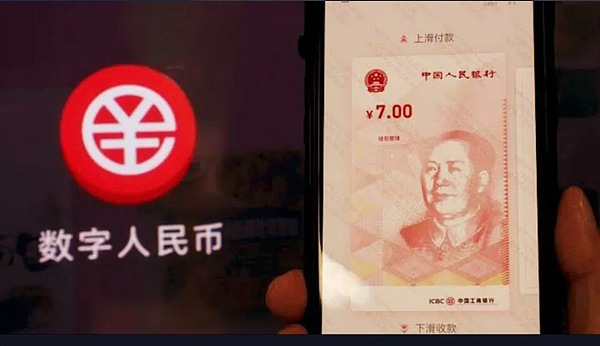
The same idea of "making digital money generate more money" is being explored, but this time the player has changed—the central bank.
Interest accrual is a prerequisite, proving that the digital yuan has finally realized: simply being "correct" isn't enough; users need a reason to choose it.
The Dilemma of "Theoretically Correct" The digital yuan began its pilot program in 2019. Six years later, the figures are quite impressive: 230 million personal wallets, 3.48 billion transactions totaling 16.7 trillion yuan. But ask the people around you, how many actually use it daily? The answer is likely: received a red envelope, tried it once, and then nothing more. Where does the problem lie? It lies in a seemingly academic term: M0. The central bank initially positioned the digital yuan as a "digital substitute for cash." Cash is M0, currency in circulation, and it doesn't accrue interest. Therefore, the digital yuan also doesn't accrue interest. The logical chain is perfectly self-consistent. But the problem is that the use cases for cash are disappearing. Before 2019, China's mobile payment penetration rate had already exceeded 85%. Open WeChat or Alipay, scan, and it's done in a fraction of a second. Asking users to switch to a new tool for a "dual offline payment" function (paying without internet) is too costly to convince. How many scenarios in daily life require immediate payment even without internet access? Even more critically, the M0 positioning brings a structural problem: banks have no incentive to promote it. The concept of 100% reserves means that for every 100 yuan a user deposits into a digital yuan wallet, the bank must deposit 100 yuan as reserves with the central bank, and this money cannot be touched. The bank bears all the costs of developing the system, maintaining the network, and promoting it to users, but it doesn't earn a single penny from those 100 yuan. I bear the costs, but I don't make any profit. This is a bad deal no matter how you look at it. Therefore, after six years of piloting the digital yuan, with countless scenarios, red envelopes, and activities, it has never formed a spontaneous network effect. Users have no incentive to hold it, and banks have no incentive to promote it; neither side is working, so the wheel won't turn. What changed this time: From M0 to M1. On December 29, 2025, the People's Bank of China released a document with a very long title: "Action Plan on Further Strengthening the Management and Service System and Related Financial Infrastructure Construction of Digital RMB". The document is long, but the core change is only one sentence: Digital RMB has changed from "digital cash" to "digital deposit". The document mentions three key changes: First, interest calculation. Starting January 1, 2026, the balance in a digital RMB wallet will accrue interest at the current deposit rate. Currently, the current deposit rate is about 0.05%, so 10,000 yuan deposited for one year will earn 5 yuan. The interest rate isn't high, but the jump from 0 to 0.05% is a qualitative change. Secondly, bank liabilities. Previously, the digital yuan was a liability of the central bank, just like the paper money in your pocket. Now it's a liability of banks. Banks can include this money in their balance sheets for lending and investment, making profits. Of course, reserves must be paid, but no longer at 100%. Thirdly, deposit insurance. The digital yuan is included in the deposit insurance program. Your money, like ordinary deposits, is backed by the state's credit. The original words of Lu Lei, Vice Governor of the People's Bank of China, were: the digital yuan has "moved from a cash-type 1.0 version to a deposit-money-type 2.0 version." In layman's terms: The digital yuan in your wallet is finally starting to have time value. However, the 0.05% interest rate is almost negligible. But the significance of this change goes far beyond that small amount of interest. First, it solves the question of "why hold it?". For the past six years, the promotion of the digital yuan relied on "subsidies in exchange for trial use." Red envelopes, promotions, and coupons were given out. Once used, it was forgotten because holding it offered no benefit—it didn't earn interest, and it was better to keep it in WeChat Wallet (although it doesn't earn interest either, at least it's convenient to use). Now it's different. Even a mere 0.05% means "it's better to have it here than in your pocket." Mu Changchun, director of the Digital Currency Research Institute of the People's Bank of China, said at this year's Bund Conference: "Letting ordinary people and businesses hold idle, non-interest-bearing assets will cause the loss of the time value of money." Currency should naturally have time value; not accruing interest is a design that goes against human nature. Secondly, banks finally have an incentive. The M1 positioning means that banks can use digital RMB to do business. Users deposit money, banks can lend it out, invest it, and earn interest spreads. With rights and responsibilities aligned, their enthusiasm naturally increases. This is the most crucial underlying logic of this reform. Third, China is the first major economy globally to accrue interest on its CBDC. More than 130 countries and regions worldwide are exploring central bank digital currencies (CBDCs), but the vast majority remain at the level of "digital cash." This is because accruing interest on CBDCs is theoretically controversial (would it lead to bank runs?) and operationally risky. China has taken this step, providing a new benchmark for the evolution of CBDCs globally. Beyond the "interest accrual" aspect, the digital yuan offers even greater potential for imagination. Traditional deposits are simply numbers, lying dormant in an account, static. The digital yuan is a string of code that can be assigned rules. The central bank's white paper states: "Programmability is achieved by loading smart contracts that do not affect the function of the currency." In other words, the digital yuan can also be "conditional money." In past pilot programs, digital yuan red envelopes had expiration dates, becoming invalid afterward—a basic application of programmability. The future application potential is enormous. Government-issued consumption vouchers can only be used in specific industries, automatically being recycled after expiration, and are fully traceable; a certain percentage of wages paid by companies can be automatically transferred to pension accounts; cross-border trade payments are automatically settled upon fulfillment of delivery conditions, eliminating the need for manual reconciliation; targeted poverty alleviation funds can only be used to purchase production materials and cannot be used for gambling or high-end consumption. The common thread in these scenarios is that the rules for using currency can be pre-set and then executed automatically. In the past, central banks relied on "aggregate tools"—interest rate cuts, reserve requirement ratio reductions, and quantitative easing—to regulate the economy. The problem is that the transmission chain is too long; money leaves the central bank, passes through banks and enterprises, and finally reaches the real economy, resulting in huge losses and making it difficult to target specific sectors. Economists call this "time lag and leakage in monetary policy transmission." The programmability of the digital yuan theoretically allows for "precision drip irrigation" of monetary policy. The central bank can stipulate that this money can only flow to small and micro enterprises, can only be used for green investments, and can only be spent within 6 months. This is something traditional currencies cannot do. Of course, there are two sides to every coin. If currency can be programmed, who decides the rules? Will programmability become another form of control? Will consumer freedom be restricted? There are no standard answers to these questions, but they will certainly become the core controversies of the next stage. Domestically, it's one game; cross-border, it's another. The Multilateral Central Bank Digital Currency Bridge (mBridge) has entered the MVP stage. This is a joint project of the Digital Currency Research Institute of the People's Bank of China, the Hong Kong Monetary Authority, the Bank of Thailand, the Central Bank of the UAE, and the Bank for International Settlements. In 2024, the Central Bank of Saudi Arabia also joined. As of November 2025, mBridge had processed 4,047 cross-border payments, totaling RMB 387.2 billion, with digital RMB accounting for 95.3%. Each settlement took 6 to 9 seconds, and the cost was more than 50% lower than traditional cross-border payments. These figures demonstrate that the technology is viable. However, its scale is still small, and it is far from becoming a mainstream cross-border payment channel. The core issues of cross-border payments are trust and rules. The US dollar's status as the global reserve currency is not solely due to the size of the US economy, but also to the historical legacy of the Bretton Woods system, the network effect of the SWIFT system, and the depth and liquidity of the US financial markets. For the digital yuan to make a mark in the cross-border arena, technology is merely the first step; a long series of geopolitical equations must be solved. The interest rate addresses the question of "willingness to hold." But holding is only the first step; more difficult hurdles lie ahead: Willingness to use it? Will merchants accept it? Can a spontaneous network effect be formed? A 0.05% interest rate has limited leverage effect. Looking back at 2014, Yu'ebao relied on a 19-fold interest rate spread to awaken the financial awareness of hundreds of millions of people overnight, forcing bank reforms and interest rate liberalization. It was a game-changer. The digital yuan currently has almost no interest rate advantage and can no longer rely on interest rate spreads. It needs to find other breakthroughs: a better product experience, richer usage scenarios, or stronger policy support. Ultimately, currency is used, not designed. In 2014, Yu'ebao used a 19-fold interest rate spread to tell the Chinese people: your money should have time value. In 2026, the digital yuan will accrue interest, continuing this logic: for the first time, giving money in digital wallets a reason to "stay there." But a deeper change is that as currency becomes digital and programmable, the time value of money can be set, allocated, and even controlled more precisely. Who sets it? How is it allocated? Who gets the returns? Who bears the risks? These questions are perhaps far more important than "whether or not to accrue interest." The digital yuan has just entered the game. The real competition has only just begun.


 Brian
Brian

