Author: Delphi Digital; Translator: @Jinse Finance xz
In the traditional financial sector, the vast majority of major tokenization pilot projects run on the same infrastructure. UBS, SWIFT, Mastercard, JPMorgan Chase, and Coinbase all use Chainlink. But can such adoption translate into real benefits?
1. Infrastructure
Equities Data Streams will expand to 24/7/5 coverage by 2026. This system aggregates price information from top data providers, verifies it through an oracle network, and provides sub-second updates. On-chain derivatives, prediction markets, and structured products can now reference real US stock prices.
Chainlink Runtime Environment is responsible for handling workflow execution. Developers can orchestrate workflows using modular components such as data feeds without having to manage node infrastructure themselves. This network is designed to ensure execution continues even if individual nodes fail. CRE natively supports the ISO 20022 standard and can be directly embedded into existing Swift infrastructure without additional conversion layers.
Confidential Compute will enter early access phase in early 2026, utilizing a trusted execution environment to process sensitive data without exposing it. Data enters in encrypted form, is processed in an isolated environment, and only the result is output. A proof mechanism verifies that the computation runs correctly within a true TEE. This means institutions can use public blockchains without exposing sensitive operations. CCIP connects over 60 blockchains through a layered security model. Independent networks are responsible for execution and monitoring, and can suspend transmissions if anomalies are detected. Coinbase chose it as the sole cross-chain bridge for all Coinbase Wrapped Assets. Over the past year, CCIP's cumulative transaction volume has increased approximately 7 times.
2、Chainlink's Current Status
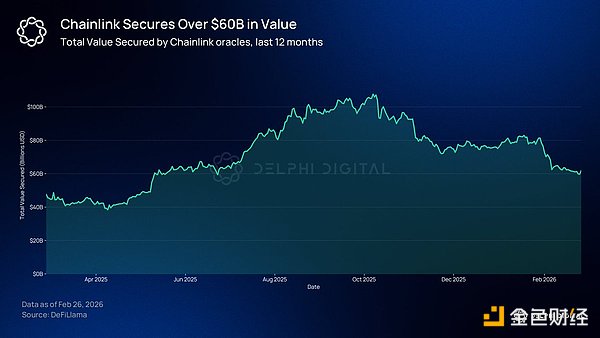
Chainlink's persistent weakness lies in the fact that everyone relies on it, yet nobody pays much for it. However, since 2025, the team has introduced two mechanisms that could potentially change this situation.
Through a smart value recovery mechanism in partnership with Aave, MEVs are recovered during liquidation, capturing $16 million in nine months.
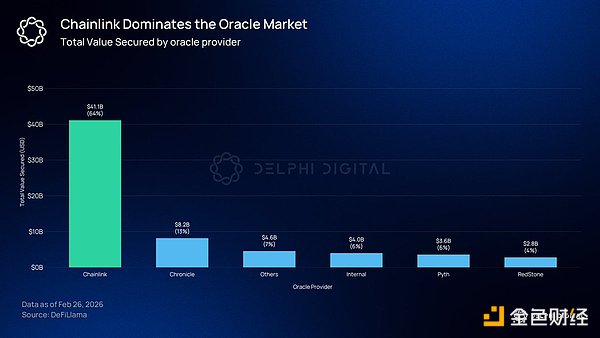
Chainlink received 35%, approximately $5.6 million. This is significant as a proof of concept, but the mechanism needs to be expanded to other lending protocols for sustainable growth. The Chainlink Reserve converts enterprise payments into LINK purchases on the open market. Since its launch seven months ago, the reserve has accumulated 2.3 million LINK. This is still in its early stages, but enterprise payments are real. 3. Macro Landscape In terms of total locked value, Chainlink holds a 64% share of the oracle market. Protocols like Aave and Lido run their critical infrastructure through Chainlink, and switching vendors would mean contract rewriting, audits, governance voting, and real migration risks. Instead of leaving, Lido migrated its cross-chain infrastructure to CCIP, deepening its partnership with Chainlink. Maintaining a leading position means working on three fronts: launching Confidential Compute before institutions build their own privacy solutions; extending SVR beyond Aave to demonstrate the scalability of its revenue model; and convincing banks that public blockchain solutions are simpler than private ones. Chainlink's value hinges on the massive rollout of institutional tokenization. For those who believe tokenization is imminent, Chainlink is the infrastructure layer.


 JinseFinance