Author: Haotian; Source: X, @tmel0211
Recently, the hottest topic on Twitter and various social media platforms has been the on-chain activities of those "1011 insider addresses" or big players like Yi Lihua. These addresses are under the spotlight, and every move they make sparks heated discussions.
The big shots' inner thoughts are: how wonderful it would be if blockchain had native privacy features. Let's talk about @aztecnetwork today, the privacy infrastructure project that received $100 million in funding from a16z:
1) Aztec's recent participation in Uniswap's new token issuance mechanism CCA (Continuous Clearing Auction) also verified its ability to attract investment and attention. In short, Aztec positions itself as a privacy-first Layer 2 network on Ethereum.
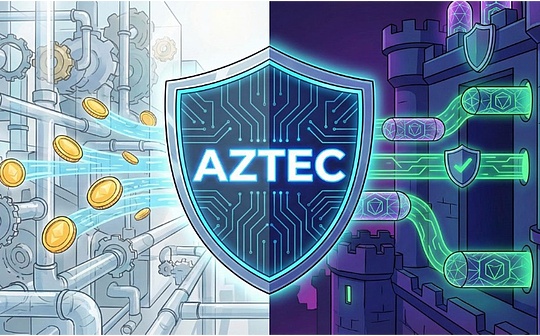
It's not content with simply being a faster Ethereum; it aims to be the "SSL layer of the blockchain." It seems the positioning of Layer 2 networks will likely be adjusted, ultimately leading to a specific chain providing system privacy solutions. 2) So, how does Aztec's privacy solution differ from familiar projects like Zcash and Tornado Cash? A key characteristic: most early privacy projects took extreme approaches, either encrypting all information or using a hybrid dark pool, thus carrying some regulatory risks. Aztec's logic is not to force all information to be anonymous, but rather to use a hybrid state model. It simultaneously supports "public state" and "private state" within a single smart contract. This is like entering a high-end club; everyone in the lobby can see you drinking (public state), but only you and the cashier know your specific booth privacy and bill (private state). This design allows DeFi protocols to maintain transparency in liquidity (e.g., how much money is in the pool), while making users' holdings and strategies visible only to themselves. 3) In terms of technical details, Aztec insists on a client-side proof mechanism, which is a key feature that acts as a moat. In other layer 2 technical frameworks, users initiate transactions, nodes execute them, and then prove the execution was correct. But Aztec believes this is not secure enough. Aztec requires that transaction execution and ZK Proof generation be completed directly on the user's own device (PXE environment), supported by the meticulously crafted Noir programming language and PLONK proof system. This ensures that sensitive data never leaves the user's phone or computer, effectively eliminating the possibility of data leakage at the physical isolation level. 4) Why is it said that only when "privacy" possesses programmable attributes will many commercial possibilities truly be unlocked? It's actually quite easy to understand: 1. Institutional-grade DeFi: Wall Street giants can conduct large-scale transactions on-chain without worrying about being targeted by predators in the dark forest; 2. Compliant KYC: Users can prove to the protocol that they are qualified investors without disclosing their original passports or residential addresses; 3. Asymmetric information games: Because games like Texas Hold'em or fog of war, which facilitate large-scale user expansion, cannot be played in a fully transparent environment, strong privacy features can help the large-scale adoption of games across the entire chain. That's all. To be fair, Aztec isn't a lone hero in the privacy arena. There's a long road from discovering its potential to its final application, as privacy technologies often mean higher computational costs and more complex user experiences. Fortunately, under the overarching trend of "compliance," privacy services have become a rigid infrastructure requirement to meet regulatory demands, and there's no way to circumvent it. However, I believe the privacy arena is a "high-society game" born with a silver spoon in its mouth, and the basic market structure and form at the infrastructure level are already largely established. The next step is to see who can truly break into the final round and popularize a programmable privacy operating system that supports complex logic to the market.

 Anais
Anais